
Years ago, the first time I opened a trading terminal, I thought I had the costs figured out. I read the commission table, worked out how little I’d pay per trade, and felt clever about it. Then I noticed something I couldn’t explain: even when the price hadn’t moved a single tick, I was already down money the moment I entered a position.
That loss wasn’t a glitch. It was the spread — and it’s the cost most beginners never account for.
What a spread actually is
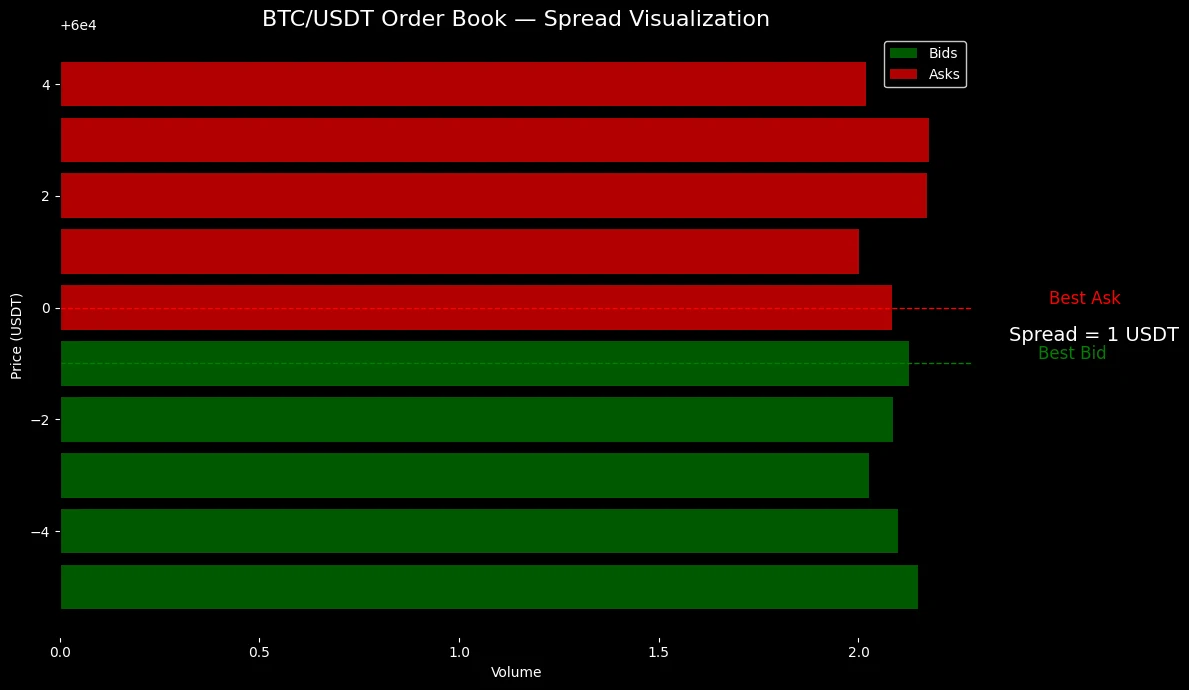
Every market is a negotiation between two sides. The bid is what buyers are offering right now — someone willing to pay $60,000 for Bitcoin. The ask (or offer) is what sellers are demanding — someone who won’t let go below $60,002. The spread is simply the gap between those two prices: the distance between the highest bid and the lowest ask.
Why your trade starts in the red
If you want in immediately, you buy at the ask — you accept the seller’s price. If you want out immediately, you sell at the bid — you meet the buyer’s price. That’s why a fresh position is already losing before anything happens.
Take Bitcoin with a bid of $60,000 and an ask of $60,002 — a $2 spread. Buy 1 BTC at the ask and your position is instantly marked against the bid: down $2 without the price moving a millimetre. Commissions you can calculate in advance. Funding you can plan for. The spread is baked into every entry, which is why I think of it as the silent commission.
The apple-market version is the same idea: one person will buy apples at $1, another will sell at $1.10. Want one right now? You pay $1.10 for something the market values at $1. That ten-cent gap is unavoidable.
What the width of a spread tells you
The spread isn’t an arbitrary number — it reflects how much liquidity and competition sit in a market. On deep, liquid markets like EUR/USD or BTC/USDT on a major venue, spreads are razor-thin, often 0.01% or less. On thin markets — exotic forex pairs, low-cap stocks, a random altcoin — they widen sharply, and a wide spread is itself a warning: fewer buyers and sellers are competing. You’re stepping into a desert, not a crowded marketplace.
Compare two cases. EUR/USD at a bid of 1.10000 and an ask of 1.10001 — a spread of one pip, about $10 on a standard lot. You can scalp that all day for tiny cost. Now a low-cap altcoin at a bid of 1.00 and an ask of 1.10 — a spread of 10% of the coin’s value. In the first market you can trade actively; in the second you’re behind before you’ve started.
The lesson
Spreads matter more than most beginners realise. A good strategy in a high-spread market can bleed out on cost alone, while a mediocre one in a low-spread market survives long enough to improve. So when I decide what to trade, I don’t only look at the setup — I ask what the spread is telling me. It never flashes on the screen, but it quietly decides whether you’re playing a fair game or funding someone else’s.
Ignore the spread and you hand over your edge before the first candle. Respect it, and you start to see why some markets reward discipline and others simply punish activity.
Next in this series: bid and ask — where buyers and sellers negotiate.
Compare spreads across Binance and Bybit in real time on ChartThread →