
Crypto is the only major market that never closes. No opening bell, no weekend gap, a chart that just keeps printing. It is easy to conclude that the clock doesn’t matter.
The volume says otherwise. Line up any liquid pair by hour of day and the same shape appears week after week: activity builds through the European morning, peaks in the early US afternoon, and thins out badly overnight. The market is open 24/7, but the people trading it are not.
I learned this from my own systems before I understood the reason. The signals clustered after 14:00 UTC and went quiet by late evening, and for a while I treated that as a quirk of the strategy. It wasn’t. It was the market’s schedule showing through.
Why a 24/7 market still has office hours
Most of the size in crypto comes from desks, funds, and market makers, and those are staffed by people who work regular hours in their own time zones. When a region’s desks are active, its share of the world’s liquidity is in the books. When they go home, that liquidity is pulled.
So the day breaks into three broad sessions, named for the regions doing the trading:
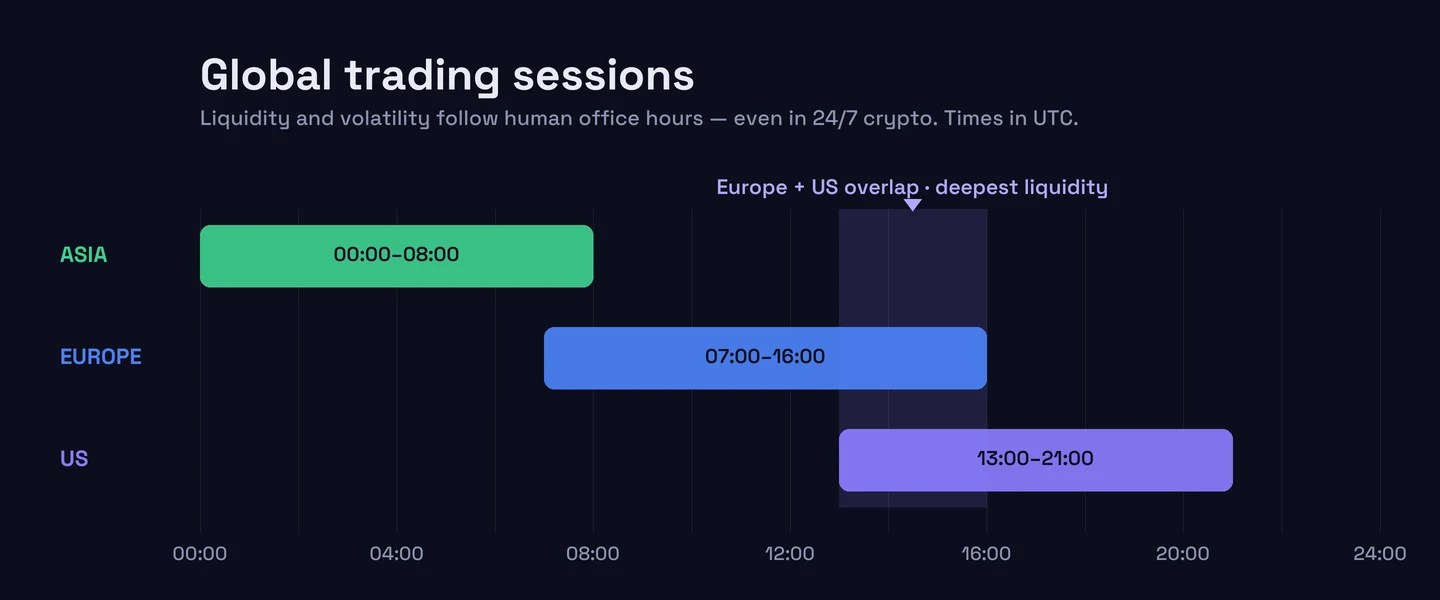
| Session | Time (UTC) | Who is active |
|---|---|---|
| Asia | 00:00–08:00 | Japan, Korea, China, Hong Kong, Singapore |
| Europe | 07:00–16:00 | UK and continental Europe |
| US | 13:00–21:00 | US, Canada, Latin America |
The boundaries are soft. Nobody rings a bell at 07:00 UTC. But the character of the tape changes as one region hands over to the next, and the handovers themselves are events:
| Window (UTC) | What is happening |
|---|---|
| 00:00–03:00 | Asia ramps up while the US winds down |
| 07:00–09:00 | Europe opens as Asia closes; volatility usually picks up |
| 13:00–16:00 | Europe and the US are both at their desks; the deepest books of the day |
What actually changes between sessions
The mechanics are the ones covered earlier in this series. When more participants are active, order books are deeper, spreads are tighter, and a given order causes less slippage. Liquidity is not a fixed property of a market; it follows the people providing it.
That has a direct consequence for how price behaves. In the deep hours, it takes real money to move the market, so moves carry more information. In the thin hours, small orders push price around, and you get sharp wicks and false starts that would have been absorbed without a trace at 14:00 UTC.
Weekends are the extreme case. The desks are closed, the books are thin all day, and the same fragile behaviour shows up regardless of the hour.
Why this matters for reading levels
A level is only as meaningful as the trading that happened at it. A break that occurs in the middle of the Europe–US overlap happened against the deepest books of the day, with the most participants voting. The same break at 23:00 UTC on a Sunday happened against almost nobody, and it often gets unwound as soon as real liquidity returns.
That is the practical takeaway, and it is about reading, not scheduling: when you look at a reaction at a level, look at when it happened. The hour tells you how much conviction was behind it.
The session clock is one more piece of context around the levels themselves. In the next articles we go back to price: how markets alternate between accumulation and distribution, and what separates a clean level from a contaminated one.
If you want the level-watching done for you around the clock, sessions and all, that is what ChartThread’s levels are for.