Risk management · Lesson 1 of 16
How much should you risk per trade? The risk formula
This article opens the last part of this series: risk. Nobody likes the subject, and everybody needs it — because trading isn’t about being right. It isn’t about catching tops, predicting bottoms, or becoming a candle whisperer. Trading is a business of managing probabilities, and above all, of managing losses.
Loss is not a bug
Every trade is a deal: I risk X to maybe win Y. The loss side of that deal is not a malfunction — it’s half of the design. If you want the rewards, you sign up for the losses; there is no version of the business without them.
What the market punishes is not losing. It’s unpriced losing: the forgotten stop, the oversized position, the “hope” trade. When the market smells that kind of blood, it redistributes the money to whoever priced their risk properly — that’s what all those liquidation cascades and stop sweeps from earlier in this series actually are, seen from the losing side.
Risk is the parachute
Would you jump out of a plane hoping you’re maybe not that high? Drive without brakes, hoping the lights stay green? That’s what a position without a defined risk is. Risk management isn’t the thing slowing you down — it’s the reason you’re allowed to be in the vehicle at all.
The mental shift that makes it work: when you place a trade, treat the risked money as already spent. It’s an investment in a probability, not a promise. You control exactly how large that investment is with two tools: where the stop goes, and how big the position is. The stop’s location belongs to the chart — beyond the level, outside the stop clusters. The position’s size belongs to arithmetic.
The formula
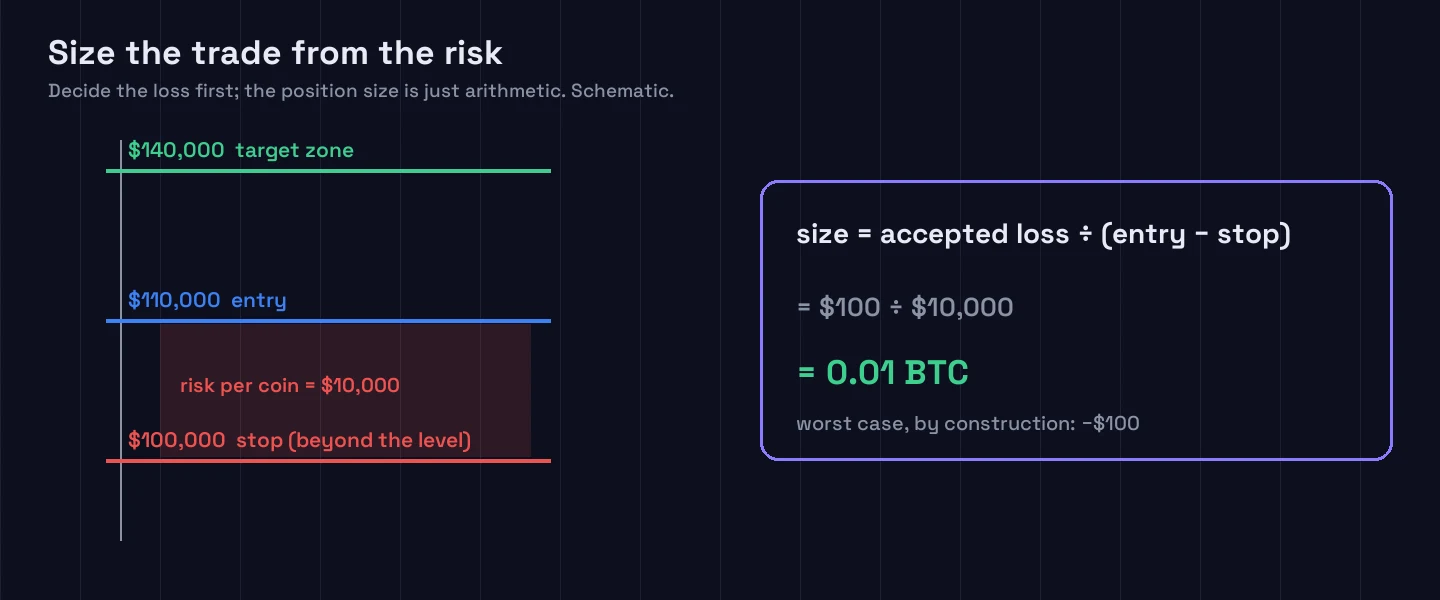
One line:
position size = money you accept losing ÷ (entry − stop)
Worked example. Say the most you accept losing on one idea is $100. Bitcoin trades at $110,000; the structure says it shouldn’t fall below $100,000, so that’s where the stop goes.
- Risk per trade: $100
- Entry: $110,000, stop: $100,000 → risk per coin: $10,000
- Size: $100 ÷ $10,000 = 0.01 BTC
If Bitcoin crashes through $100,000 — you lose exactly $100. Not “a lot”, not “we’ll see”: one hundred dollars, decided before the trade existed. You’re still in the game, still emotionally intact, still able to take the next trade. The size came out of the risk; it was never an input.
Notice what this formula quietly forbids: it makes “how much do I want to buy?” an illegal question. The market sets the distance to the stop (that’s structure), you set the dollars you’ll spend on the attempt (that’s your business decision), and the size is whatever falls out. Traders who pick the size first are answering the only question that was never theirs to answer.
If you’re reading this mid-mistake
Already in a trade with no brakes, watching a red number grow, feeling sick? The procedure is short: close the position. Fix the loss. Forgive yourself. Next time, enter with the parachute on. The tuition was cheaper today than it will be tomorrow.
Trading without risk control is gambling with charts as decoration. With it, each trade becomes a priced experiment — and the rest of this series’ tools decide where the experiments are worth running.
The next articles build on this base: how volatility sets the stop distance, why leverage becomes irrelevant once you size from risk, and the weekly loss cap that keeps a bad stretch from becoming a funeral.
Finding the structures worth risking a hundred dollars on is the job ChartThread does all day.
Educational content, not financial advice. Trading carries a risk of loss.