
When I started trading, I pictured every market as an open highway: put in your order, get filled instantly, no questions asked. That idea broke the first time I entered a small-cap altcoin and watched my own order move the price. I wasn’t a passenger in that market — I was the truck on a one-lane village road.
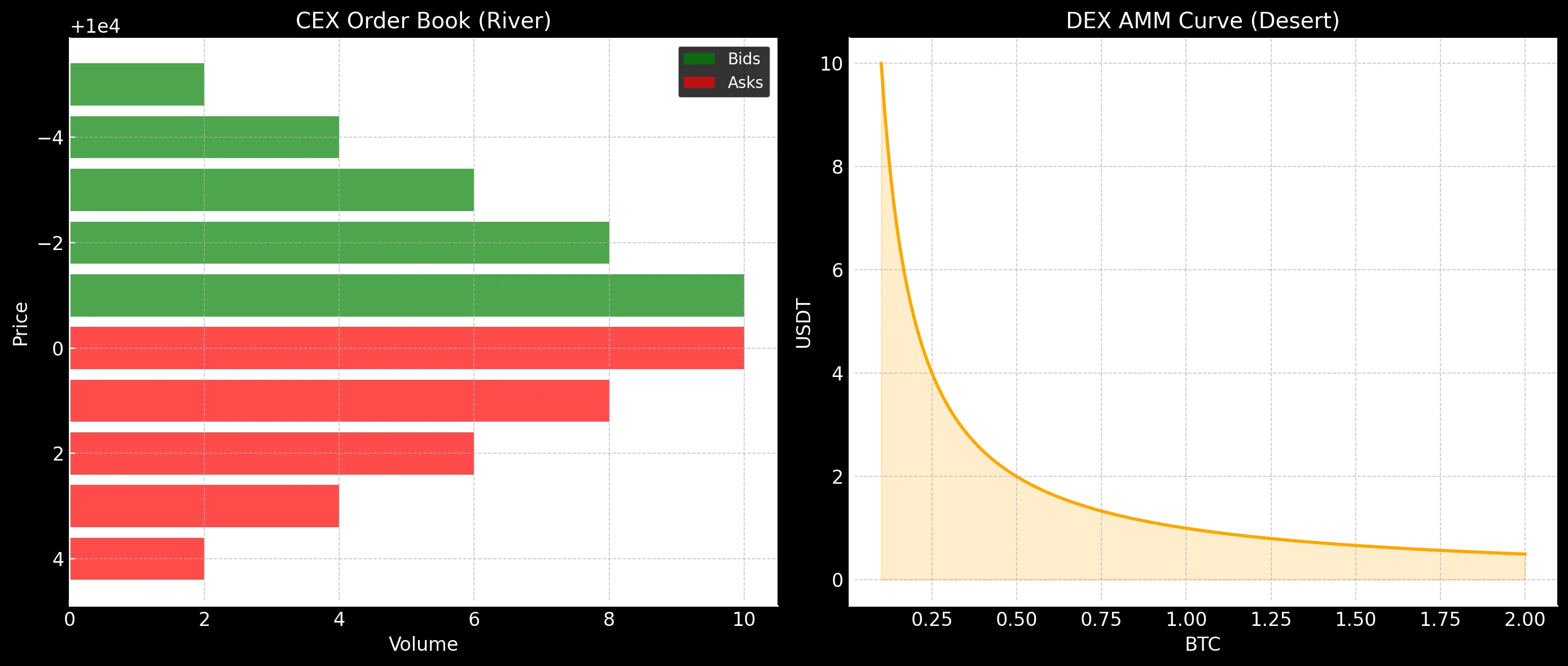
That is liquidity, and it quietly decides more about your results than most of the things traders obsess over. A liquid market has plenty of buyers and sellers, tight spreads, and a deep order book — BTC/USDT on Binance, where you can put in a large order and the market barely notices. An illiquid market has shallow depth, wide spreads, and participants who vanish exactly when you need them: a micro-cap token on a small venue, where one order leaves footprints the market remembers for days. A river versus a desert.
The $10 million rule of thumb, and why it lies
There’s a rule of thumb in trading circles: if a market’s daily volume is above $10,000,000, you can “safely” trade $5,000 in it. I’ve checked that against a lot of intraday data, and it’s only half true.
Statistically you’ll often be fine. But markets don’t fill orders from an average — they fill them from the order book that exists at the exact moment you click, at the exact price you need. Daily volume tells you nothing about whether the depth is there right now. A $5,000 order can slip through cleanly one minute and barely half-fill the next, because the book shifted. That gap is where scalping systems, arbitrage, and anything that depends on precision quietly fall apart — and it’s the same mechanism behind slippage: when the liquidity at your price runs out, the rest of your order fills worse.
So the habit worth building is simple: don’t trust the daily-volume headline. Look at the actual depth at your price level before you size the trade.
Liquidity sets the ceiling on how big you can get
This isn’t only about single trades. If you risk a fixed percentage of your account per trade, liquidity is the hard cap on how large that account can grow in a given market. You can’t scale forever — at some point your position is big enough that entering it moves the price against you, and the edge you were trading disappears into your own impact.
That’s why any honest projection of returns has to include liquidity. There’s no point modelling million-dollar trades in a market that can’t absorb them; the spreadsheet says one thing and the order book says another.
On a DEX, you’re not trading the market — you’re bending it
Order books aren’t the only design. On a decentralized exchange, most trading runs through an AMM (Automated Market Maker). There’s no queue of buyers and sellers; a formula sets the price from the balance of two assets in a pool, and every trade changes that balance.
Take the simplest pool:
- It starts with 1 BTC and 100,000 USDT.
- You buy 0.1 BTC.
- Now the pool holds 0.9 BTC and 110,000 USDT.
The ratio moved, so the price of BTC in that pool jumped the instant your trade landed — you paid more than the price you saw going in. That self-inflicted move is price impact, and in a big pool ($100M of liquidity) it’s tiny and nobody bothers you. In a thin pool it’s large, and it’s an invitation: arbitrage and sandwich bots watch for exactly the price impact you create, step in around your trade, and pocket the difference. On an AMM you aren’t just taking a price — you’re shaping the curve, and if you don’t see that, you’re the free lunch.
Know which game you’re playing
Plenty of traders study charts, indicators, and fundamentals and never look at liquidity — then wonder why a “perfect” setup still lost money. It’s worth being blunt about the two camps:
- Some chase illiquid markets because “that’s where the 100x is.” Occasionally true. Most of the time it’s where accounts quietly bleed out on impact and spread.
- Others won’t touch anything illiquid and call it gambling. Mostly right — but they also miss the rare moment a desert floods.
Both have a point, and the resolution is the same: know which market you’re in before you commit. Rivers are for consistent survival — deep enough that you can think about skill instead of fills. Deserts are for the occasional lottery ticket, sized so that being wrong doesn’t matter.
I learned that as directly as it gets. I once pointed a scalping bot at a thin DEX market, expecting to skim small profits. Instead my orders were the market — I wasn’t taking advantage of liquidity, I was providing it, and paying for the privilege. I wasn’t trading; I was donating. Now I check the depth before anything else.
Liquidity is the difference between trading as a strategy and trading as a hope. Before your next trade, the honest question isn’t just “is this a good setup” — it’s “am I walking into a river, or a desert?”