Risk management · Lesson 8 of 16
Take profit first: close half, let the rest run
Open positions keep many traders up at night. One exit rule removes most of that stress: take half the profit early, then let the rest run with no risk left in it.
The lie of holding for the big move
Accounts die waiting for the one big candle. A green trade turns red because ego whispered I don’t want crumbs, I want the whole pie, and the market, which owes nobody a pie, took back what it had offered. Everyone who’s traded has watched +$500 become −$200 while “staying disciplined” about a target that was really just greed with a number on it.
The alternative rule: when the market hands you a piece, cut it, put it on the plate, and eat. That piece is yours forever. Whatever remains in the trade plays on as if it costs nothing, because at that point, it does.
The sequence
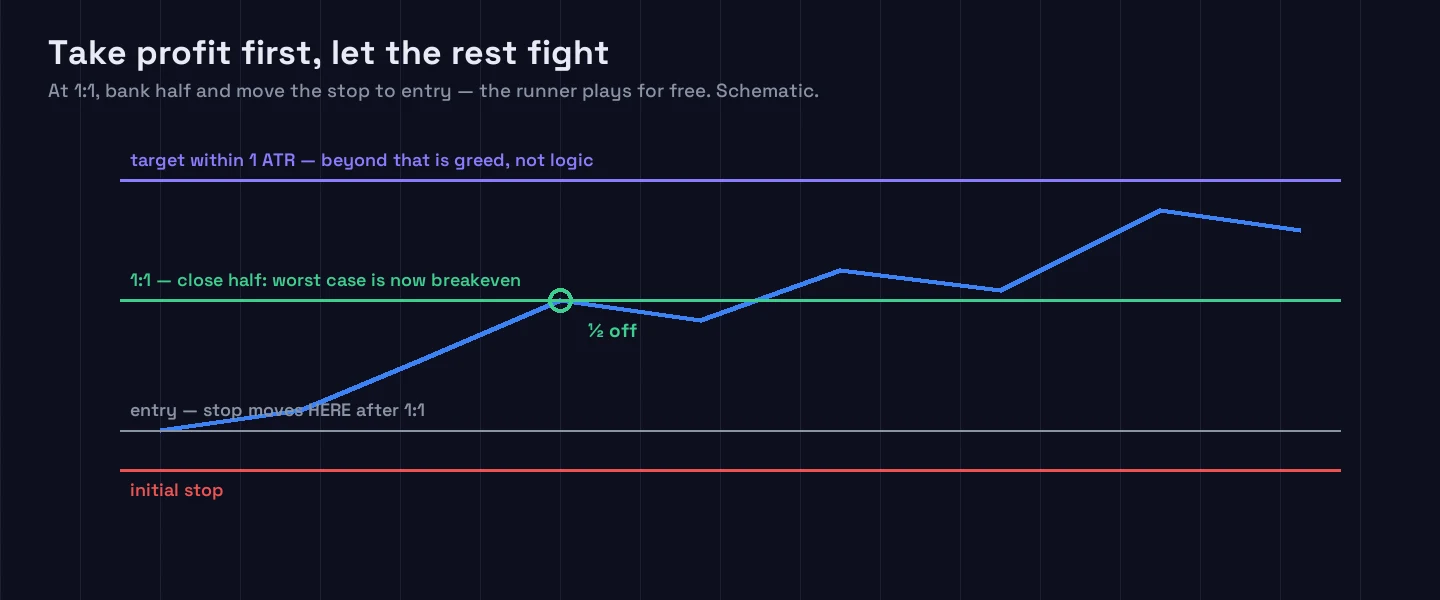
- Size in normally. No lottery tickets, no crazy leverage: the usual arithmetic.
- Always trade from a stop. Risk fixed from the start; the stop is insurance, placed by structure, non-negotiable.
- At one-to-one, close half and move the stop to entry. “One-to-one” means the trade is up as much as it risked: with $100 at risk, it is up $100. Close half there, banking $50, and move the stop on the other half to your entry price. From here the worst case is a small win: the banked $50, less fees.
- Keep the target within one day’s average range. The average true range is the size of a typical day’s move. Measure it from your entry; a target further than that is a wish, not a plan.
- Stop caring. Half secured and stop moved: walk away. Whether the runner explodes or dies, you’ve already been paid.
Why it works
Because trading isn’t about being right; it’s about staying alive. Most people trade with hope. This is trading with receipts.
Yes, closing half takes less than a perfect exit would have. That “less” buys the two things no perfect exit ever delivers: a cushioned account (even a full stop-out after the 1:1 costs almost nothing) and a clean mind. Trades become probability experiments instead of emotional hostages. And the psychology compounds exactly the way the risk pyramid predicts: a trader who is never badly hurt makes better decisions all day.
What it costs, in numbers
The honest objection is that closing half early gives up part of the big winners. Whether that matters depends on how your trades behave. “R” below means the amount risked on one trade. Take 100 trades with the stop 1R away and the target 3R away:
| What the trade does | Full size to 3R | Half off at 1R, stop to entry |
|---|---|---|
| 30 trades reach 3R | +90R | +60R |
| 20 reach 1R, then fall back | −20R | +10R |
| 50 hit the stop first | −50R | −50R |
| Total | +20R | +20R |
With this mix, both plans earn the same. Taking profit first wins when many trades reach one-to-one and then fall back; it loses when most of them go on to the full target. Check your own journal: count the trades that reached one-to-one and then returned to the stop. And decide the rule before you enter: a half closed on impulse is the costly kind of early exit.
Take profit first. Let the rest fight.
Knowing where one-to-one and the next structure sit, before the trade and not during it, is what ChartThread’s levels hand you.
Educational content, not financial advice. Trading carries a risk of loss.