
The market doesn’t shout before it explodes. It whispers. And the clearest whisper it produces is the squeeze.
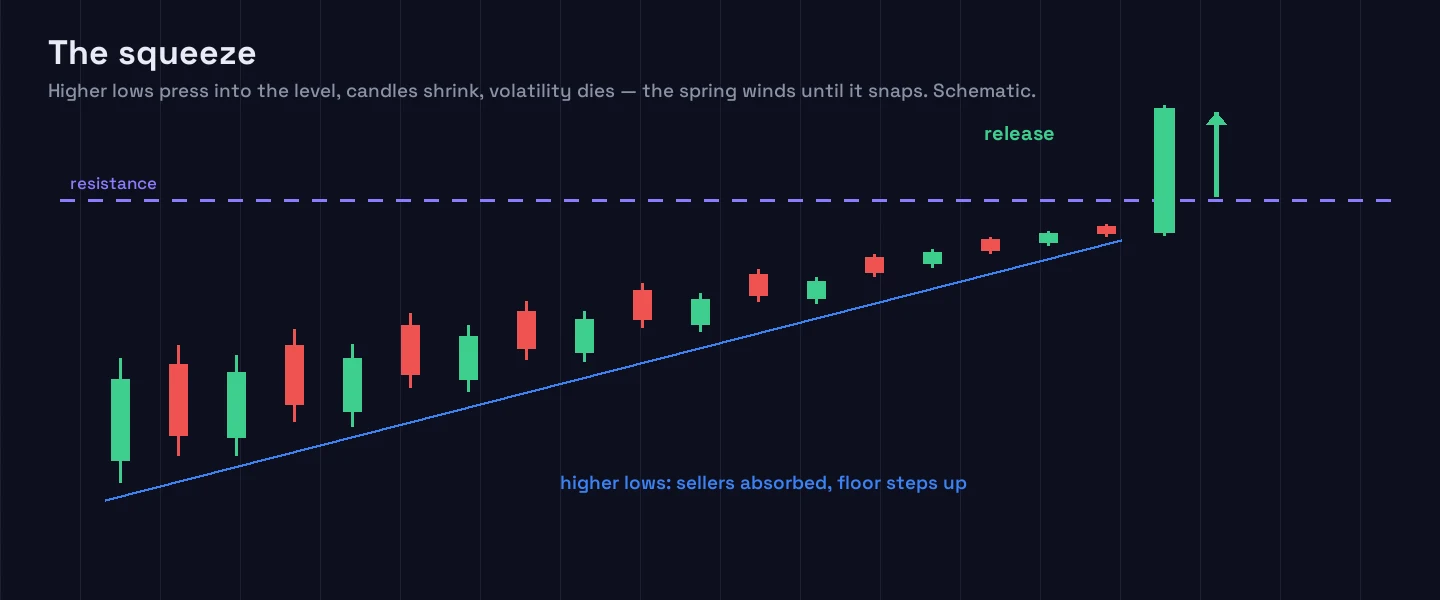
The picture is always the same. Price presses against a level. Each bar closes a little tighter than the last. Each pullback is shallower than the one before, the lows creeping upward like a spring being wound. Volatility dies, candles shrink, and the chart goes quiet — while underneath, energy piles up.
Why the squeeze means something
A strong level doesn’t fall to enthusiasm — it’s defended, and taking it requires accumulated energy. The squeeze is that accumulation made visible. Higher lows pressing into resistance mean the sellers’ inventory is being eaten with every touch; lower highs grinding into support mean the buyers are running dry. Every time price is pressed against the wall, the wall weakens a little — until one final push goes through.
It is the exact opposite of yesterday’s V-shape. The V spends energy reaching the level; the squeeze stores energy against it. Same destination, opposite fuel gauge.
What makes a squeeze real
Not every tight range qualifies. The genuine article has three traits together:
- Accumulation at the level, not near it. Price grinds against the wall — it doesn’t fly in from a distance and hover. The compression has to happen where the fight is.
- Shrinking volatility. Bars get progressively smaller. The quietness is the point: it means neither side is giving ground, and the range has nowhere left to compress.
- Progressive pressure. Higher lows into resistance, or lower highs into support. The staircase shows one side stepping forward after every exchange — the pressure-cooker signal from the breakout checklist.
Two of the three can happen by accident. All three together are a coiled spring.
The impatience trap
The failure mode is jumping at any touch of the level, or mistaking loud for strong. If a move arrives on large, erratic bars, that’s not compression — that’s distribution, energy already being spent, and the odds flip against continuation. The explosive moves are born in silence, out of exactly the kind of price action that makes impatient watchers close the tab.
A squeeze also doesn’t promise the first attempt succeeds. Sometimes the coil snaps immediately; sometimes the first break fakes and the level needs a retest before the real move. What the squeeze tells you is not the timing — it’s that the odds have tilted, and in which direction the spring is leaning.
None of this is about predicting every tick. It’s about recognising the rare moments when the market has quietly told you what it’s preparing to do.
This article closes the “three behaviours” part of the series — breakouts, their failures, and the approaches that precede them. Thursday the series turns to context: the forces around a level that decide how much any signal is worth, starting with volume.
Spotting squeezes as they form — every market, every level, without staring at charts all day — is what ChartThread is for.