
Everyone loves the drama of the first breakout. The candle rips through the level, volume spikes, and the feed fills with rocket emojis. But more often than not, that first touch is noise. The truth arrives on the second visit — the retest.
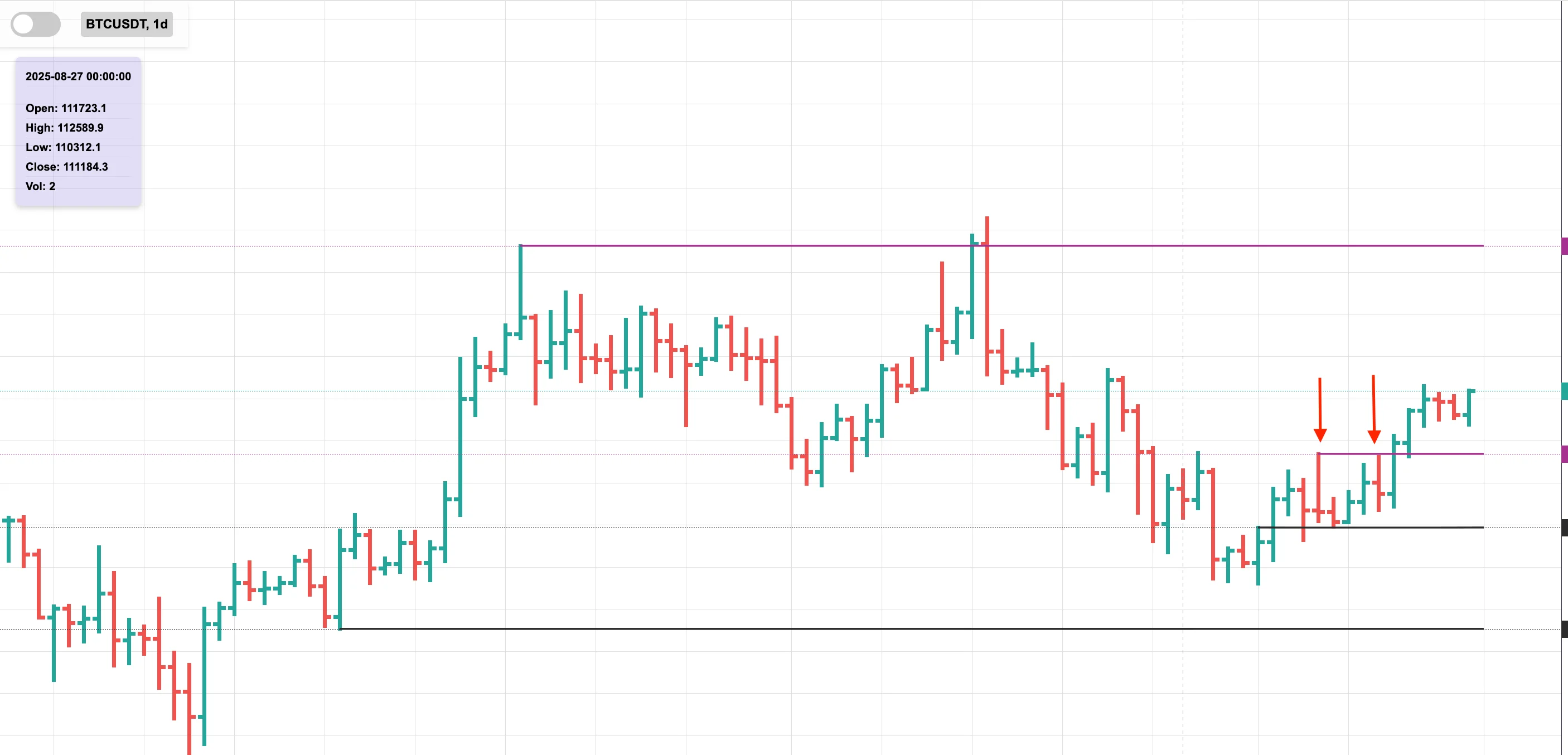
The illusion of the first touch
This series has covered the mechanics before: a fast move into a level consumes its own fuel. The first break often happens at the exact moment the market is most exhausted — the push through the line was the last of the energy, not the beginning of a trend. That is how false breakouts are born.
Which is why the first touch, however convincing it looks, proves very little. It’s an opening argument, not a verdict.
What the second visit reveals
The retest — especially a quick one, within roughly ten days — is where the market shows its hand. And the information is not just that price came back, but how it came back.
If, after a supposed breakout, the market doesn’t collapse but drifts back calmly, closes near the level, and presses against it again — someone large is still defending the side they chose. A held retest tells you three things at once:
- The accumulation was real. Whoever drove the break had time to reload, and did.
- The weak hands are gone. The first move flushed the chasers; what remains is positioned, not excited.
- The level still matters. If it didn’t, price would simply wander off. Coming back to fight for the line is itself evidence the line is worth fighting for.
Seen this way, a retest isn’t hesitation. It’s the market gathering strength for the more decisive run — the same logic as the break that holds, observed one step later.
Three fingerprints of a strong retest
Not all retests are equal. The trustworthy ones share a profile:
- Close in time. Within about ten days, the same participants are still at the table and it’s still the same fight. After a month or more, the context has changed — new positioning, new information, effectively a different level.
- Tight closes. Bars shrink, volatility dies, price hugs the level instead of swinging around it. That’s energy loading — the squeeze behaviour — not energy being wasted.
- Volume that holds. If volume stays steady or builds while price sits at the level, the interest is real and a continuation is the likelier resolution. If volume dries up, expect a stall.
The dilemma nobody escapes
The first touch is where the excitement is, and most market participants can’t resist it — they enter on the break, then get shaken out when the market breathes. The retest feels like watching everyone else have fun at the party. But the sustainable move usually starts there, not at the fireworks.
And if price runs away without ever coming back? Then it runs. The market doesn’t run out of chances; there is always another level forming somewhere. Missing a move costs nothing. Chasing noise costs capital.
The second test of a level, quick, tight, and supported — that’s when a break has actually proven something. Watching levels for exactly that moment, across every market at once, is what ChartThread does.