How to profit when price falls: short selling explained
To short sell is to sell first and buy back later, keeping the difference if the price fell in between. There are two ways to do it. Through a stock broker, you borrow shares and sell them. With perpetual futures, on crypto or on stocks such as NVIDIA (NVDAUSDT), you trade a contract and borrow nothing at all. Both let you profit from a fall, and both carry the same main risk: a sharp rise.
What you’ll learn
- The two ways to short: borrowing shares, or trading a contract
- What a real short looks like, drawn on ChartThread
- What holding a short costs: borrow fees or funding
- What a short squeeze is, and why shorts fuel it
Two ways to sell what you do not own
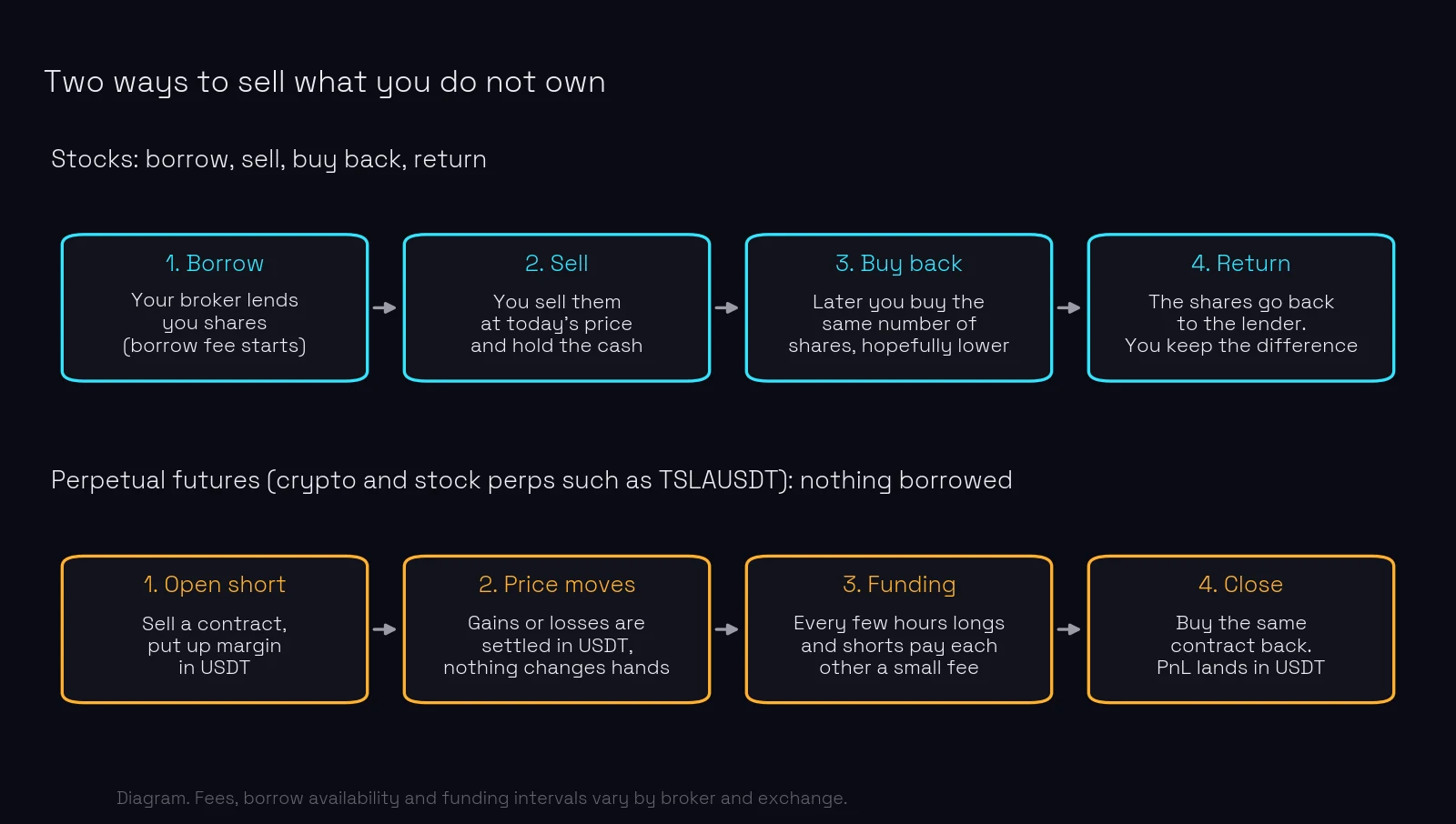
Through a stock broker: borrow, sell, buy back, return.
- Your broker lends you shares, from its own inventory or other clients’ accounts.
- You sell them at today’s price.
- Later you buy the same number back, hopefully cheaper.
- You return them and keep the difference.
While you hold the borrowed shares you pay a borrow fee, a yearly rate charged daily. For large, liquid stocks it is usually small. For stocks many people want to short, it can be high, and the lender can ask for the shares back. Rules differ by country and broker, so check yours.
With futures: a contract, nothing borrowed. A futures contract is an agreement on a price, not the instrument itself (see spot vs futures). To go short, you sell a contract to someone who is buying it and put up margin in USDT as a deposit. Nothing changes hands except USDT: gains and losses settle in it as price moves, and you close by buying the contract back. The perpetual kind never expires, as explained in what a perpetual future is.
A real short, drawn in ChartThread
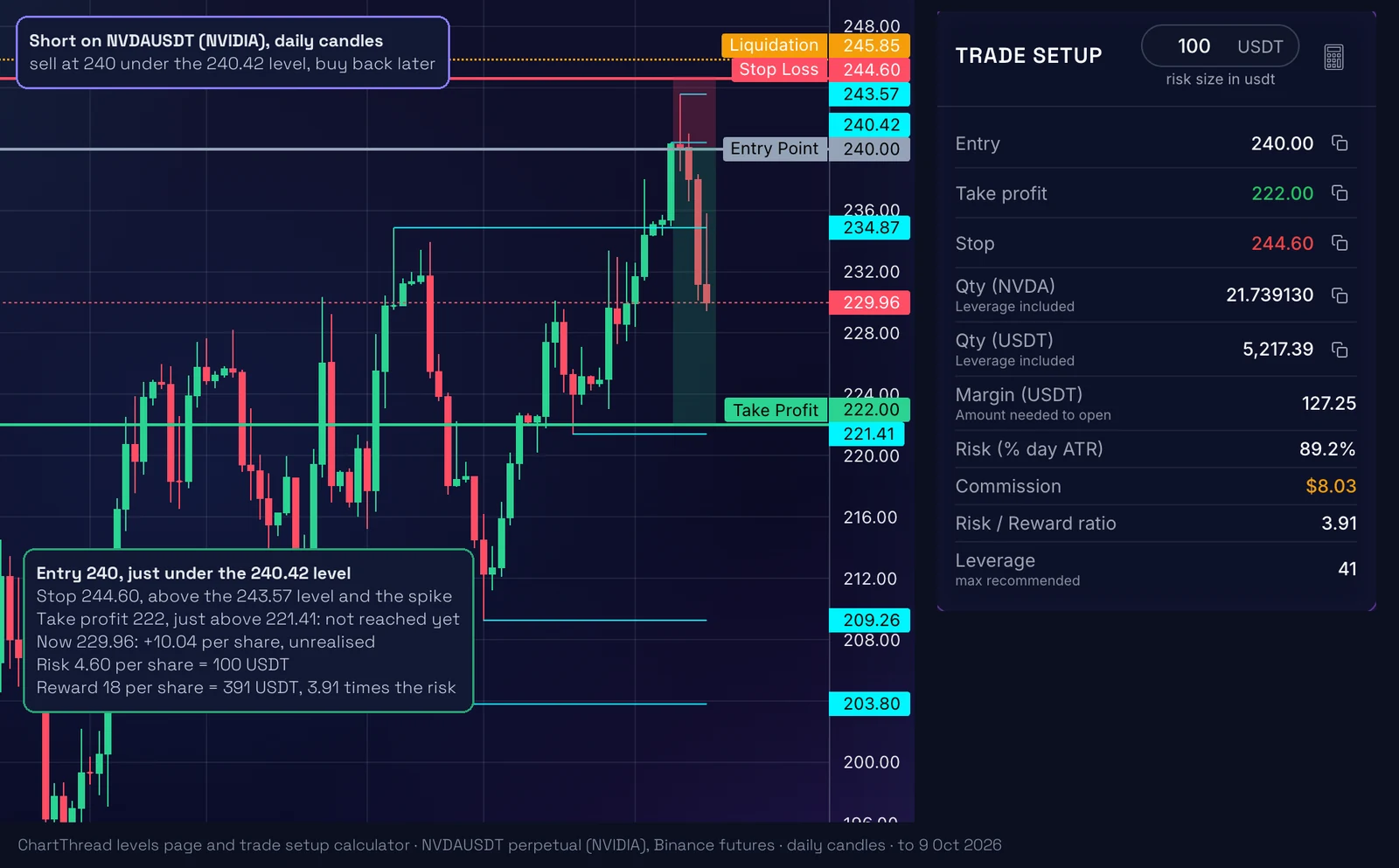
Here is a short position on NVIDIA, drawn on ChartThread’s levels page with the trade setup calculator. It is an example chosen with hindsight to show the mechanics, not a trade signal.
- Entry 240, just under the 240.42 level, where price stalled on 5 and 6 October.
- Stop 244.60, above the 243.57 level and the 6 October spike.
- Take profit 222, just above the next level down, 221.41.
Risking 100 USDT, the 4.60 between entry and stop sets the size: shares. The trade is still open, so its P&L is unrealised: it moves with every tick until you buy back.
Example: what the NVIDIA short makes, and what holding it costs
At the last price, 229.96:
If the take profit is reached:
If the stop is hit instead:
Now funding. Instead of a borrow fee, perpetuals have a funding rate: every few hours, one side pays the other a small share of the position value. Say the rate is 0.01% per 8-hour interval and negative, so shorts pay, and you hold for three days, 9 intervals (example figures; check your exchange):
For comparison, a short through a broker. Short 100 Intel shares at 120 (12,000 dollars), pay an example borrow fee of 3% a year, and buy back at 110 after 20 days:
Both costs are small per day and real per month. Check them before holding a short for days.
What is a short squeeze?
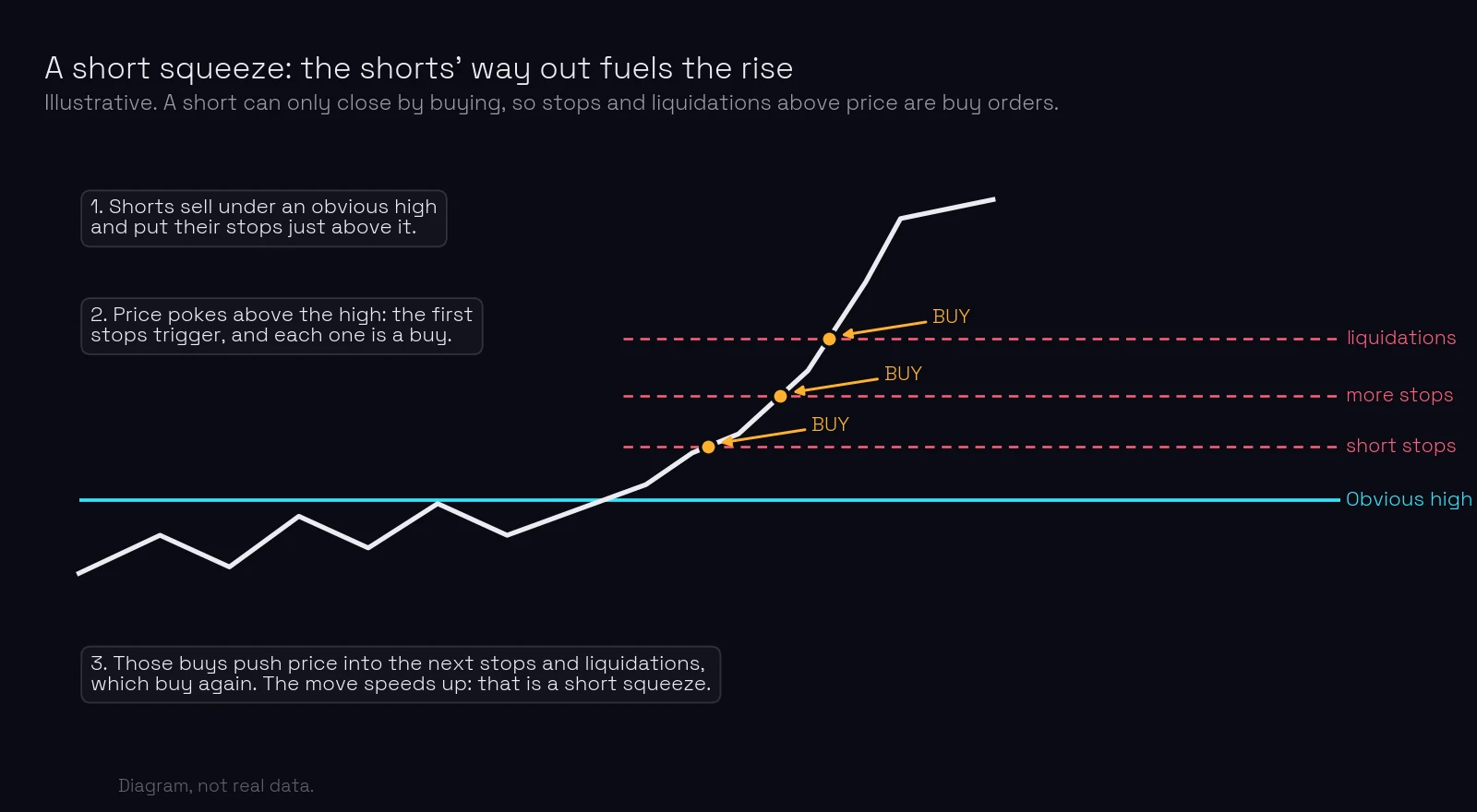
A short can only close with a buy. That is fine one trade at a time. But shorts tend to put their stops in the same place, just above an obvious high, and when price pokes above it:
- The first stops trigger, and each one is a buy order.
- Those buys push price into the next stops and liquidations, which buy again.
- The move speeds up. That chain is a short squeeze.
What most traders miss.
Shorts are the one group whose way out fuels the move against them. A long’s stop is a sell into a fall; a short’s stop is a buy into a rise. Where the crowd’s short stops sit is where a squeeze can start: see where stop losses cluster coming soon and the four market players.
Funding is a charge for being in the crowd. When most traders pile into shorts, the perpetual tends to trade below spot and funding turns negative, so shorts pay longs every interval just to stay in. The more crowded the short, the more it costs to hold.
Through a broker, the borrow can be taken away. Borrowed shares can be recalled, and the fee for a heavily shorted stock can rise while you hold. Your short can be forced closed for reasons that have nothing to do with your analysis.
Common mistakes
- Shorting without a stop. A short’s loss has no ceiling (see long and short positions). Place the stop when you open the trade.
- Putting the stop where everyone else does. Stops just above an obvious high are the fuel for squeezes. Give the stop room beyond the level, as in the NVIDIA example.
- Ignoring holding costs. Check the funding rate or borrow fee before holding a short for days.
- Shorting on cross margin. A squeeze can then reach your whole balance. Use isolated margin (see isolated vs cross margin).
- Shorting because price “has gone up too much”. A rising market can keep rising. Short from a reason, such as a level that holds, not from a feeling.
Key takeaways
- Shorting is selling first and buying back later; you profit if price falls.
- Through a broker you borrow shares and pay a borrow fee; with perpetual futures you borrow nothing and pay or receive funding.
- Every short closes with a buy, so crowded shorts can turn a rally into a squeeze.
- Fees, borrow availability and funding schedules differ: check yours.
Lesson test · 8 questions
Check yourself
Can you pass on the first try?
Passing the test completes this lesson. Tests in a module open in order, each after the one before it. A first-try pass scores 100%. Each wrong answer costs 10 points, and every 10 wrong answers lock the test for 30 minutes. Once you pass, your score is final, except that a score of 50 or less can be retaken once.
Tests in a module open in order. Pass the test of the previous lesson first: Long and short positions: what do they mean?. You can still read the questions here.
-
You open a short on NVDAUSDT, a perpetual futures contract on NVIDIA. Who lends you the shares?
-
As an example, you short 20 Tesla contracts (TSLAUSDT) at 380 and close at 365. What is your result before fees and funding?
-
Same example short, 20 Tesla contracts at 380, but price rises and your stop at 387.50 is hit. What is your result?
-
Funding is negative and you hold a short on a perpetual. What happens at each funding time?
-
As an example, your short has a position value of 10,000 USDT, funding is 0.01% per interval with shorts paying, and you hold through three funding times. How much funding do you pay?
-
Why can a short squeeze push price up so fast?
-
As an example, you short 100 shares of a stock through a broker at 40 dollars (4,000 dollars) with a borrow fee of 5% a year, and buy back at 35 after 73 days. What is your result before commissions?
-
Which risk applies to a short through a stock broker but not to a short on a perpetual contract?
Free account
Take the test and keep your score
- Your answers are checked and every lesson you pass is marked complete.
- Your scores build into your course score, on any device.
- You come straight back to this question after signing up.
Next: the four market players: long buyer, long seller, short seller, short buyer. Or draw a short on ChartThread’s levels page.
Terms in this lesson
Related lessons
Educational content, not financial advice. Trading carries a risk of loss.