Types of orders: market, limit, stop and stop-limit
An order is your request to the broker or exchange to buy or sell an instrument, in a certain direction and a certain size. Every order ends up in the order book, but not all of them in the same way. Some trade at once, some wait for your price, and some wait hidden until price reaches a trigger. There are four basic types, and each one gives you certainty about one thing and gives up another.
What you’ll learn
- What market, limit, stop and stop-limit orders do, each with a diagram
- The plus and the minus of each one
- How take profit and stop loss work as postponed orders
- How much slippage to plan for on a stop
- Why a stop-limit stop loss can end in liquidation, and what protects your deposit
Market orders: the whole position, right now
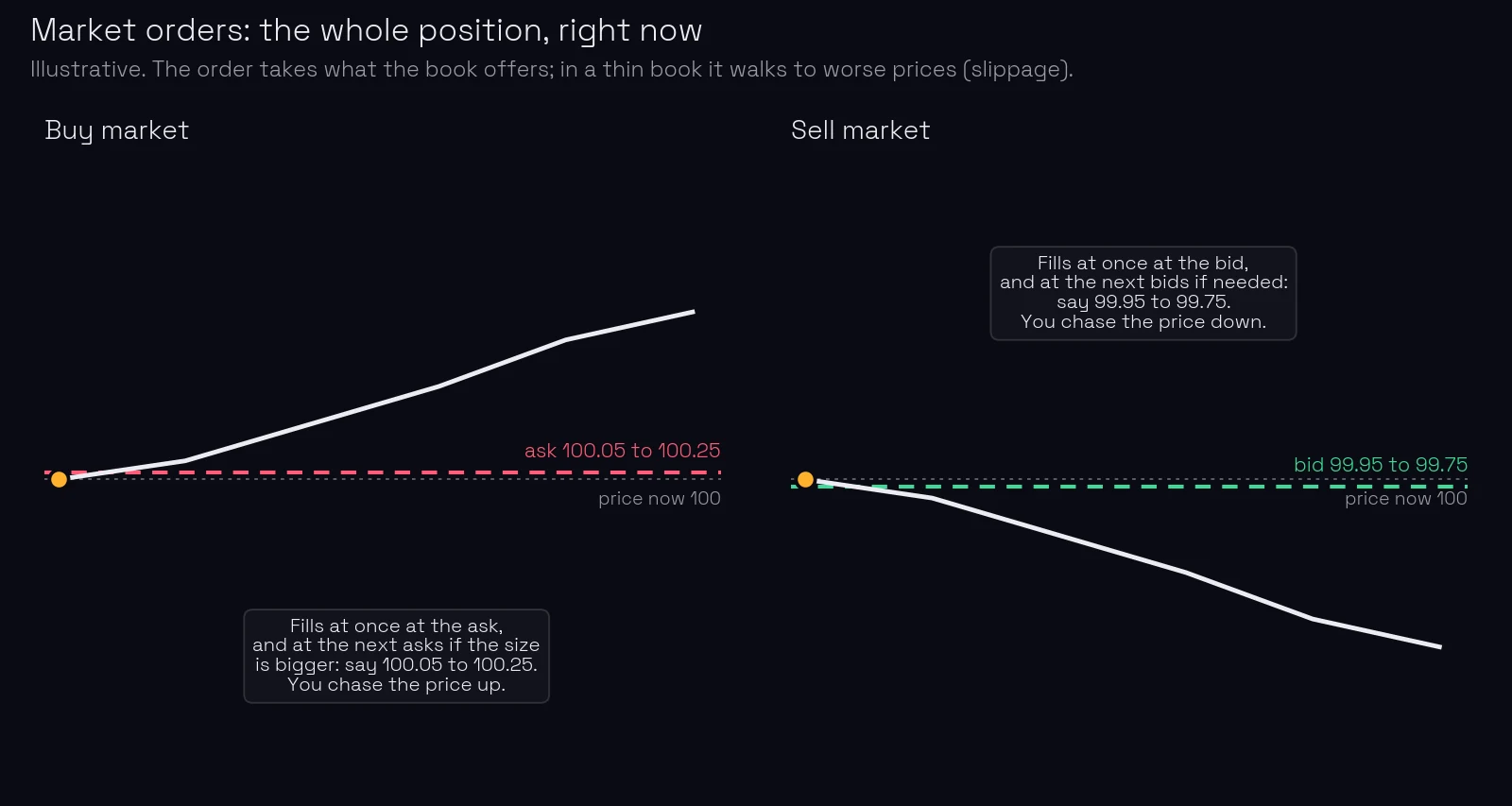
A buy market or sell market order says: trade now, at whatever price is there. A market order buys from the best asks or sells into the best bids, and if your size is bigger than what waits at the best price, it takes the next prices too.
- Plus: it guarantees the entire position, immediately.
- Minus: slippage. You get the price that is there, not the one you saw, and in a thin book or a fast move that can be noticeably worse.
A market order often means you are running to catch the price. If you have to chase, ask whether you planned the trade or are reacting to it.
Limit orders: your price, if the market comes to you
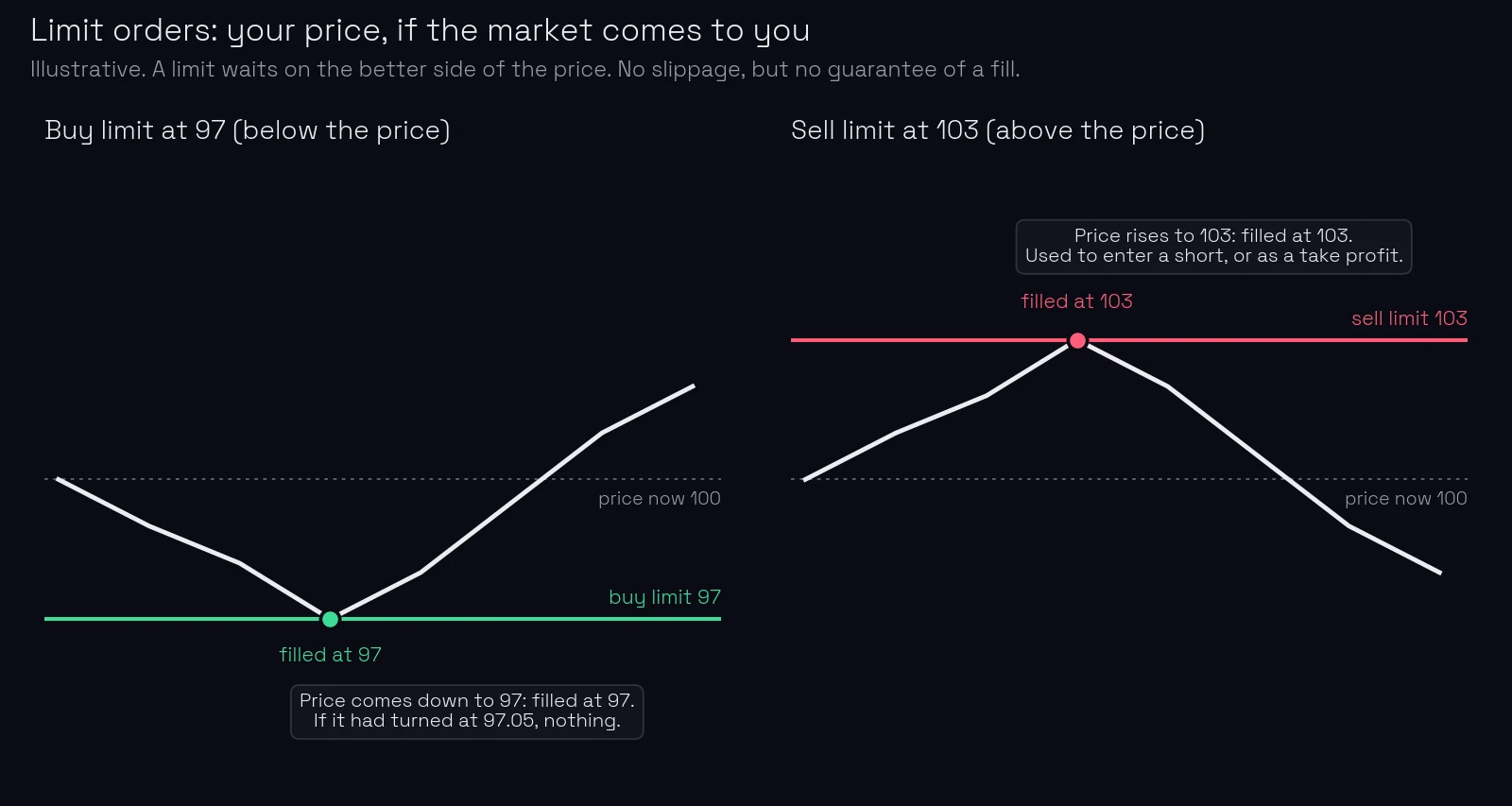
A buy limit or sell limit order says: trade only at this price or better. A limit order waits on the better side of the price: a buy limit below it, a sell limit above it.
- Plus: a fixed entry price and no slippage. You never pay worse than your limit.
- Minus: no guarantee you get the full position, or any of it. Price can stop one tick before your order and turn away, and you wait in a queue behind everyone who came first (price, then time).
Limit orders are used both to enter a position and to take profit.
Stop orders: postponed, then at market
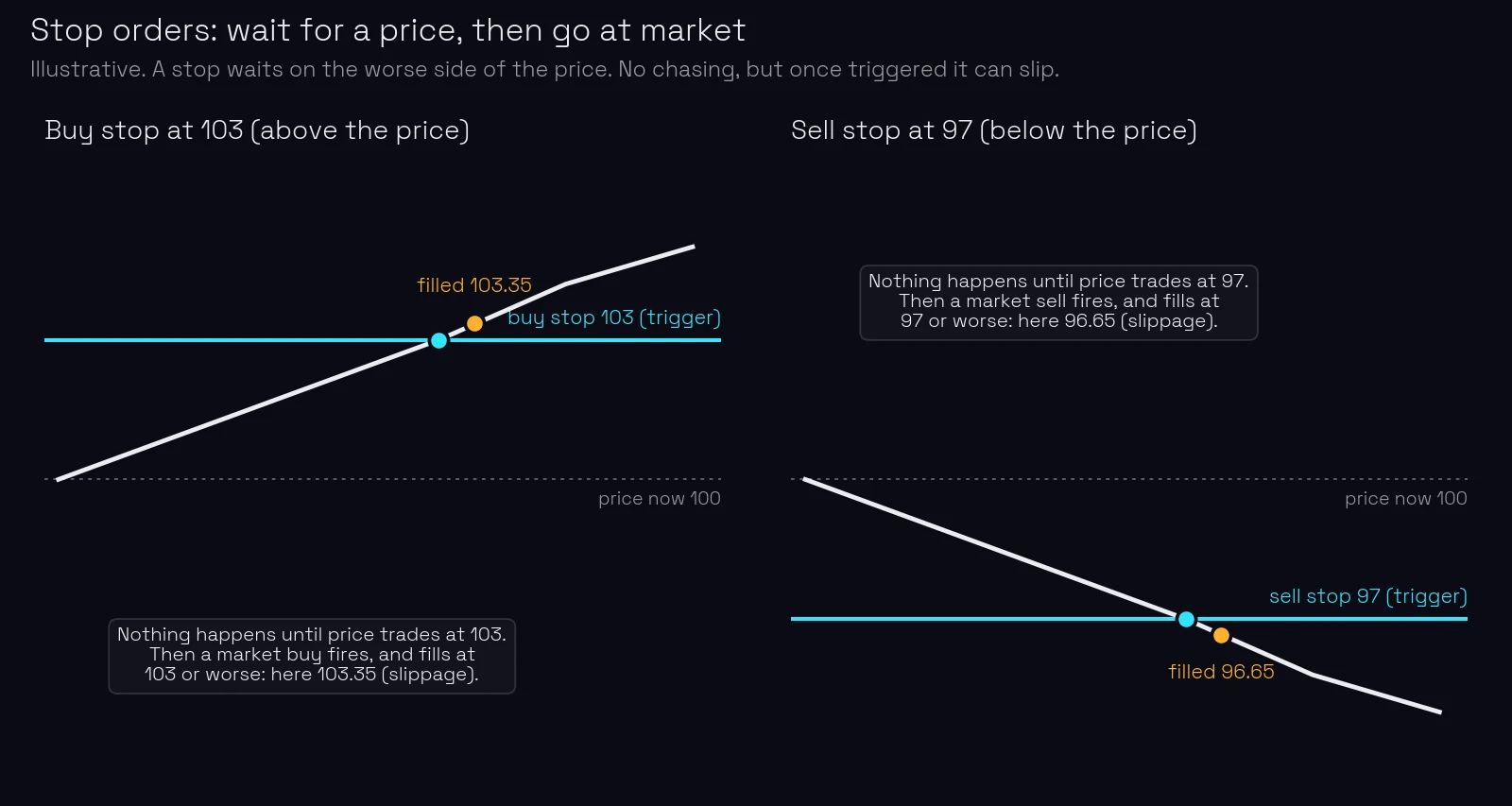
A buy stop market or sell stop market order is a postponed order. You set a trigger price; the order sleeps until price trades there, then becomes a market order. A stop order waits on the worse side of the price: a buy stop above it, a sell stop below it.
- Plus: you do not need to sit and chase the price. The order goes in when price gets there, for an entry on a breakout or to get out of a losing trade.
- Minus: slippage. The trigger decides when the order is sent, not the price it gets. Once triggered, it fills at the trigger or worse.
Stop-limit orders: postponed, with a worst price
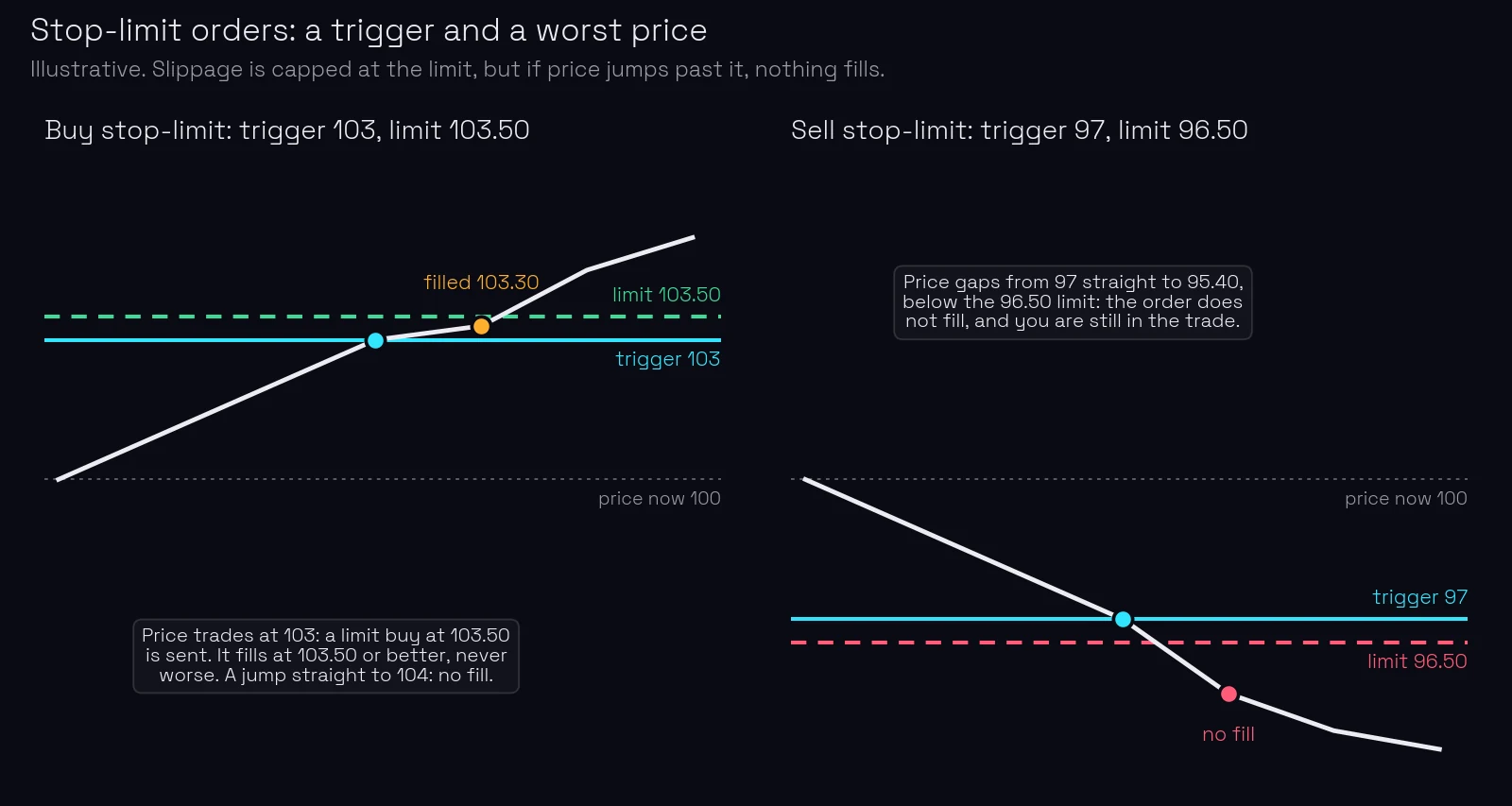
A buy stop-limit or sell stop-limit has two prices: the trigger that wakes it up, and the limit, the worst price you accept once it is awake. When price trades at the trigger, a limit order is sent instead of a market one.
- Plus: you do not need to wait at the screen, and you are protected from slippage: it never fills worse than your limit.
- Minus: no guarantee of the position. If price jumps past your limit, nothing fills. For an entry that just means a missed trade; for an exit it means you are still in a losing trade.
Take profit and stop loss: the two orders that close a trade
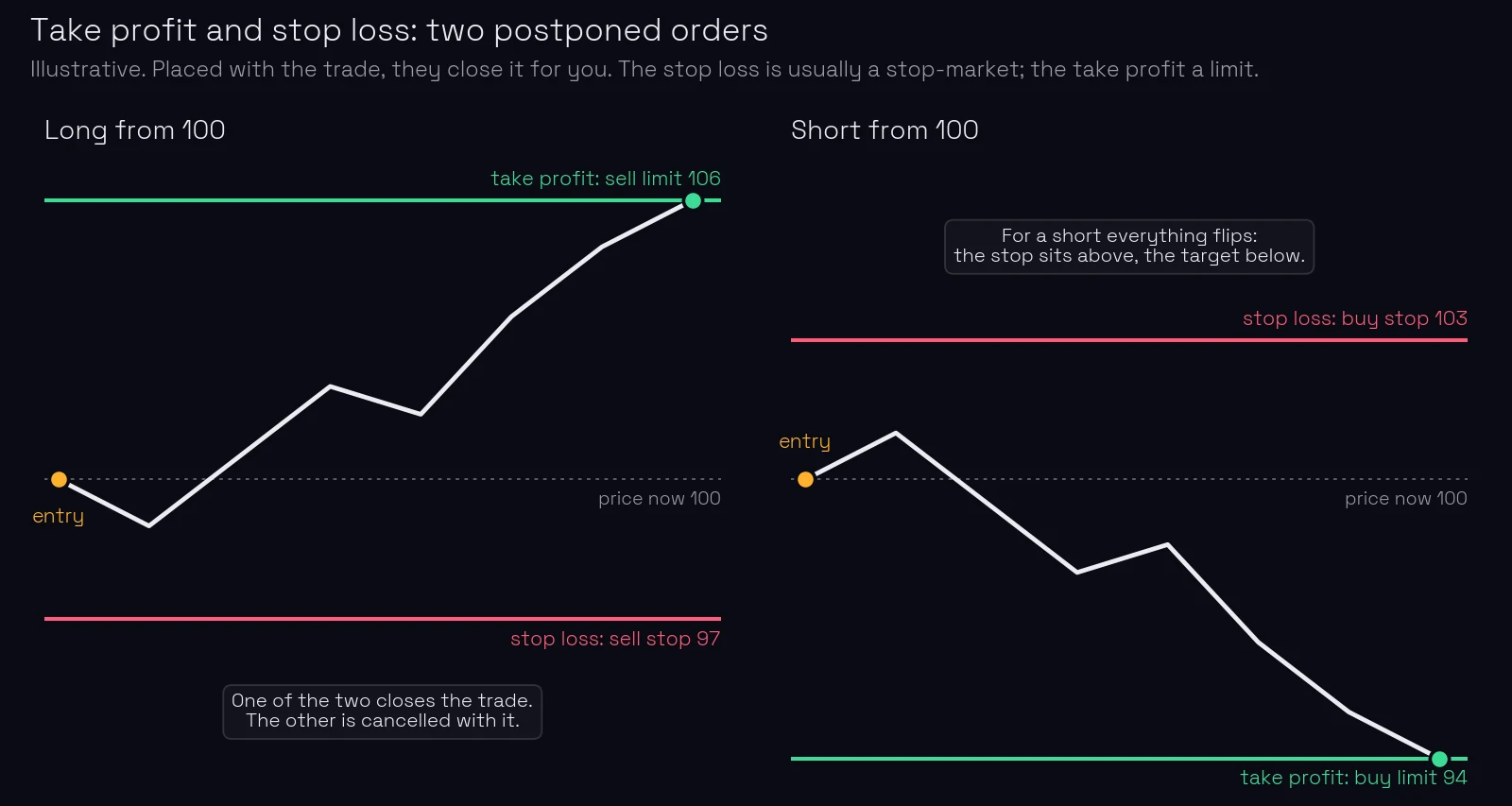
A take profit and a stop loss are postponed orders placed with the trade, so it closes itself whether or not you are watching:
- For a long: the take profit is a sell limit above the price, the stop loss a sell stop below it.
- For a short: everything flips: the stop loss is a buy stop above, the take profit a buy limit below.
Whichever is reached first closes the position, and the other should be cancelled with it. This is exactly what you draw with the calculator on ChartThread’s levels page: entry, stop and take profit as three lines, as in long and short positions.
Example: how much slippage to plan for
A stop loss is a market order once it fires, so it rarely fills exactly at the stop. As a rule of thumb, plan for slippage of 5 to 10% of your stop distance. It depends on how thin the order book is and how big your order is.
Take the Tesla long from long and short positions: entry 353, stop 345.50, a distance of 7.50, with 13.33 shares sized to risk 100 USDT.
So the realistic loss if the stop is hit is not 100 USDT but about 105 to 110. Size the trade so that number, not 100, is the one you can accept.
In a crash it can be far worse. On 10 October 2025, AVAX fell so fast that in one second trades printed from 11.94 down to 10.00:
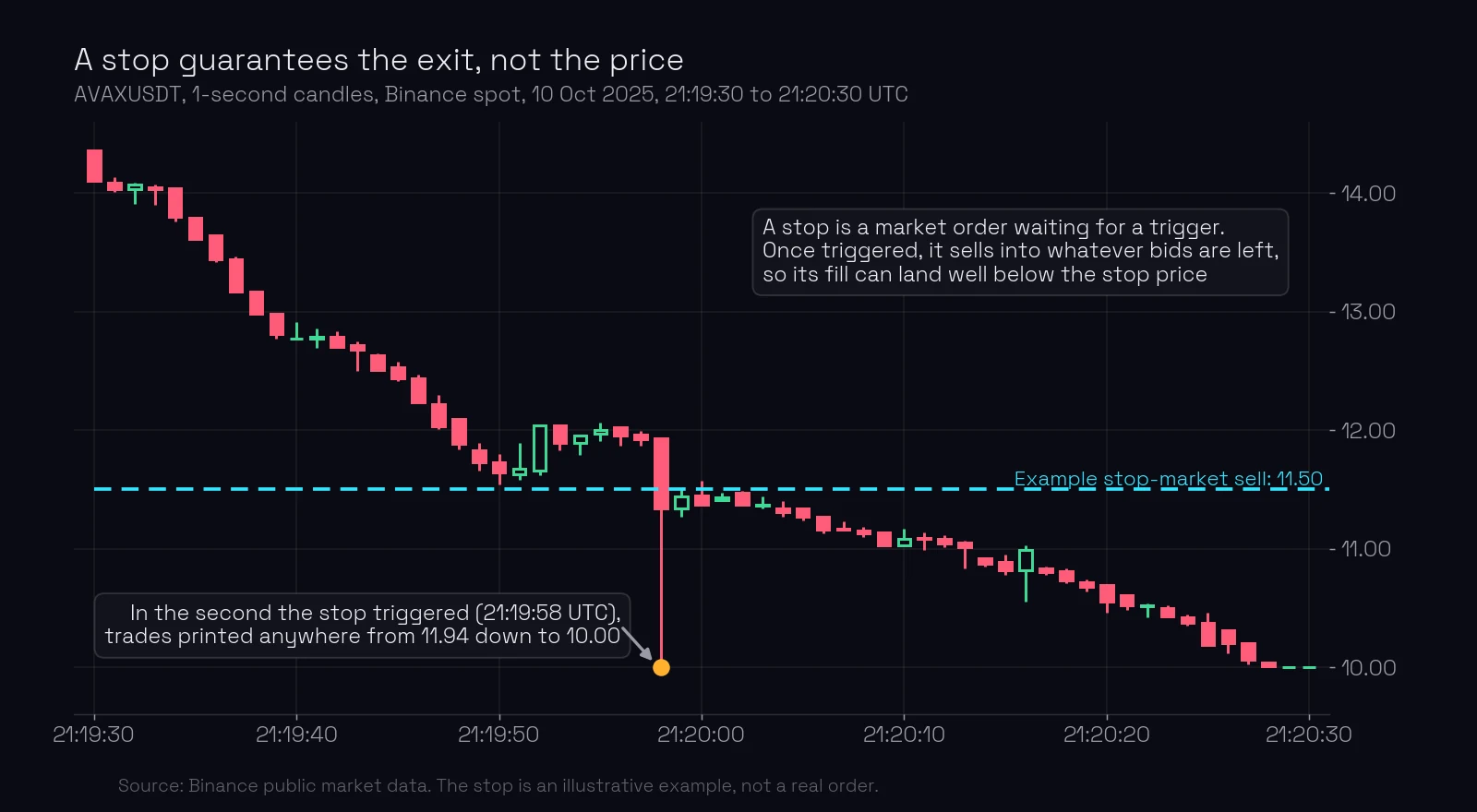
A sell stop at 11.50 in that second could have filled anywhere down to 10.00. A stop-limit with a limit at 11.40 might not have filled at all, and the position would still be open at 10.00. In a market like that, a bad fill is still better than no exit.
When a stop-limit stop loss never fills: liquidation
A stop loss set as a stop-limit is a postponed order in two steps. It sleeps until price reaches the trigger; then it wakes up and creates a limit order. If price is moving fast, it can run straight past that limit before anyone fills it. Your stop loss was triggered, but the order that should have closed the position never executed. You are still in the trade, and the loss keeps growing. On futures, it keeps growing until the exchange liquidates the position.
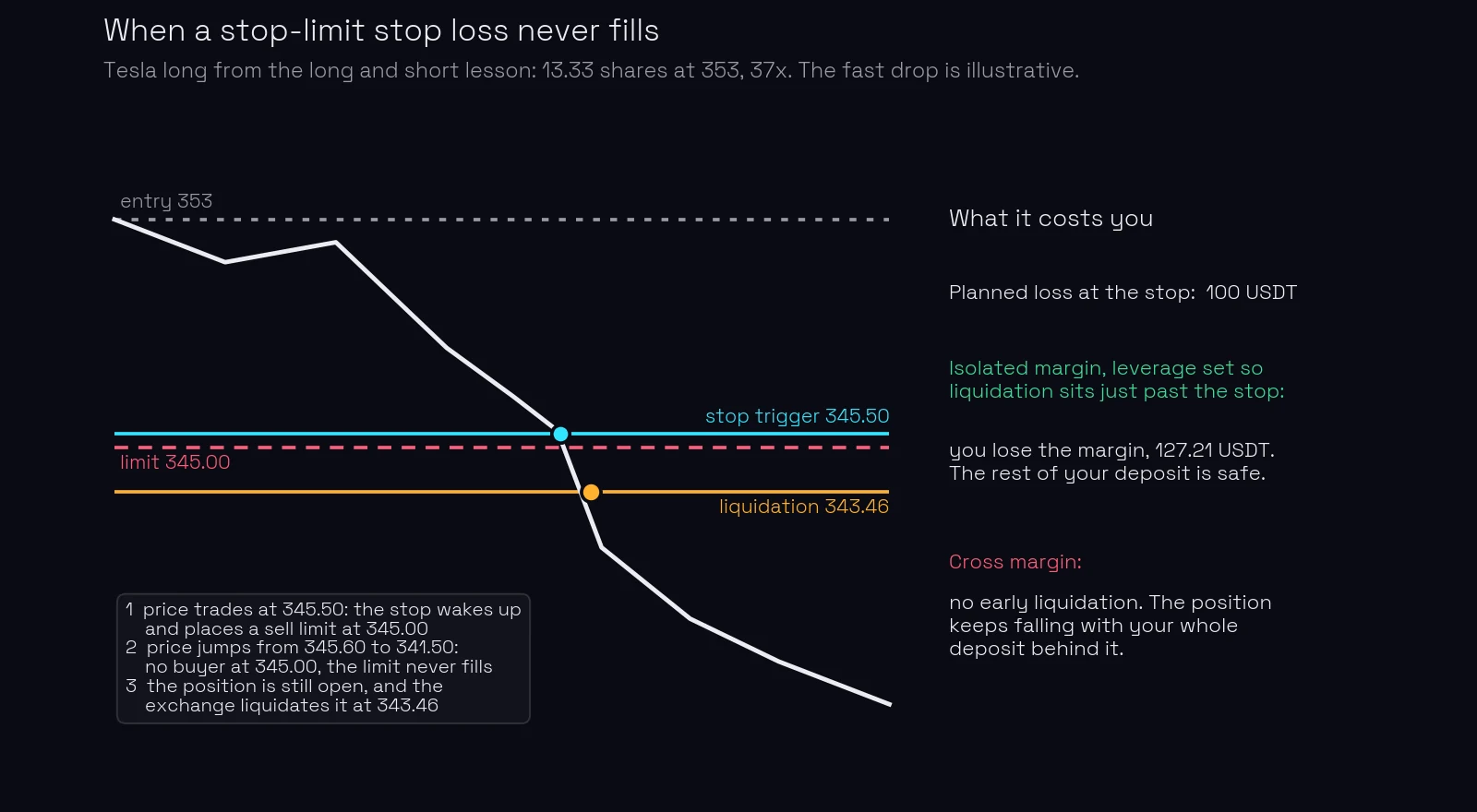
Take the Tesla long from long and short positions: 13.33 shares at 353, a stop at 345.50, a planned loss of 100 USDT. Set that stop as a stop-limit with a limit at 345.00, and say price drops fast from 345.60 to 341.50. The limit never fills. What saves you now is how you set up the position before the trade:
- Isolated margin. Only the margin assigned to the trade, 127.21 USDT here, can be lost. When the position is liquidated, the rest of your deposit is untouched.
- The right leverage. In that example the calculator set leverage so the liquidation price, 343.46, sits just past the stop. Then liquidation acts as a backup stop: the loss is 127 USDT instead of 100, not your account. How to choose that leverage is the subject of what is leverage and how to avoid liquidation.
- Cross margin has no such backstop: the position keeps drawing on your whole balance while it falls.
This is one more reason to use a stop-market for protective stops: it always fills, even if it slips.
All four orders at a glance
| Order | Fills | Plus | Minus | Used for |
|---|---|---|---|---|
| Market | at once, at the best prices there | the whole position, guaranteed | slippage; you chase the price | getting in or out now |
| Limit | only at your price or better | fixed price, no slippage | may fill partly, or not at all | entries at a level, take profit |
| Stop (market) | when price trades at the trigger, then at market | no need to chase; it waits for you | slippage after the trigger | stop loss, breakout entries |
| Stop-limit | when triggered, only up to your limit | slippage protected | may not fill at all | entries where missing the trade is fine |
Two options you will meet on futures exchanges: reduce-only (the order can only shrink a position, so a leftover stop cannot open a new one) and post-only (a limit order that is cancelled rather than filled at once, so you always pay the lower maker fee). Names and details vary, so check your exchange.
What most traders miss.
A stop-limit is not a safer stop. For exits, a missed fill is usually worse than a bad one, because the loss keeps growing while you are still in. Many traders use stop-limits only for entries and stop-markets for protective exits.
The stop price is not your guaranteed loss. It is where your exit starts. Plan for 5 to 10% of the stop distance on top, more on thin books and big sizes.
Your stop fills worse where everyone else’s stop is. Stops cluster just beyond obvious levels. When price gets there they all become market orders at once and compete for the same bids, which is part of why a level breaks fast (what happens at a level).
Common mistakes
- Chasing with market orders. If you keep paying the ask after a move, you are reacting, not trading a plan. Use a limit at a level, or a stop for a breakout.
- Using a stop-limit as a protective stop. In a gap it may not fill at all. For exits, prefer a stop-market and accept some slippage.
- Placing a buy limit above the price and expecting it to wait. It fills at once, because the market is already better than your limit. Above the price, a waiting buy is a buy stop.
- Sizing on the stop price alone. Add 5 to 10% of the stop distance for slippage before you decide the size.
Key takeaways
- An order is your request to buy or sell an instrument, in a direction and a size, and every order goes through the order book.
- Market: the whole position now, with slippage. Limit: your price, but no guaranteed fill.
- Stop: a postponed market order. Stop-limit: a postponed limit order, slippage protected but not guaranteed to fill.
- Take profit and stop loss are postponed orders that close the trade; plan for 5 to 10% of the stop distance as slippage.
- A stop-limit stop loss can be triggered and still not fill in a fast move. Isolated margin and the right leverage make liquidation a backup stop that protects your deposit.
Lesson test · 10 questions
Check yourself
Can you pass on the first try?
Passing the test completes this lesson. Tests in a module open in order, each after the one before it. A first-try pass scores 100%. Each wrong answer costs 10 points, and every 10 wrong answers lock the test for 30 minutes. Once you pass, your score is final, except that a score of 50 or less can be retaken once.
Tests in a module open in order. Pass the test of the previous lesson first: The order book: how a price is made. You can still read the questions here.
-
What does a market order guarantee?
-
What is the main risk of a limit order?
-
Price is 100. You want to buy only if price rises through 103. Which order do you use?
-
You hold a long from 100. Where do the take profit and the stop loss go?
-
A sell stop is triggered at 97 during a fast drop. Where can it fill?
-
Your sell stop-limit has a trigger at 97 and a limit at 96.50. Price gaps from 97.10 straight to 95.40. What happens?
-
Why is a stop-limit usually a poor choice for a protective stop loss?
-
Your stop is 7.50 away and you hold 13.33 shares, sized to risk 100 USDT. Using the 5 to 10% rule, what should you plan for if the stop is hit?
-
Your stop loss is a sell stop-limit. Price triggers it, then drops fast past the limit, and the order never fills. What protects your deposit?
-
What does reduce-only do on a futures stop loss?
Free account
Take the test and keep your score
- Your answers are checked and every lesson you pass is marked complete.
- Your scores build into your course score, on any device.
- You come straight back to this question after signing up.
Next: what slippage is, and how to avoid it. Or draw entry, stop and take profit on ChartThread’s levels page.
Terms in this lesson
Related lessons
Educational content, not financial advice. Trading carries a risk of loss.