The order book: how a price is made
Every price you see was made by a machine following two rules. The exchange’s matching engine takes the book of waiting orders you met in bid and ask explained and pairs them with incoming ones: best price first, then first come, first served. That sounds static. It is not. In five seconds on a quiet Saturday evening, 20 of the 30 price levels nearest BTC’s price changed size, while only 0.05 BTC actually traded. The rest was orders joining and leaving. This lesson is about that living book: who fills first, how long you wait, and what the book does not tell you.
What you’ll learn
- The two rules that decide who trades: price, then time
- Your place in the queue, and how long a limit order really waits
- How the book changes second by second, mostly without trades
- What the book hides, and how to read it at a level
Who trades first? Price, then time
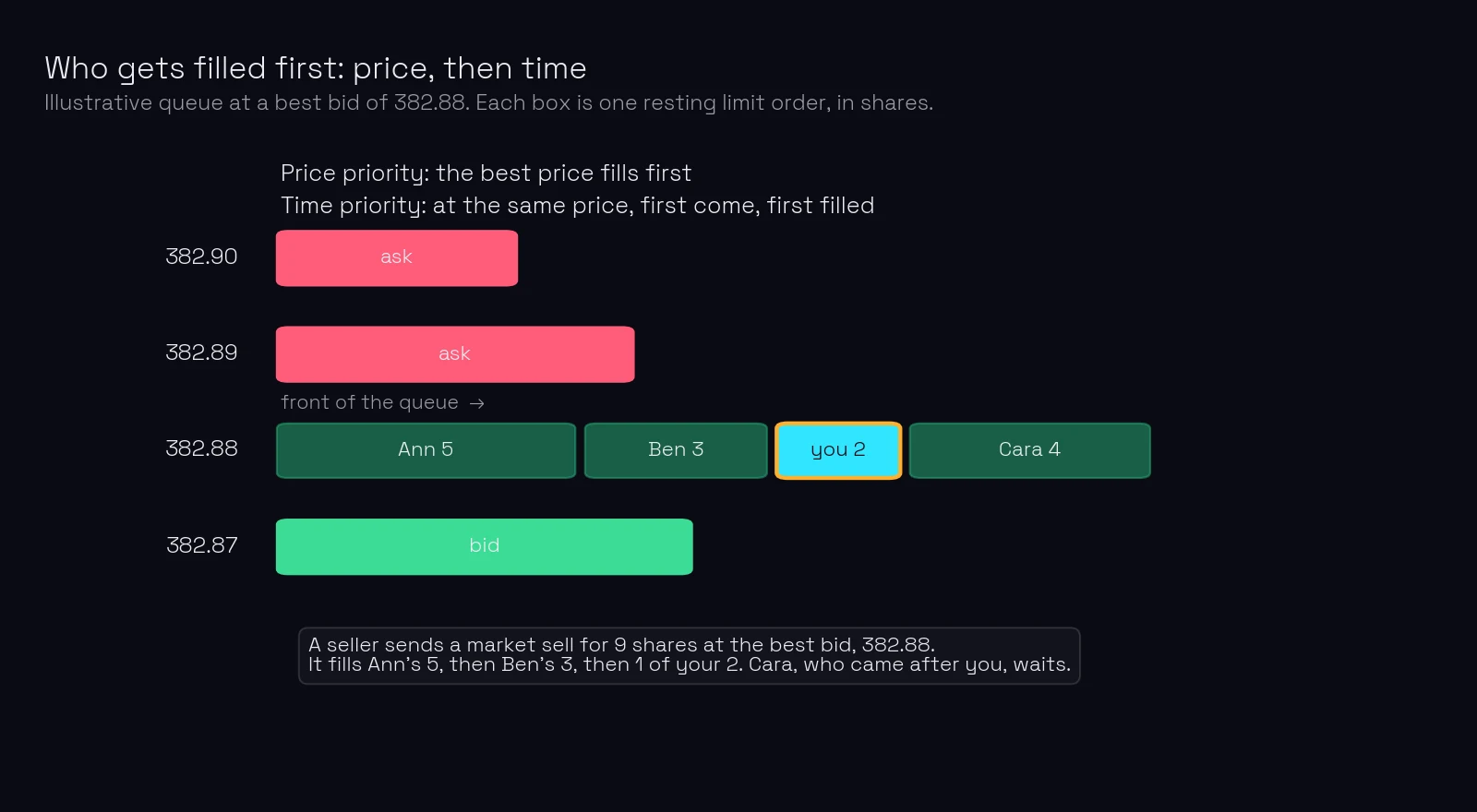
When an order arrives, the matching engine follows two rules, known together as price-time priority:
- Price first. A market sell trades with the highest bid; a market buy with the lowest ask.
- Then time. At the same price, the order that joined first fills first. Everyone else waits in line behind it.
So the best bid is not one order but a queue of them, and your limit order joins it at the back.
Example: four orders at 382.88
Ann, Ben, you and Cara each place a limit buy at 382.88, in that order: 5, 3, 2 and 4 shares. A seller sends a market order to sell 9.
- Ann gets her 5. Ben gets his 3. That is 8.
- You get the last 1, so you are half filled. Cara, behind you, gets nothing.
Now replay it, but Ben cancels his 3 shares a second before the sell arrives. The same 9 shares now fill Ann’s 5, all 2 of yours and 2 of Cara’s. Nothing about your order changed. A cancellation ahead of you moved you up the queue.
Two lessons follow. Trades can print at your exact price while you stay unfilled, because others were in line first. And if you move your order, even by one cent, you go to the back of a new queue.
How long does a limit order wait?
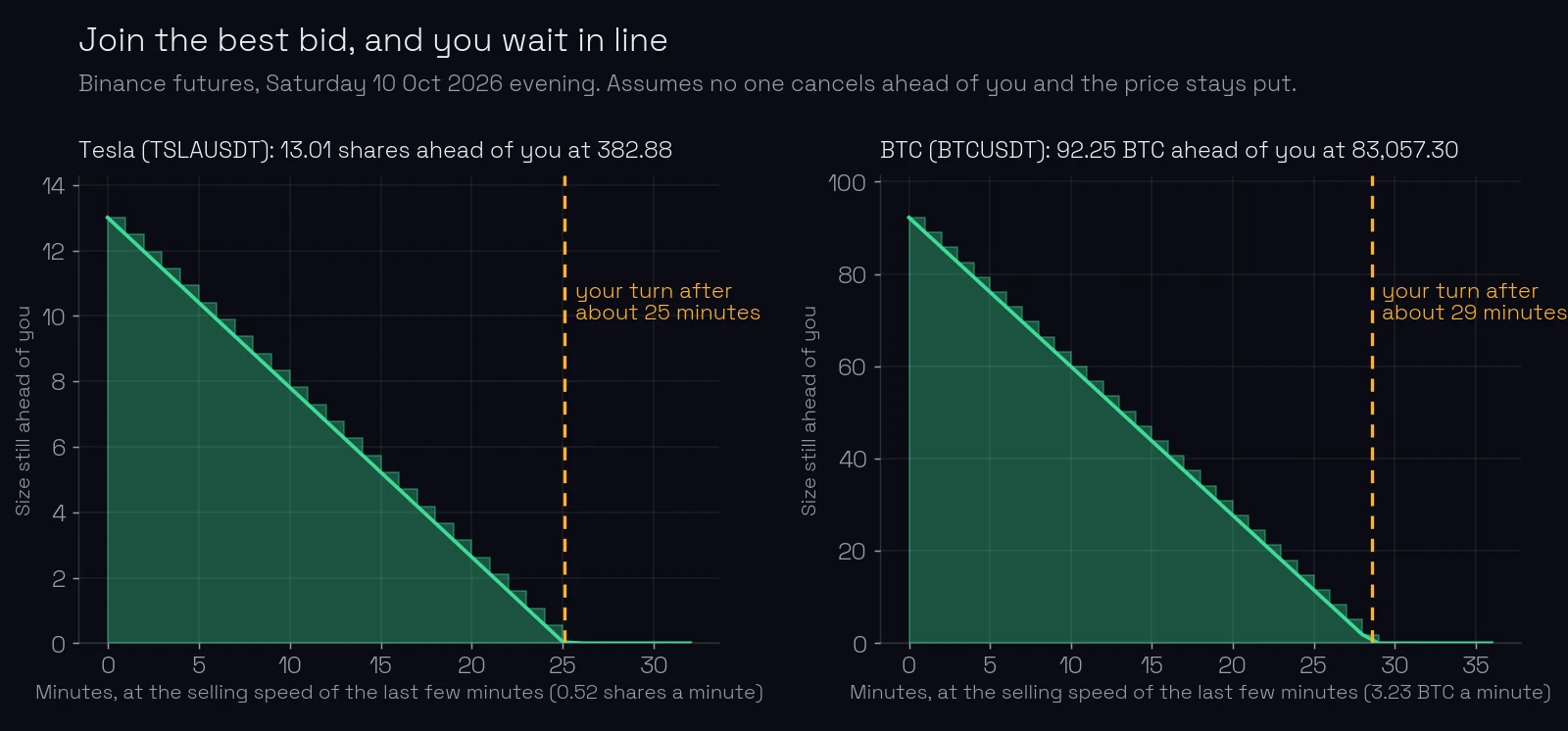
Here is the queue with real numbers. On Saturday evening, Tesla’s best bid held 13.01 shares, and over the previous few minutes sellers had hit the bid at about half a share a minute. Join that bid with a new order and, if nothing else changes, your turn comes after about 25 minutes.
BTC is the busiest book in the market, but its best bid held 92.25 BTC, about 7.7 million USDT, and sellers were hitting it at about 3.2 BTC a minute. Your wait: roughly half an hour.
In real life the wait is rarely that tidy. Orders ahead of you get cancelled, which helps; price moves away, which leaves you behind; or a burst of selling empties the whole queue in a second, as the next figure shows. The point stands: as a maker you trade only when the queue in front of you is gone.
The book breathes
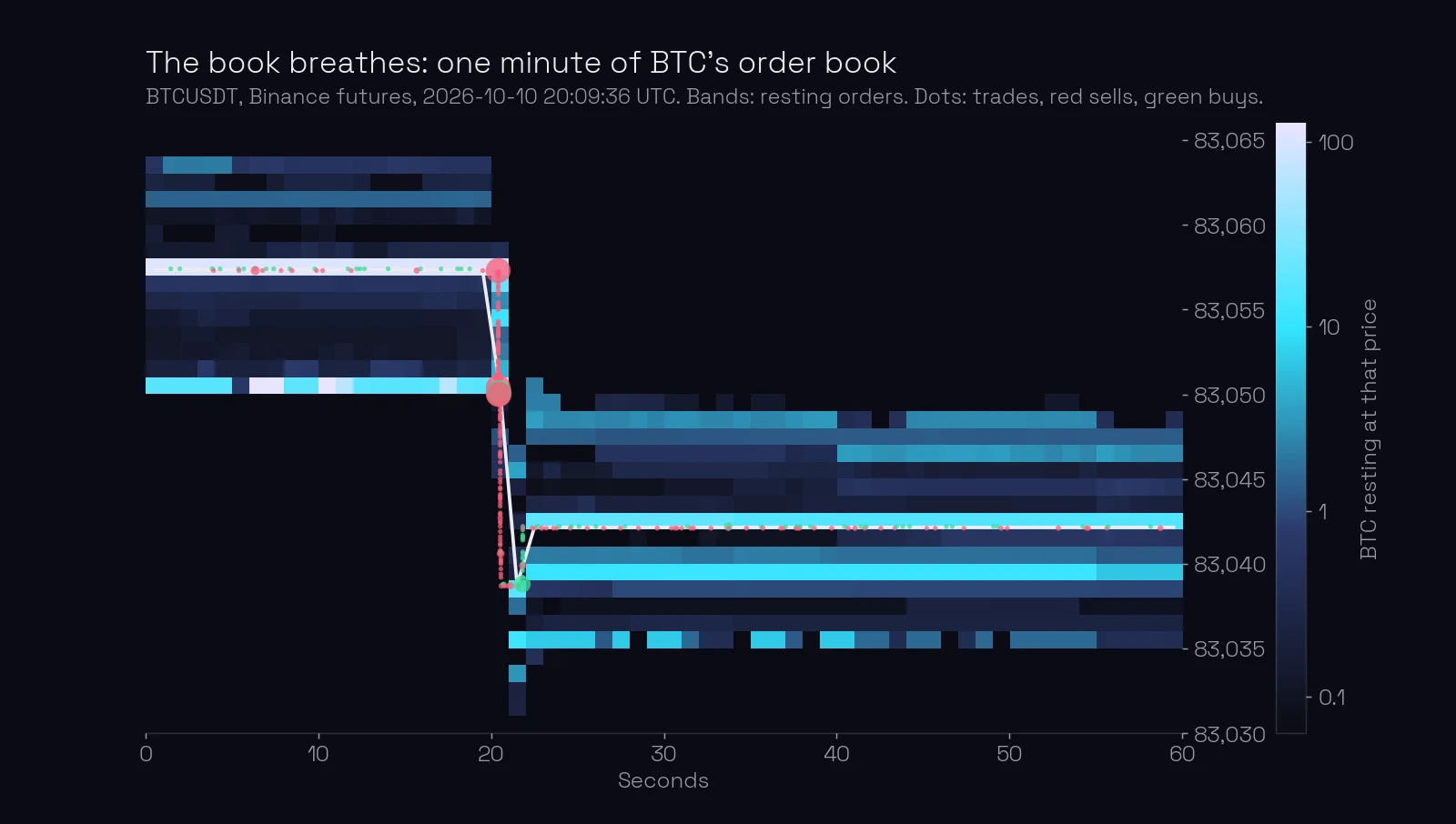
This is one real minute of BTC’s book on Binance. Each band is a price where orders were resting; the brighter it is, the more size. The white line is the middle price, and the dots are trades.
For twenty seconds almost nothing traded, yet the bands kept flickering: orders added, orders pulled. Then, in about five seconds, 153 trades sold 439 BTC into the bids. Price fell from 83,057.40 to 83,038.70, the bright bid near 83,050 was gone, and within a second a new book had formed lower down. On Tesla the same evening, three of the nearest levels changed size in five seconds with no trade at all.
Most changes in a book are not trades. They are people changing their minds.
What the book does not show
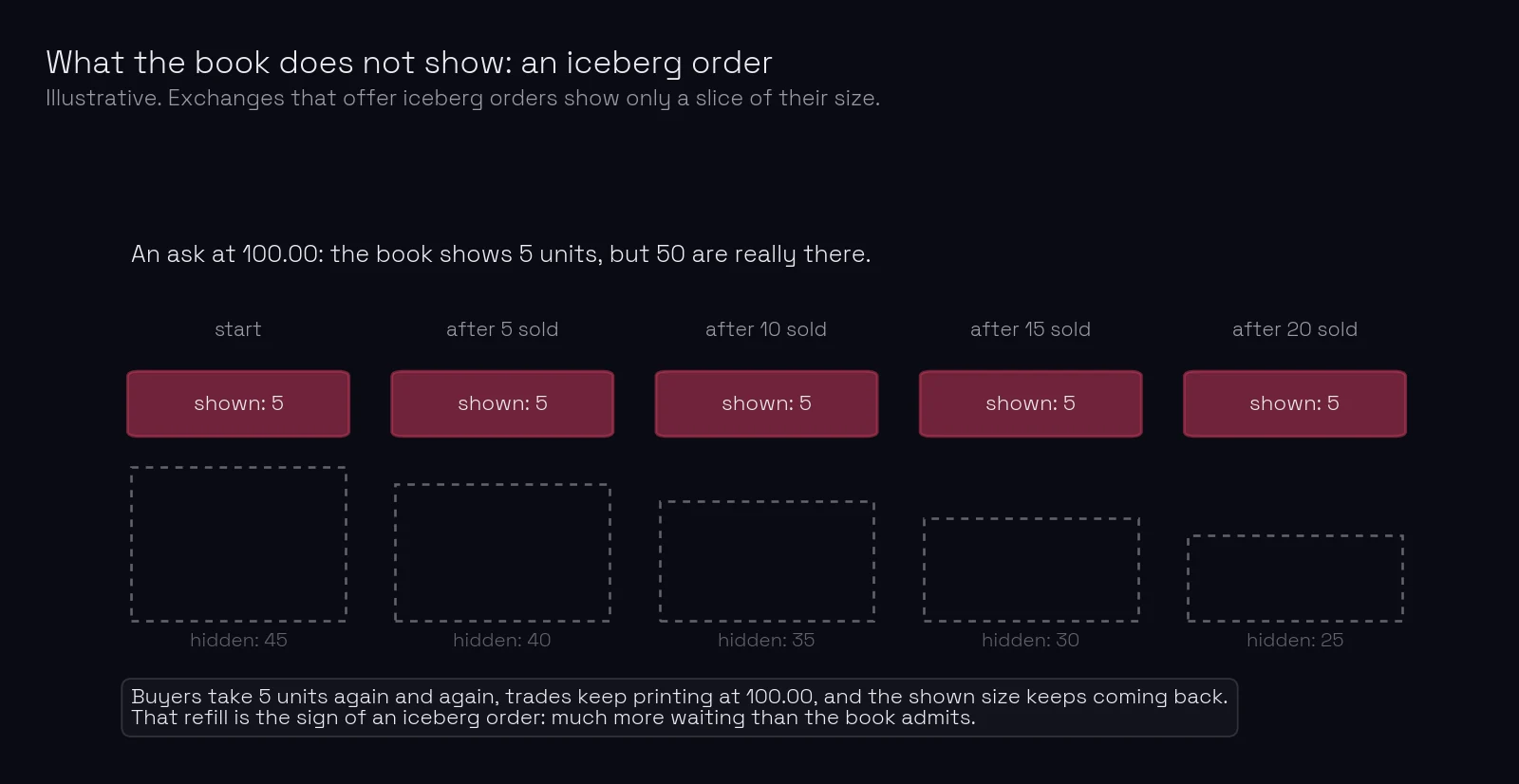
The book you see is only the visible part.
- Hidden size. An iceberg order shows only a slice of its size and refills it after each trade. The sign: trades keep printing at one price while the displayed size keeps coming back. Many stock exchanges and some crypto exchanges offer them.
- Size that will not be there. Any resting order can be cancelled in an instant, and on a fast market size often disappears just before price reaches it. Placing orders you never intend to fill, to mislead others, is called spoofing and is banned in regulated markets such as US futures.
- Other venues. The book is one exchange’s book. The same instrument can be deeper or thinner elsewhere, as bid and ask explained showed with Intel on Binance and Bybit.
Watch the book at a level
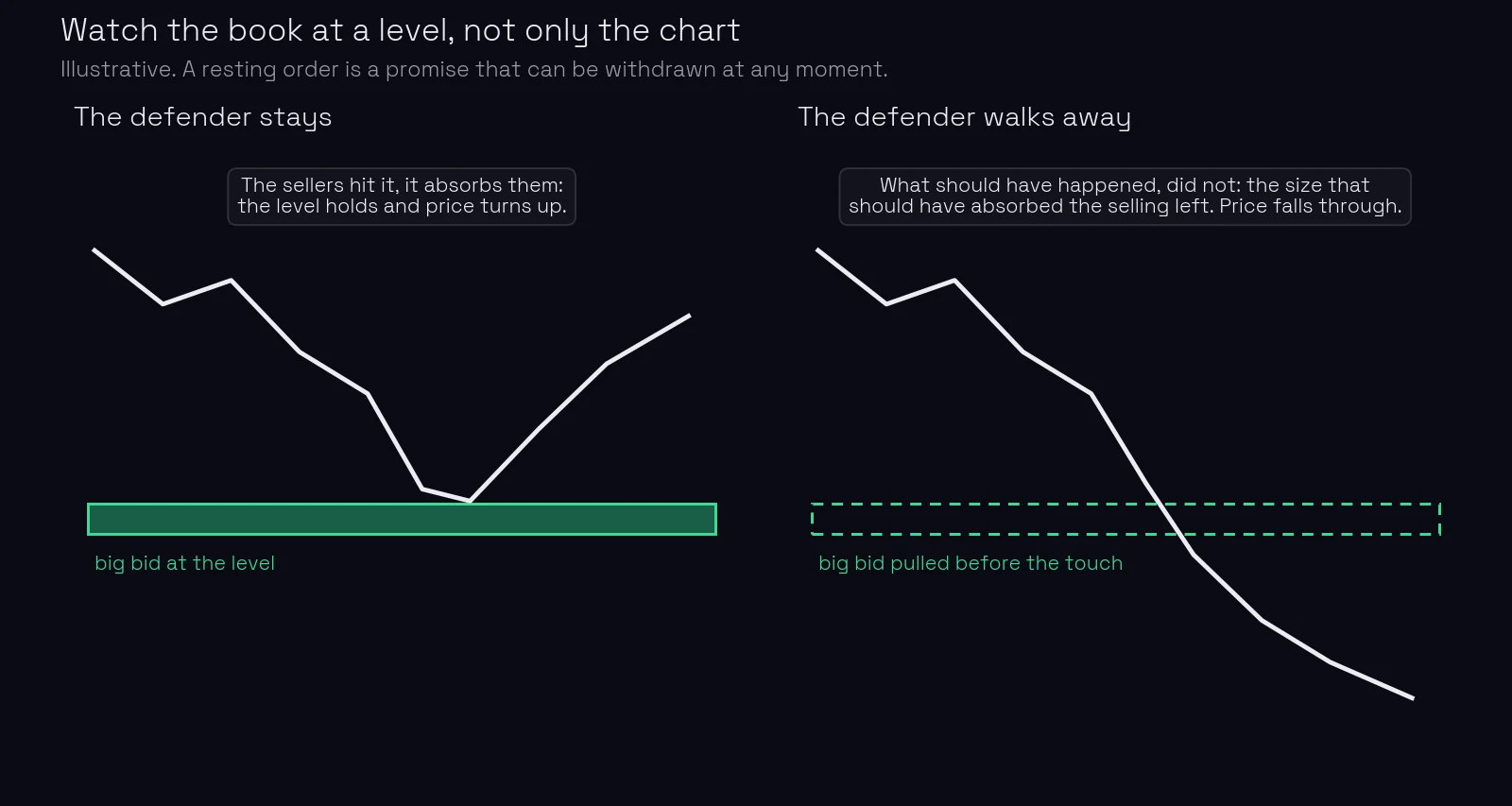
A level is often a limit player’s static orders resting at one price, as you saw in the four market players and what happens at a level. The order book is where you can watch that player at work.
- The defender stays. Price falls into the big bid, sellers hit it, it absorbs them, and price turns up. The level holds.
- The defender walks away. The big bid is pulled just before the touch. What should have happened, the absorption, did not, and price falls through. Read it the same way as on the chart: the missing event is the signal.
What most traders miss.
A big order in the book is intent, not commitment. It tells you someone wants to trade there right now. It does not tell you they will still be there when price arrives.
A cancellation can be good news or bad news. Cancellations ahead of you in the queue move you closer to a fill. A cancellation of the wall you were counting on is the defender leaving.
Quiet books can turn in a second. BTC’s book sat still for twenty seconds, then lost 19 dollars in one burst. Depth that looks solid can be eaten, or pulled, faster than you can react, so set your stop before you need it.
Common mistakes
- Expecting a limit order at the best bid to fill soon. You are at the back of a queue. Check how much size is ahead of you.
- Moving your order a cent closer to the price. It sends you to the back of a new queue; decide your price before you place it.
- Trusting a wall in the book. It can be cancelled, eaten, or partly fake. Use it as context and watch whether it really absorbs.
- Forgetting the hidden part. Trades printing at a price where the shown size never shrinks mean more is waiting there than the book admits.
Key takeaways
- The matching engine fills by price first, then by time: the best price, then the earliest order.
- Each price in the book is a queue; your limit order waits behind everyone who came first.
- Most changes in the book are orders added or pulled, not trades: in five seconds, 20 of BTC’s 30 nearest levels changed while 0.05 BTC traded.
- The book hides size (icebergs) and shows size that may vanish. At a level, watch whether the defender absorbs or walks away.
Lesson test · 9 questions
Check yourself
Can you pass on the first try?
Passing the test completes this lesson. Tests in a module open in order, each after the one before it. A first-try pass scores 100%. Each wrong answer costs 10 points, and every 10 wrong answers lock the test for 30 minutes. Once you pass, your score is final, except that a score of 50 or less can be retaken once.
Tests in a module open in order. Pass the test of the previous lesson first: What is a spread? The cost you pay on every trade. You can still read the questions here.
-
Two limit buys wait at the same price. Which one fills first?
-
Ann (5), Ben (3), you (2) and Cara (4) wait at the best bid, in that order. A market sell for 9 arrives. How many of your shares fill?
-
Same queue, but Ben cancels his 3 shares just before the market sell for 9 arrives. What happens to you?
-
You move your limit buy one cent closer to the price to fill sooner. What is the side effect?
-
13 shares wait ahead of you at the best bid, and sellers have been hitting it at about half a share a minute. If nothing else changes, how long until your turn?
-
In five seconds, 20 of the 30 levels nearest BTC’s price changed size, while only 0.05 BTC traded. What caused most of the change?
-
Trades keep printing at 100.00, but the size shown at that price never shrinks. What is the likely explanation?
-
A big bid sits at a level. Just before price touches it, the bid disappears and price falls straight through. How do you read it?
-
Why is placing large orders you never intend to fill, to mislead others, a problem?
Free account
Take the test and keep your score
- Your answers are checked and every lesson you pass is marked complete.
- Your scores build into your course score, on any device.
- You come straight back to this question after signing up.
Next: types of orders: market, limit, stop and stop-limit. Or watch where the market keeps reacting on ChartThread’s levels page.
Terms in this lesson
Related lessons
- Bid and ask explained: where every trade happens
- The four market players: long buyer, long seller, short seller, short buyer
- What happens at a level: who defends it, who breaks it
- Types of orders: market, limit, stop and stop-limit
- What is slippage, and how do you avoid it?
- Level type 4: limit-player levels
Educational content, not financial advice. Trading carries a risk of loss.