What is a perpetual futures contract?
A perpetual futures contract, or perp, is a future that never expires. You can hold it for an hour or a year. A dated future is pulled to the spot price on its expiry day; a perpetual has no such day, so the exchange ties it to spot with funding: every few hours, traders on one side pay traders on the other, and the crowded side is the one that pays. In crypto, perpetuals are where most of the trading happens, and exchanges now list them on shares, gold, oil and currencies too.
What you’ll learn
- What a perpetual future is, and how it differs from a dated one
- How funding keeps the perpetual close to spot, and who pays whom
- How big funding can get, and what is normal
- Perpetuals beyond crypto: shares, ETFs, commodities and currencies
- The difference between the mark price and the last price
How is a perpetual different from a normal future?
Everything in spot vs futures still applies: a contract on the price, margin, long or short, profits and losses paid in cash. The one difference is time. A dated future is settled at the spot price on its expiry day, which keeps it honest. A perpetual has no end, so without some other force its price could drift far from spot and stay there.
How does funding keep the price near spot?
Funding is a payment between traders, made at fixed times. The exchange compares the perpetual’s price with an index of spot prices and sets a funding rate from the difference.
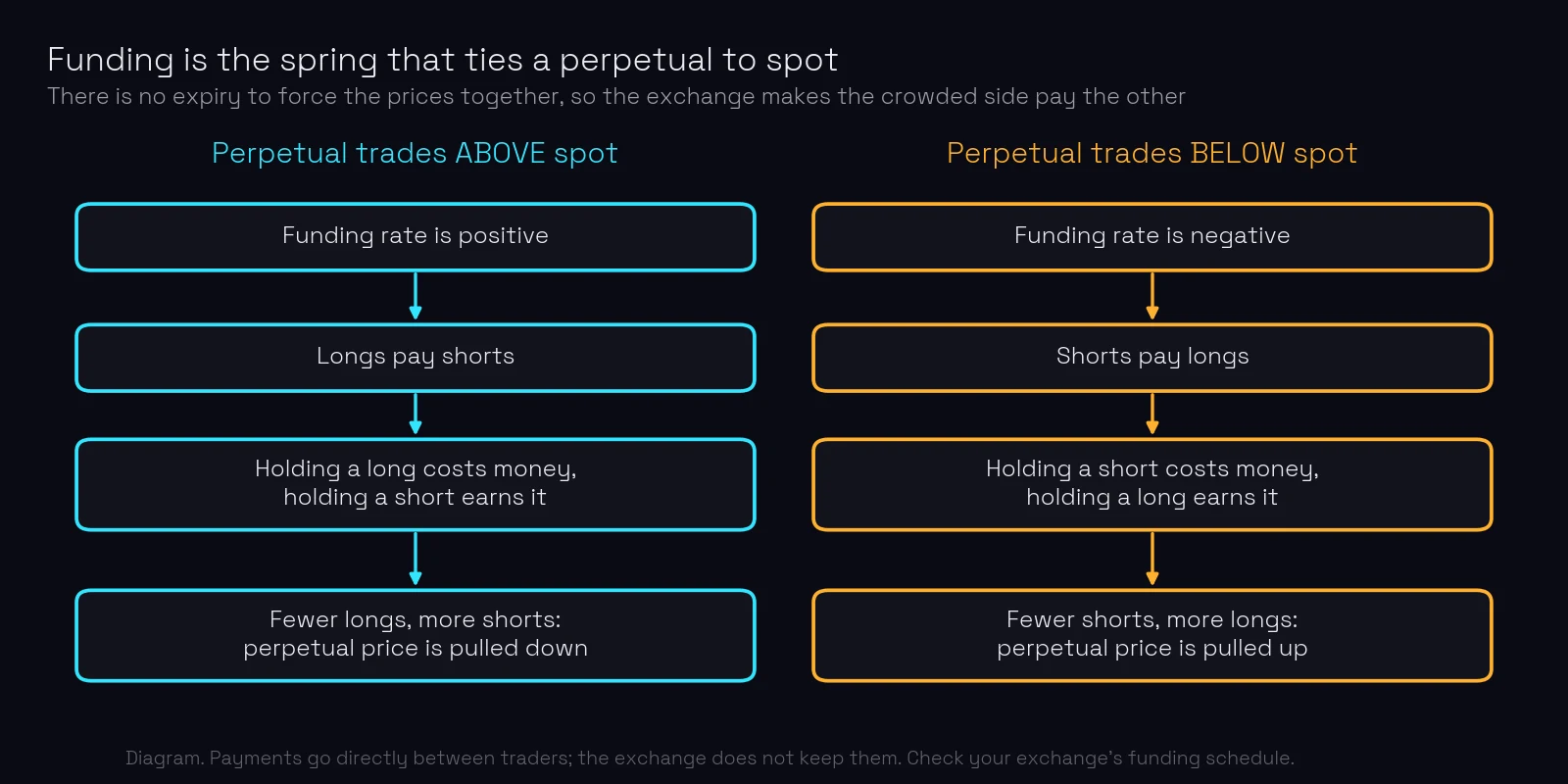
- Perpetual above spot: the rate is positive, and longs pay shorts. Holding a long now costs money and holding a short earns it, so some longs close and some traders open shorts. That selling pulls the perpetual down towards spot.
- Perpetual below spot: the rate is negative, and shorts pay longs. The pressure works the other way and pulls the price up.
The payments go from trader to trader; the exchange does not keep them. You pay or receive only if you hold a position at the moment funding is settled.
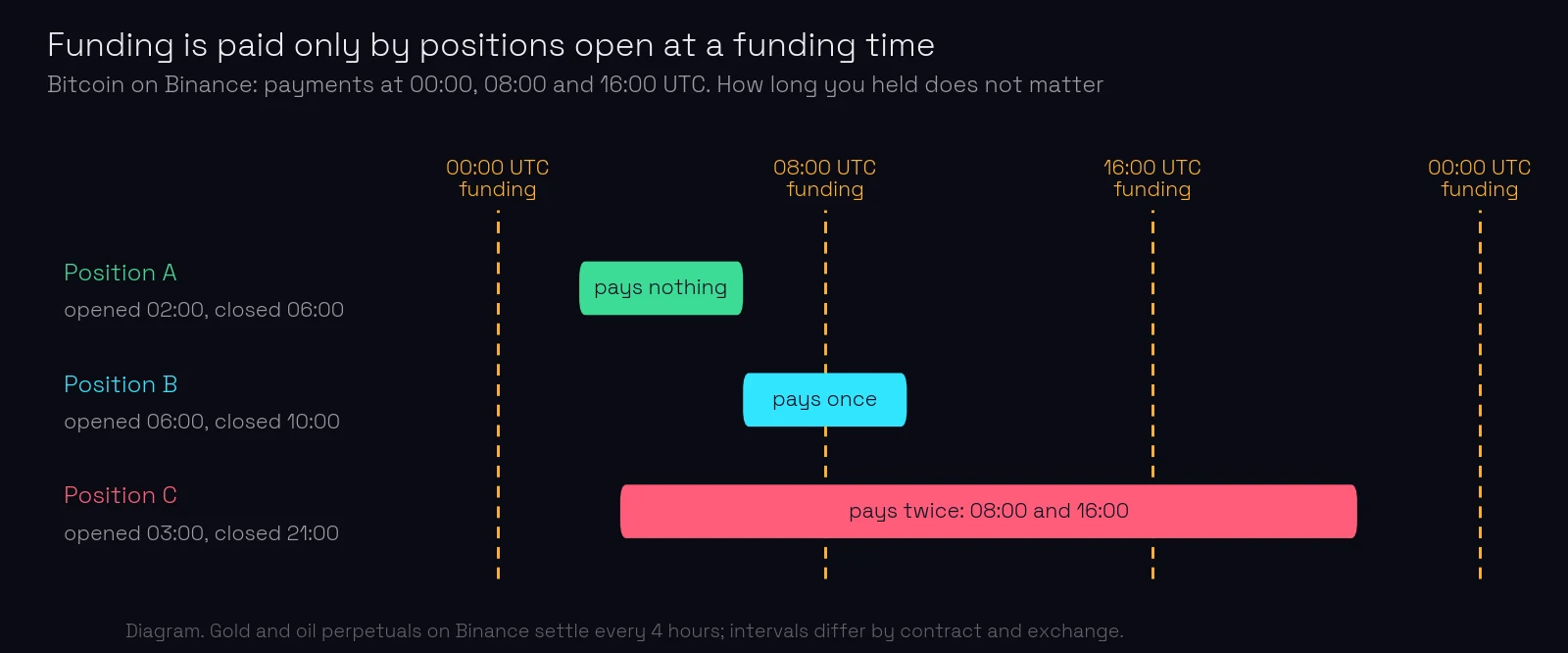
On Binance, the Bitcoin perpetual settles funding every 8 hours, at 00:00, 08:00 and 16:00 UTC. Other contracts and other exchanges use different intervals and formulas, and they change, so check your exchange’s current funding page.
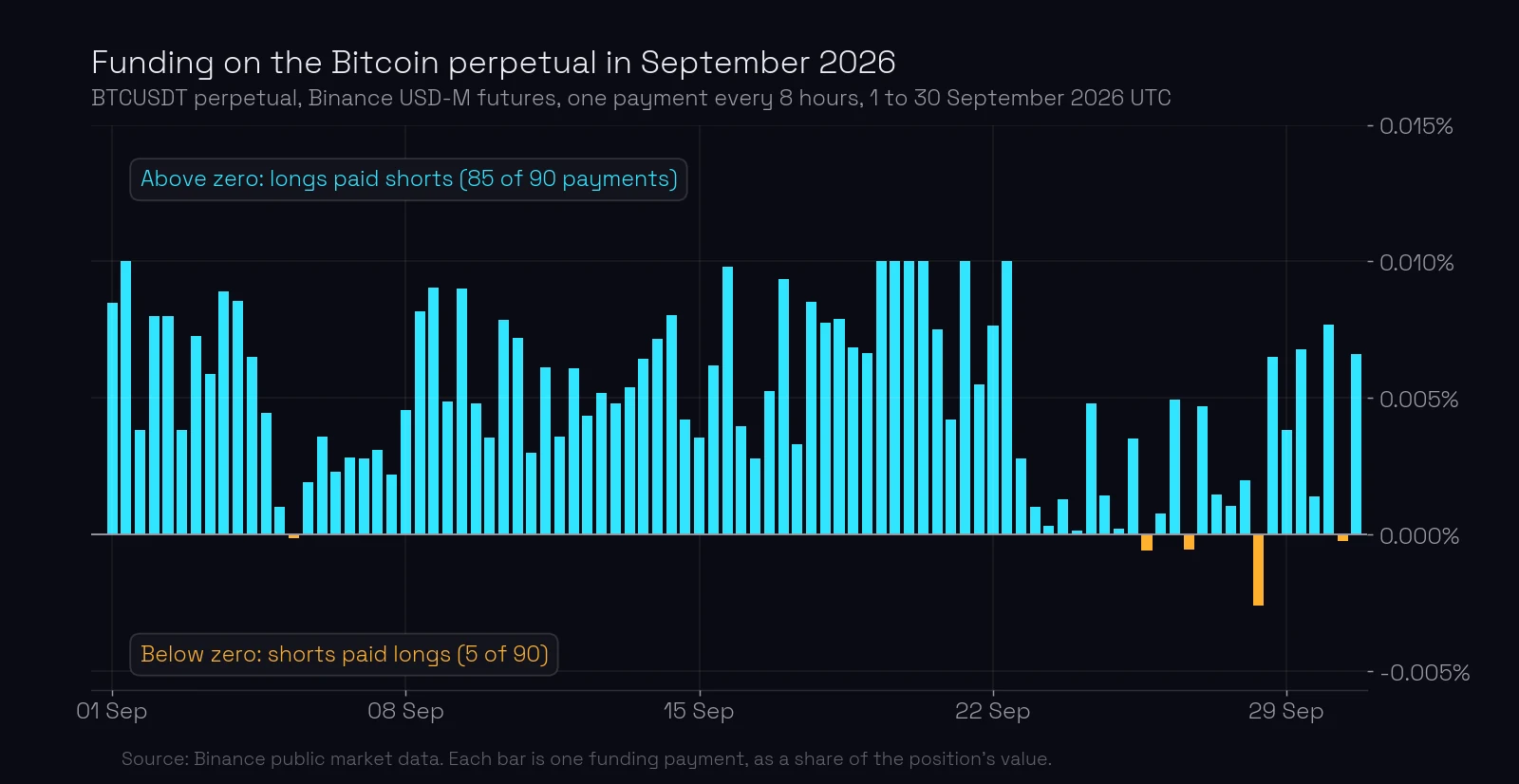
Every bar above zero is a moment when longs paid shorts. In September 2026 longs paid 85 times out of 90, a sign that more traders wanted to be long at the perpetual’s price. In the last days of the month a few bars turned negative, and shorts paid longs. The details of how the rate is calculated are in the funding rate lesson.
How big can funding get?
Each exchange publishes the rules for every perpetual: how often funding is paid, and the most it can be in one payment, called the cap (for longs paying) and the floor (for shorts paying). Here they are for a few contracts, as published by Binance and Bybit on 8 October 2026:
| Contract | Paid every | Binance cap and floor | Bybit cap and floor |
|---|---|---|---|
| Bitcoin (BTCUSDT) | 8 hours | ±0.30% | ±0.333% |
| Ether (ETHUSDT) | 8 hours | ±0.30% | ±0.333% |
| Solana (SOLUSDT) | 8 hours | ±0.375% | ±0.50% |
| Gold (XAUUSDT) | 4 hours | ±0.50% | ±0.267% |
| Apple (AAPLUSDT) | 8 hours | ±2.00% | ±0.50% |
| SpaceX (SPCXUSDT) | 8 hours | ±1.00% | ±0.30% |
The cap is an emergency limit, not a normal day. On crypto perpetuals the formula includes a small fixed interest part, so with the perpetual sitting right on spot the rate is about +0.01% per 8 hours: longs pay a little by default. On the share and commodity perpetuals above, that interest part is zero, so their normal funding is zero.
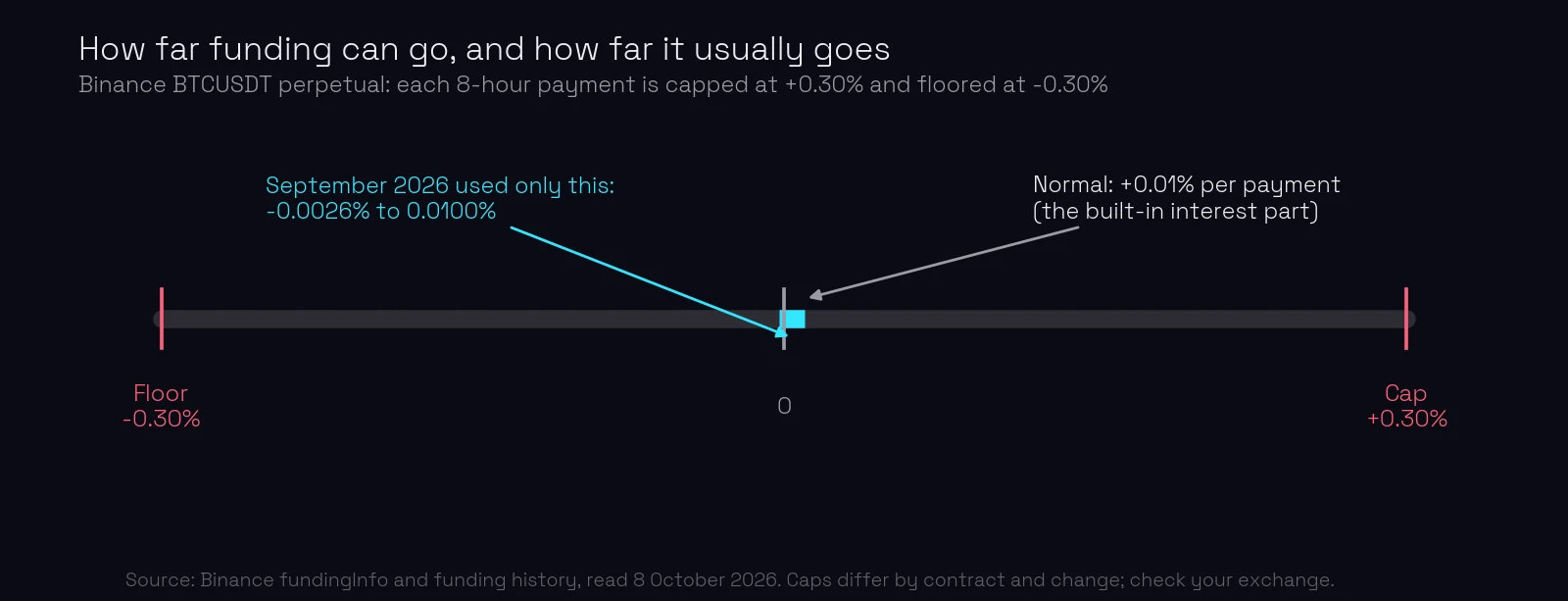
In September 2026 Bitcoin funding on Binance never left the range from −0.0026% to +0.0100% per payment, a tiny part of the ±0.30% allowed. Rates near the cap appear only in extreme, one-sided markets, and that is exactly when they hurt: at +0.30% every 8 hours, a long pays 0.9% of its value a day.
Perpetuals beyond crypto
Perpetuals were born on crypto exchanges, but the same contract now exists on other markets. On Binance and Bybit you can trade perpetuals that follow:
- Shares: Apple, NVIDIA, Tesla and SpaceX, among many others.
- ETFs: SPY for the S&P 500 and QQQ for the Nasdaq-100.
- Commodities: gold, silver, crude oil and natural gas.
- Currencies: a few, such as the US dollar against the Brazilian real.
They work exactly like a crypto perpetual: margin, long or short, no expiry, and funding to keep them near the price of the share, the metal or the barrel. They also trade when the stock exchange or the commodity market is closed, so their price keeps moving at night and at weekends. Funding behaves very differently from one market to another.
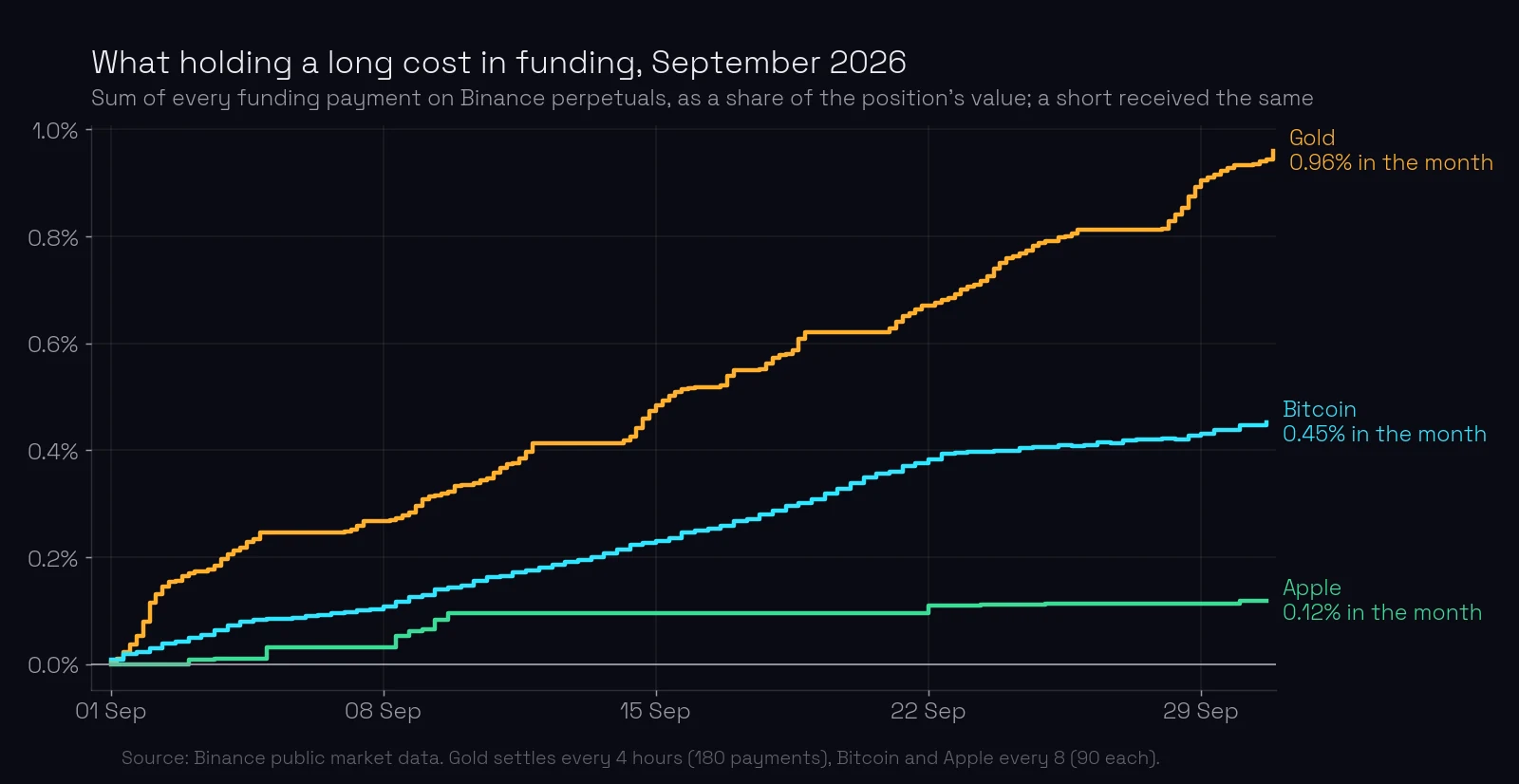
In September 2026 a gold long paid 0.96% of its value in funding, more than twice as much as a Bitcoin long, because gold pays every 4 hours and its rate was positive all month. An Apple long paid 0.12%: 77 of its 90 payments were exactly zero. Before you hold a perpetual for weeks, look up its funding history, not just today’s rate.
What is the mark price?
A perpetual shows two prices. The last price is the price of the most recent trade on the perpetual’s order book. The mark price is the exchange’s estimate of fair value, built mainly from spot prices on several exchanges. Exchanges use the mark price to value open positions and to decide liquidations, so a single sharp wick on one order book does not wipe out traders whose positions are otherwise fine. Funding payments are also calculated on the position’s value at the mark price.
Why do perpetuals dominate crypto trading?
They combine everything traders want from futures (leverage, easy shorting, no coins to move) with none of the chores of dated contracts: no expiry, no rolling into the next contract, and one contract per coin instead of several, so all the trading concentrates in a single deep order book. Perpetuals were introduced by BitMEX in 2016 and are now offered by every large crypto exchange.
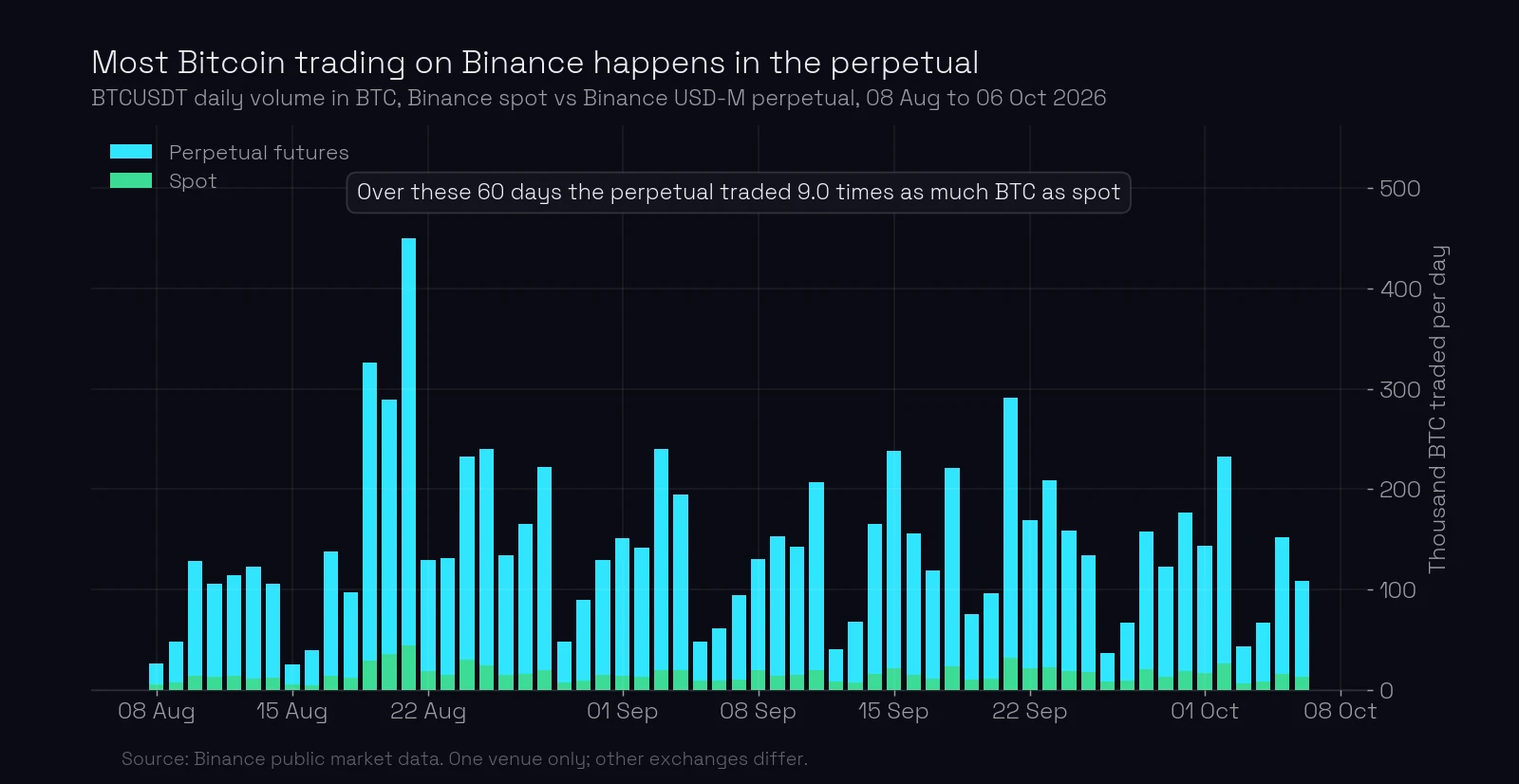
That is one venue and one period, but the picture is typical of crypto: much of the trading, and much of the price discovery, happens in perpetuals.
What funding cost a Bitcoin long in September 2026
Real payments from the September chart, on a position of 1 BTC. The payment is the position’s value at the mark price times the funding rate:
On 1 September 2026 at 08:00 UTC, the rate was +0.0100% and the mark price 78,600.20:
The rate was positive, so a 1 BTC long paid 7.86 USDT and a 1 BTC short received it.
On 28 September 2026 at 08:00 UTC, the rate was −0.002585% and the mark price 82,924.82:
The rate was negative, so this time the short paid 2.14 USDT and the long received it.
Added together, the 90 rates of September come to +0.4528%. With the mark price averaging about 80,341, a long held through the whole month paid roughly:
At that pace for a year:
The gold perpetual, at 0.96% for the month, works out to about 11.7% a year. Funding is a real cost of holding, and it differs by market.
What most traders miss.
Funding is charged on the whole position, not on your margin. A rate of 0.01% per 8 hours is 0.01% × 3 × 365 = 10.95% of the position’s value a year. At 10 times leverage, that is 109.5% a year of the margin you put down. A small number on the funding page can quietly eat a position held for weeks.
Funding is paid only by whoever holds a position at the settlement time. A trade opened and closed between two funding times pays none. A position open across the timestamp pays the full amount, even if it was opened a minute before.
Funding is a reading of the crowd. When funding stays high and positive, many traders are paying to stay long. If price then turns down, those crowded longs are the ones forced to sell, and that selling feeds the move.
Common mistakes
- Ignoring funding on a long-held position. Add up the payments before you plan to hold a perpetual for weeks.
- Watching the last price for liquidation. Liquidation follows the mark price. Check where your liquidation price is against the mark price.
- Assuming funding works the same everywhere. Intervals, caps and formulas differ by exchange and by contract. Check before you trade.
- Opening a position just before funding without checking the rate. You pay the whole payment for holding it across the timestamp.
Key takeaways
- A perpetual is a future with no expiry date.
- Funding keeps it near spot: positive funding means longs pay shorts, negative means shorts pay longs.
- The mark price, built from spot prices, is used for profit and loss, liquidation and funding.
- Funding is charged on the full position value, so leverage multiplies its cost relative to your margin.
- Each contract has a published cap and floor; normal funding is about +0.01% per 8 hours on crypto and zero on most share and commodity perpetuals.
- Perpetuals now exist on shares, ETFs, commodities and currencies, and their funding differs a lot by market.
- Perpetuals dominate crypto trading; on Binance the Bitcoin perpetual traded 9 times spot volume in our 60-day sample.
Lesson test · 10 questions
Check yourself
Can you pass on the first try?
Passing the test completes this lesson. Tests in a module open in order, each after the one before it. A first-try pass scores 100%. Each wrong answer costs 10 points, and every 10 wrong answers lock the test for 30 minutes. Once you pass, your score is final, except that a score of 50 or less can be retaken once.
Tests in a module open in order. Pass the test of the previous lesson first: Spot vs futures: what's the difference?. You can still read the questions here.
-
Example: the funding rate is +0.01% and you are long 2 BTC on the perpetual, with a mark price of 85,000. What happens at the funding time?
-
Example: the funding rate is -0.005% and you are short 1 BTC, with a mark price of 80,000. What happens at the funding time?
-
Funding is 0.01% every 8 hours and stays there for a year. You hold a long at 5 times leverage. Roughly what share of your margin goes to funding over the year?
-
You open a perpetual long one minute before a funding time and close it two minutes after. How much funding do you pay or receive?
-
A sharp wick on the perpetual’s order book trades briefly through your liquidation price, but the mark price stays well above it. What happens to your long?
-
Why does a perpetual future need funding payments when a quarterly future does not?
-
When funding is positive and longs pay shorts, where does the money go?
-
Funding has stayed high and positive for weeks. Then price turns down. Why can the fall speed up?
-
A perpetual is capped at +0.30% per 8-hour funding payment, and funding sits at the cap for a whole day. What does a long pay that day?
-
In September 2026 a long on Binance’s gold perpetual paid 0.96% in funding and a long on the Apple perpetual paid 0.12%. What is the best conclusion?
Free account
Take the test and keep your score
- Your answers are checked and every lesson you pass is marked complete.
- Your scores build into your course score, on any device.
- You come straight back to this question after signing up.
Next: types of trading, from scalping to position trading. To see where price is likely to react on any of these perpetuals, from Bitcoin to gold or Apple, open ChartThread’s levels.
Related lessons
Educational content, not financial advice. Trading carries a risk of loss.