What is a stock exchange, and how does it work?
An exchange is a company whose business is running a market. It keeps the order book where buyers and sellers wait, matches them by strict rules, publishes every trade, and makes sure both sides actually get what they agreed. A stock exchange does this for company shares; other exchanges do it for futures, currencies or crypto. The idea is the same for every trading instrument, and so are most of the mechanics you need as a trader.
What you’ll learn
- What an exchange does, step by step, after you press buy
- The main types of exchanges, and how an exchange differs from a broker
- How to choose a broker you can trust
- Why every exchange has its own prices, and when the big exchanges are open
What does an exchange actually do?
Strip away the buildings and the bell ringing, and an exchange does four jobs:
- It runs the order book. It holds every resting buy and sell order and keeps them in price order, as described in what a market is.
- It matches orders. Its matching engine pairs orders by price first and time second: the best price trades first, and at the same price, whoever came first trades first.
- It publishes prices. Every trade is broadcast. The candles you see on a chart are built from this feed.
- It sets the rules. Which instruments can trade, when the market opens and closes, the smallest price step, and what happens in a disorderly market.
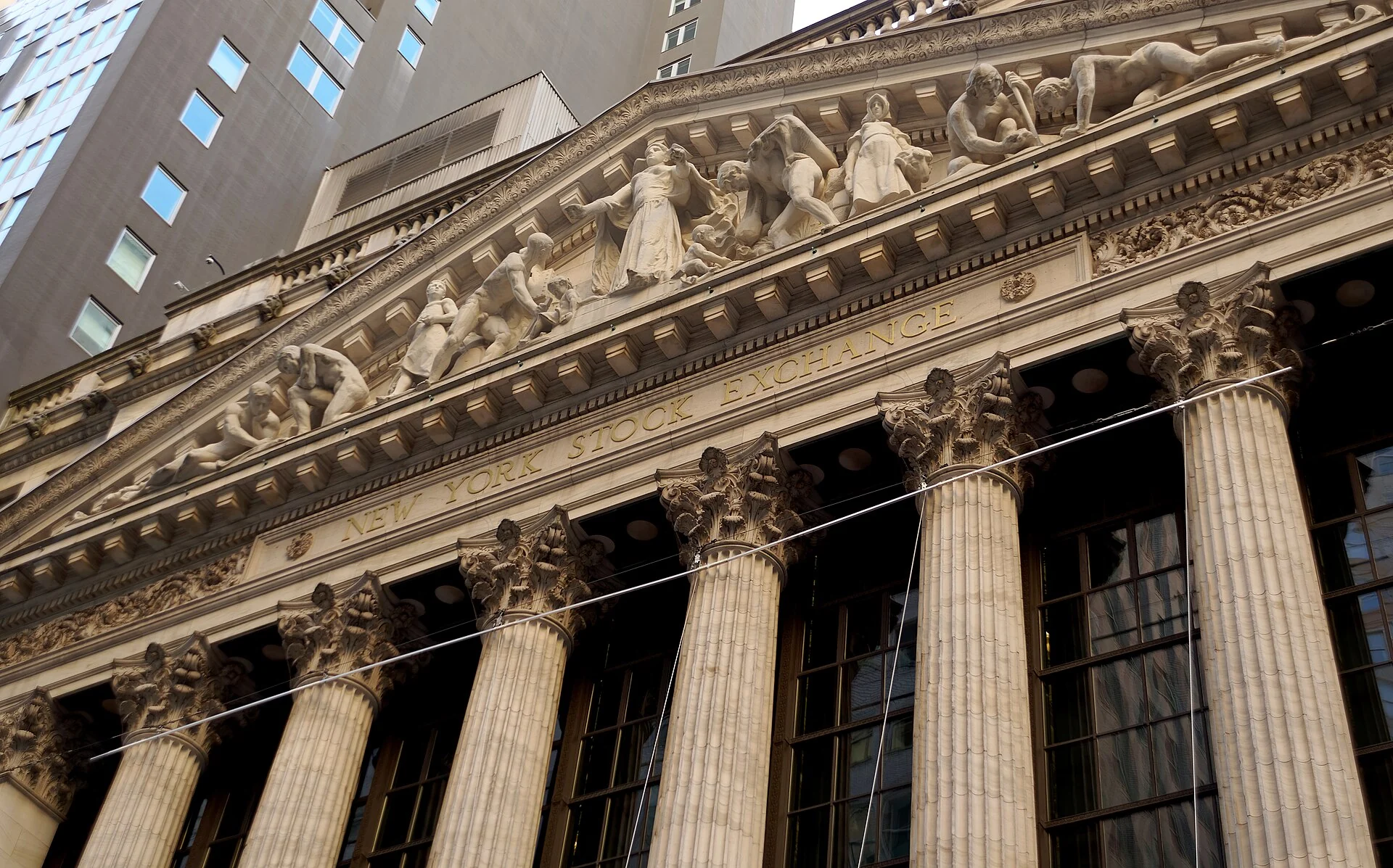
Photo: Jakub Hałun, CC BY 4.0, via Wikimedia Commons.

What types of exchanges are there?
Every exchange runs a market, but not the same kind:
- Stock exchanges list company shares and are where companies raise money when they go public. The New York Stock Exchange, Nasdaq, the London Stock Exchange (part of the London Stock Exchange Group, LSEG) and the Tokyo Stock Exchange are the best known.
- Derivatives exchanges list futures and options, contracts on the price of something else. CME Group in Chicago and Eurex in Europe are among the best known.
- Order-driven and quote-driven markets. On an order-driven exchange, everyone’s orders meet in one order book. In a quote-driven market, dealers quote their own buy and sell prices and you trade with them; most bond and currency trading still works this way.
- Floor and electronic trading. The New York Stock Exchange still keeps a trading floor, but almost every trade today, there and everywhere else, is matched by computers.
- Alternative venues. Shares also trade away from the exchanges, on alternative trading systems and private pools run by banks and brokers. They use the exchange’s prices as a reference.
- Crypto exchanges. Centralised ones such as Binance and Bybit run order books much like a stock exchange. Many now also list contracts that follow shares, such as NVDAUSDT for NVIDIA. Decentralised exchanges replace the order book with software on a blockchain.

Photo: London Stock Exchange, CC BY-SA 3.0, via Wikimedia Commons.

Exchange or broker: what’s the difference?
The exchange runs the market. A broker is your door into it. On a traditional stock exchange you rarely talk to the exchange directly: your order goes to a broker, the broker checks your account and sends the order on, the exchange matches it, and a separate clearing house steps in between buyer and seller to guarantee the trade and settle it, shares going one way and cash the other. In the United States, most stock trades settle one business day after the trade.
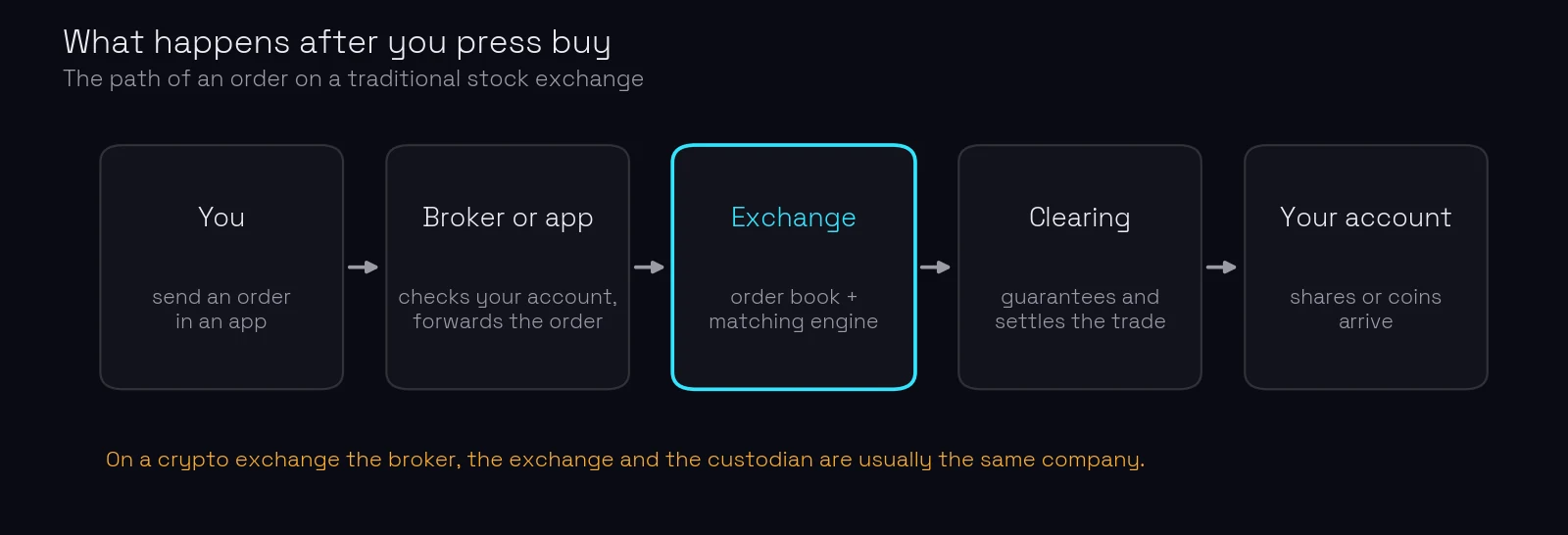
The difference matters because not every broker sends your order to an exchange. Some brokers take the other side of your trade themselves, which is common with contracts for difference (CFDs): then your “market” is the broker’s own price, not the exchange’s order book. A crypto exchange usually plays every role at once: broker, exchange and custodian of your money. That is convenient, since trades settle instantly and the market never closes, but your money is only as safe as that one company. When the FTX exchange collapsed in November 2022, customers could not withdraw their funds.
How do you choose a good broker?
Before you send a broker any money, check these, in this order:
- Regulation. The broker should be licensed by a recognised financial regulator in the country where it serves you. Look the firm up on the regulator’s own register; a logo on the broker’s website proves nothing.
- Where your money sits. Ask whether client money is kept separate from the broker’s own money, and whether an investor protection scheme covers you if the broker fails.
- Real costs. Add up commissions, the spread, overnight financing on leveraged positions, currency conversion and withdrawal fees. A broker with “zero commission” usually earns it back somewhere in that list.
- How orders are filled. Does the broker send your orders to an exchange, or take the other side itself? Can you use stop and limit orders on the instruments you trade?
- The instruments and hours you need. Not every broker offers every market, and some limit trading outside the main session.
- Withdrawals. Start small: deposit, place one trade, and withdraw. A broker that is slow to pay out a small amount will not be faster with a large one.
Different exchanges trade different instruments
Each exchange decides what it lists. NVIDIA shares trade on Nasdaq, gold futures on CME, and bitcoin on crypto exchanges, while a crypto exchange such as Binance may also list a contract that follows the NVIDIA share price. Before you look for a chart or place a trade, check that the venue actually trades the instrument you want, in the form you want: the share itself, a future, or a contract that follows it.
Why does every exchange have its own price?
Because every exchange runs its own order book. The same instrument on two exchanges means two separate queues of buyers and sellers. Traders who buy on the cheaper venue and sell on the dearer one keep the prices close, but never identical.
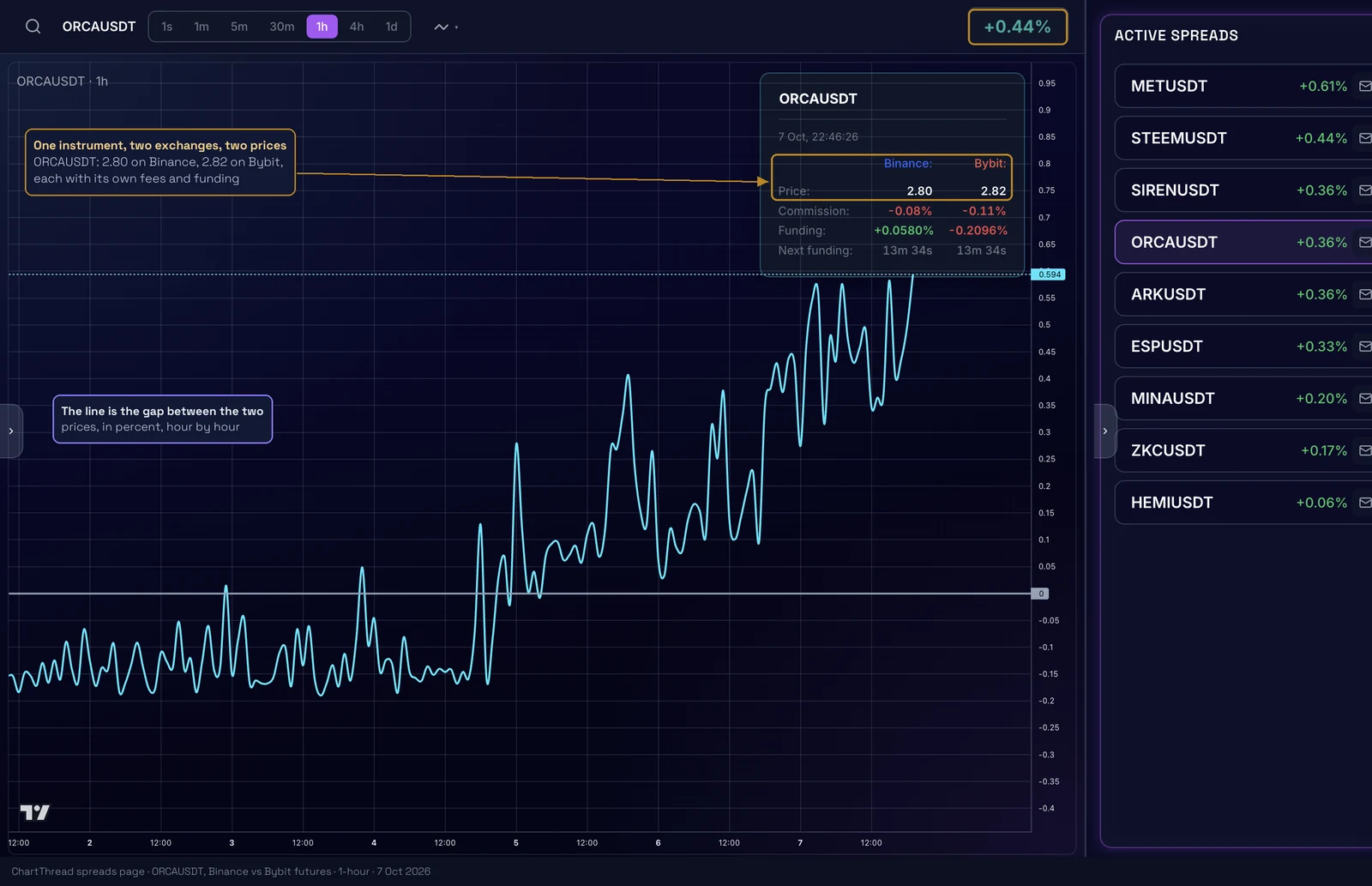
The chart above is ChartThread’s spread monitor. It tracks the same instrument on two exchanges, here ORCAUSDT on Binance and Bybit, and plots the gap between the two prices as a percentage. On large instruments the gap is usually tiny; on smaller ones it can open up for hours. You can see today’s spreads on ChartThread.
A worked example
Can you profit from a gap between exchanges? Take a real one on a large instrument: at 05:00 UTC on 4 October 2026, Binance closed the hour for BTCUSDT at 84,912.01 and Bybit at 84,890.00. Say you buy 1 BTC on Bybit and sell 1 BTC on Binance, paying an example fee of 0.1% on each trade (check your own exchanges’ fee schedules).
The gap was only 0.026% of the price, while the fees were about 0.2%. And these are closing prices at the end of the hour; you could not have caught both of them at the same instant anyway. A gap is worth trading only when it is larger than all the costs together: both fees, the spread inside each order book, and funding on futures. That is exactly what a spread monitor helps you check.
When are the major exchanges open?
Stock exchanges trade in sessions; crypto exchanges trade around the clock. Regular trading hours, in each exchange’s local time:
| Exchange | City | Regular session (local time) |
|---|---|---|
| New York Stock Exchange | New York | 09:30 to 16:00 |
| Nasdaq | New York | 09:30 to 16:00 |
| Toronto Stock Exchange | Toronto | 09:30 to 16:00 |
| London Stock Exchange | London | 08:00 to 16:30 |
| Euronext | Paris, Amsterdam and others | 09:00 to 17:30 |
| Deutsche Börse (Xetra) | Frankfurt | 09:00 to 17:30 |
| SIX Swiss Exchange | Zurich | 09:00 to 17:30 |
| National Stock Exchange of India | Mumbai | 09:15 to 15:30 |
| Shanghai Stock Exchange | Shanghai | 09:30 to 11:30 and 13:00 to 15:00 |
| Hong Kong Exchanges | Hong Kong | 09:30 to 12:00 and 13:00 to 16:00 |
| Tokyo Stock Exchange | Tokyo | 09:00 to 11:30 and 12:30 to 15:30 |
| Australian Securities Exchange | Sydney | 10:00 to 16:00 |
| CME Globex (futures) | Chicago | Sunday 17:00 to Friday 16:00, with a daily one-hour break |
| Crypto exchanges (Binance, Bybit and others) | Online | 24 hours a day, 7 days a week |
Most stock exchanges also run pre-market and after-hours sessions, close on their own public holidays, and change their clocks on different dates, and some are adding longer sessions. Check the exchange’s own calendar before you plan around an open or a close.
What most traders miss.
The chart you look at is one exchange’s history. A wick on Binance can be shorter or longer than the same wick on Bybit. Draw your levels on the venue you actually trade, and do not be surprised when another exchange’s chart disagrees by a few ticks.
Closed markets leave gaps. When a stock exchange is closed, news keeps arriving. The next session can open far from the last close, leaving a jump on the chart where no trade happened. Those gaps and the prices around them often act as levels later, which is why gap levels have their own lesson. Some contracts that follow a share on crypto exchanges keep trading while the stock market is shut, so their charts can show moves the stock exchange never saw.
Your broker is part of your risk. If your broker or exchange fails, a good trade does not help you. Choose venues as carefully as trades.
Common mistakes
- Treating every exchange’s price as “the” price. Each venue has its own order book. Trade and draw levels on the one you use.
- Chasing small gaps between exchanges. After fees, most of them cost money. Do the arithmetic first.
- Ignoring trading hours. A level from yesterday’s close can be jumped over at today’s open. Plan for gaps.
- Choosing a broker by its bonus. Check the regulator’s register, the real costs and a small withdrawal first.
- Keeping everything with one company. Spread funds across venues and keep long-term holdings in your own custody.
Key takeaways
- An exchange runs the order book, matches orders by price then time, publishes trades and sets the rules.
- A broker is your access to the exchange; some brokers trade against you instead of sending your order on.
- Choose a broker by regulation, protection of your money, real costs and how it fills orders.
- Every exchange is its own market and lists its own instruments, so prices differ slightly between venues.
- Stock exchanges have sessions and holidays; crypto exchanges never close.
Lesson test · 10 questions
Check yourself
Can you pass on the first try?
Passing the test completes this lesson. Tests in a module open in order, each after the one before it. A first-try pass scores 100%. Each wrong answer costs 10 points, and every 10 wrong answers lock the test for 30 minutes. Once you pass, your score is final, except that a score of 50 or less can be retaken once.
Tests in a module open in order. Pass the test of the previous lesson first: What is a market? Buyers, sellers and a price. You can still read the questions here.
-
Two buy orders for a stock rest at 237.00. Order A, for 20 shares, arrived first; order B, for 50 shares, arrived a few seconds later. Someone sells 10 shares at market. Which order fills?
-
One buy order waits at 237.01 and arrived late. Another waits at 237.00 and arrived much earlier. A market sell arrives. Which buy order trades first?
-
Example: Bitcoin trades at 90,000 on one exchange and 90,030 on another. You buy 1 BTC on the cheaper one and sell 1 BTC on the dearer one, paying an example fee of 0.1% on each trade. What is the result?
-
Why can the same trading instrument trade at slightly different prices on two exchanges at the same moment?
-
You draw a level from a wick on Bybit’s chart, but you trade on Binance. What should you expect?
-
In the traditional stock market, what does the clearing house do?
-
What is the main extra risk of keeping your money on a crypto exchange, compared with a stock broker and exchange?
-
Your broker offers CFDs on a stock index and takes the other side of every trade itself. What does that mean for you?
-
A broker’s website shows the logo of a well-known financial regulator. What should you do before depositing?
-
It is a Saturday afternoon. Which of these can you trade?
Free account
Take the test and keep your score
- Your answers are checked and every lesson you pass is marked complete.
- Your scores build into your course score, on any device.
- You come straight back to this question after signing up.
Next: which markets exist, from stocks to crypto. To see how far apart two exchanges are right now, open ChartThread’s spreads.
Terms in this lesson
Related lessons
Educational content, not financial advice. Trading carries a risk of loss.