What is liquidation, and how do you never get liquidated?
Liquidation is what happens when a leveraged position loses so much that the money backing it is nearly gone. The exchange’s risk engine closes it by force and keeps most of what is left. The way to never be liquidated is simple: your own stop loss must always sit well before the liquidation price, so you leave the trade on your terms long before the exchange would.
What you’ll learn
- What exactly triggers a liquidation, and why the exchange uses the mark price
- The margin call: the warning before liquidation
- What liquidation costs you: fees, the insurance fund, and penalties at prop firms
- How to estimate your liquidation price for a long or a short
- The one rule that makes liquidation impossible for you
What triggers a liquidation?
When you open a leveraged position, you put up margin: a deposit that covers your losses. With leverage of 25x, $400 of margin controls a $10,000 position. As price moves against you, the loss comes out of that margin.
The exchange also sets a maintenance margin: the smallest amount of margin it requires to keep the position open, usually a small percentage of the position’s value. When your margin minus your unrealised loss falls to that level, the position is liquidated.
The check is made against the mark price, not the last price of the latest trade. The mark price is a fair-value price the exchange calculates, built mainly from an index of spot prices on several venues. Its job is to stop one sharp trade on one exchange from liquidating thousands of people. So a wick on your chart can poke through your liquidation price without liquidating you, and the reverse can happen too.
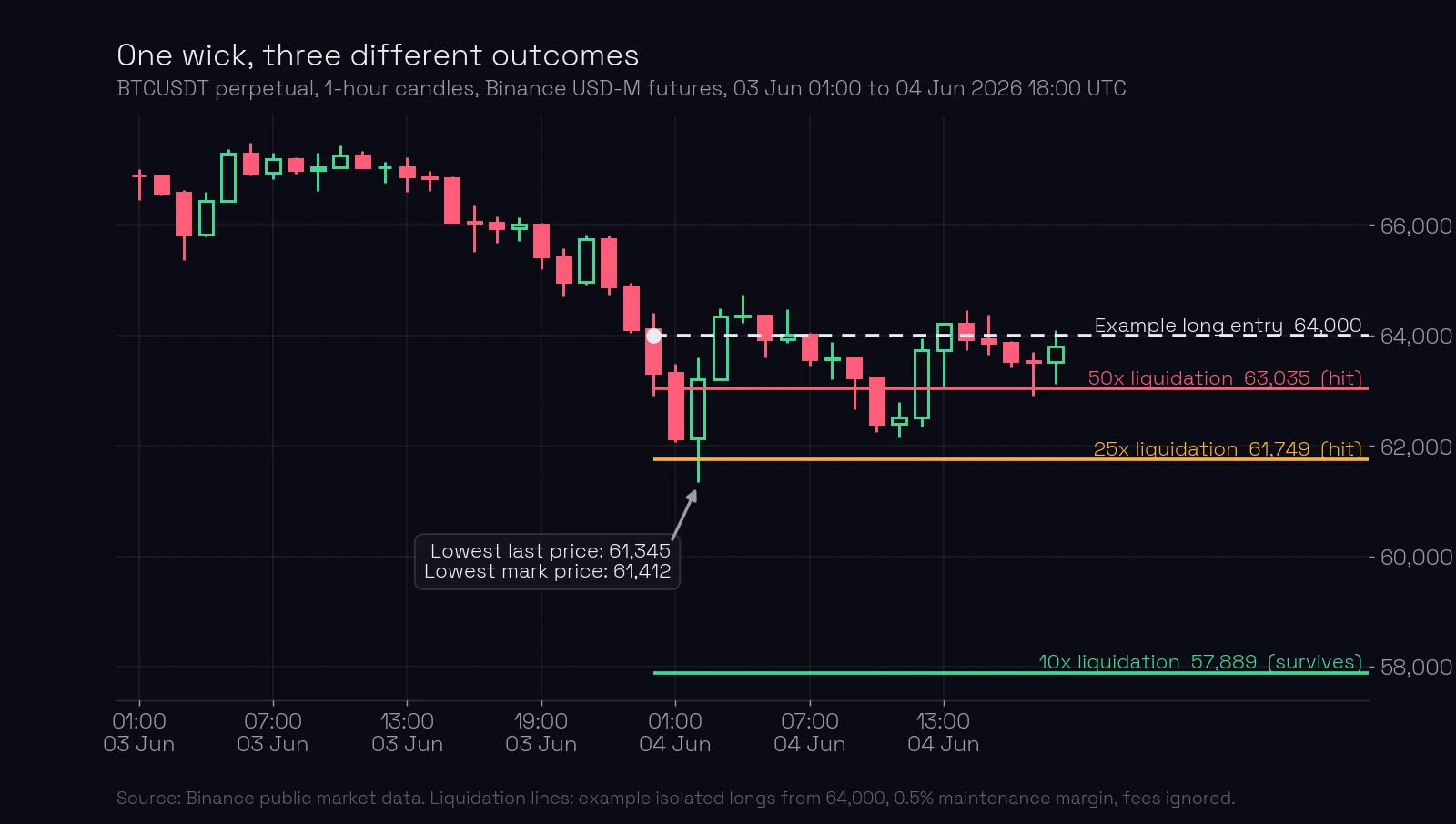
The chart shows a real wick. Three example traders open the same long at 64,000 and differ only in leverage. The 50x trader is liquidated within two hours by an ordinary dip. The 25x trader is liquidated by a single wick that recovered within the hour. The 10x trader never comes close.
Before liquidation: the margin call
Most exchanges warn you before they liquidate. That warning is a margin call.
On Binance futures, risk is measured by the margin ratio: the maintenance margin divided by your margin balance (your margin plus the unrealised profit or loss). At 100% the position is liquidated. Binance recommends keeping the ratio below 80%, and sends margin call and liquidation call notices by email and in-app message.
Three things to know about it:
- It comes late. At an 80% margin ratio, your margin balance is only a little above the maintenance margin: most of the margin you put up is already lost.
- It is not guaranteed. Binance says it will try to send the notices but has no obligation to, and in a fast move it may skip the margin call and send only the liquidation notice.
- It is not an invitation to add money. Adding margin moves liquidation further away by putting more money into a trade that already went wrong. If your stop was placed correctly, it closed the trade long before any margin call.
What liquidation costs you
Three mechanisms sit behind every liquidation.
- Liquidation fee. When the engine takes over, the margin still left in the position is mostly kept by the exchange, as a liquidation or clearance fee and as a contribution to its insurance fund. Binance, for example, charges a liquidation clearance fee, with the rate per contract in its trading rules. The forced close is also a market order, so it pays the taker fee and the slippage.
- Insurance fund. In a fast market, the forced close can fill worse than your bankruptcy price, the price where your margin is exactly zero. The insurance fund, built from those liquidation fees, covers that shortfall so the winning side still gets paid.
- Auto-deleveraging (ADL). If the insurance fund cannot cover a loss, some exchanges reduce the positions of profitable traders on the other side, ranked by profit and leverage.
Penalties beyond the exchange: prop firms
If you trade a funded account from a proprietary trading firm (a prop firm), a liquidation can cost far more than the margin. Most prop firms treat a liquidated position as a breach of their rules: the account can be closed, even if you already passed the firm’s evaluation challenge and were trading its money. Check your firm’s rules before your first trade. And once you pass the challenge, watch the liquidation price on every position as closely as the stop: on a funded account, liquidation is not only a loss, it can end the account.
A chain reaction
There is also a knock-on effect. A liquidation is a forced market order: a liquidated long is sold, a liquidated short is bought. Those orders push price further, which can trigger the next layer of liquidations. Chains like this are one reason sharp wicks happen in leveraged markets.
How do you estimate your liquidation price?
For an isolated position (margin used by this position only, see isolated vs cross margin), with leverage and a maintenance margin rate , a good approximation is:
Where each number comes from:
- Entry: the price you opened the position at. Your exchange shows it as the entry price of the position.
- , the leverage: the leverage you set for the position on the order screen (for example 25x). is your margin as a share of the position: at 25x, , so the margin is 4% of the position.
- , the maintenance margin rate: set by the exchange for each contract and position size. On Binance it is in the leverage and margin tiers of the futures trading rules; on Bybit, in the risk limit of each contract. Small positions sit in the first tier, with the lowest rate; bigger positions move to higher tiers with a higher rate.
These are approximations. Exchanges also count trading fees, use tiered maintenance margin (bigger positions need a higher rate), and in cross margin your whole balance backs the position. Always read the liquidation price your exchange shows on the order screen; use the formula to understand why it sits where it does.
Example: a 25x long and its liquidation price
Say you open an isolated long of $10,000 in BTC at 64,000 with 25x leverage. Take a maintenance margin rate of 0.5% (an example; check your exchange’s tier for your size).
Position size and margin:
Liquidation price, with and :
Check it. At 61,748.74 the loss is , so of margin is left. The maintenance margin there is . The two match, which is exactly the trigger. Note the distance: 25x does not give you 4% of room, only about 3.5%.
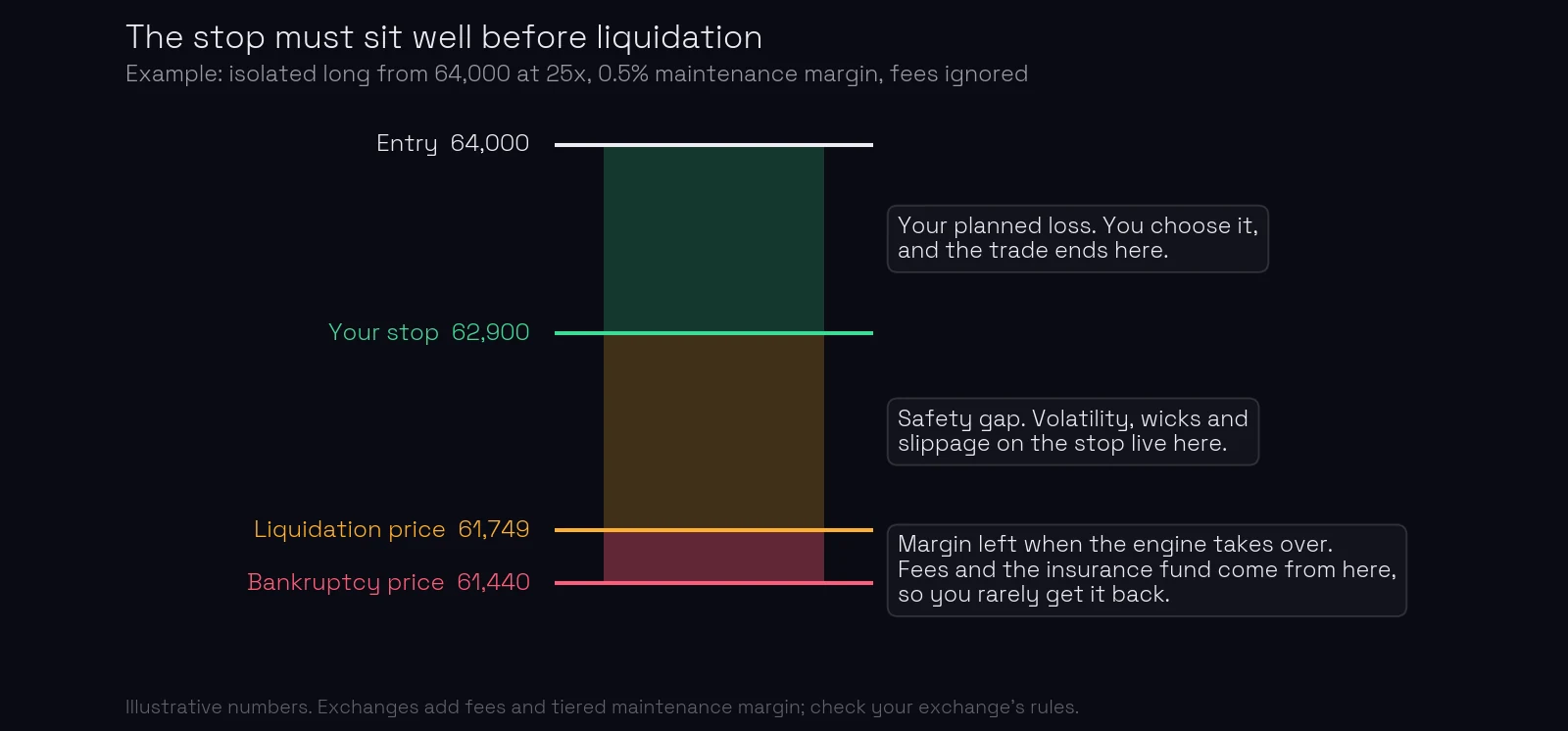
The bankruptcy price, where margin is zero, is . The $48.24 between the two is what you usually lose to the liquidation process.
Now the right way. You decide your stop from the chart at 62,900. Your planned loss is:
The gap between your stop and the liquidation price is dollars, about 1.8% of price. That gap absorbs slippage on the stop. If it were a few dollars, one fast candle could skip your stop and reach liquidation. If your stop were below 61,749, you would need lower leverage.
What most traders miss.
Leverage does not decide your loss; your stop and your size do. With a stop, the $10,000 position above loses $171.88 whether you post $400 at 25x or $2,000 at 5x. Leverage only decides where the liquidation floor is. Choose the stop first, then pick leverage low enough that liquidation sits far beyond it.
Your stop and your liquidation may watch different prices. Liquidation uses the mark price. Many exchanges trigger stop orders on the last price by default and let you switch to mark price in the order settings. In the June wick above, the last price went 67 dollars lower than the mark price. Know which price each of your exits follows.
The room is smaller than 1/L. Maintenance margin eats part of the cushion, and fees eat more. At 50x the example liquidation is only about 1.5% away, and on real exchanges it is a little closer still.
Common mistakes
- Trading without a stop because “liquidation is my stop”. Liquidation is the worst possible stop: it fires late and costs the remaining margin. Place a real stop on every leveraged trade.
- Picking leverage first. Start from the stop on the chart, size the position for the loss you accept, then choose leverage so liquidation sits well past the stop.
- Answering a margin call with more money. The call means the trade already went wrong. Close it or let the stop do its job.
- Ignoring the liquidation price on a funded account. At most prop firms a liquidation breaks the rules, even after you passed the challenge.
- Adding to a losing leveraged position. Averaging down raises your size and drags the liquidation price closer. Adding margin only delays the moment.
Key takeaways
- Liquidation happens when margin falls to the maintenance margin, measured on the mark price.
- What is left at that moment mostly goes to fees and the insurance fund, so you rarely get it back.
- For an isolated long, liquidation is roughly ; for a short, .
- Your stop must always trigger well before liquidation: the liquidation price is never between your entry and your stop. If it is, lower the leverage.
- A margin call comes late and is not guaranteed. On a prop firm’s funded account, a liquidation can close the account.
Lesson test · 10 questions
Check yourself
Can you pass on the first try?
Passing the test completes this lesson. Tests in a module open in order, each after the one before it. A first-try pass scores 100%. Each wrong answer costs 10 points, and every 10 wrong answers lock the test for 30 minutes. Once you pass, your score is final, except that a score of 50 or less can be retaken once.
Tests in a module open in order. Pass the test of the previous lesson first: Isolated vs cross margin: which is safer?. You can still read the questions here.
-
Your chart shows a wick below your liquidation price, yet your position is still open. What is the most likely reason?
-
Example: an isolated long at 50,000 with 20x leverage and a maintenance margin rate of 0.5%. Using the lesson’s formula, where is liquidation roughly?
-
Same example, but a short at 50,000 with 20x and 0.5% maintenance margin. Where is liquidation roughly?
-
A liquidated long closes below its bankruptcy price in a fast market. Who covers the shortfall first?
-
Your 25x long from 64,000 liquidates near 61,749. You want your stop at 61,500, below a level on the chart. What should you do?
-
Why can many liquidations of longs push the price even lower?
-
A trader at 50x expects about 2% of room before liquidation. Why is the real room smaller?
-
Your leveraged long is losing and you buy more to average down. What happens to your liquidation risk?
-
Binance emails you a margin call on a leveraged long. Your margin ratio is near 80%. What does it mean, and what should you do?
-
You passed a prop firm’s challenge and trade its funded account. Why must you watch the liquidation price as closely as your stop?
Free account
Take the test and keep your score
- Your answers are checked and every lesson you pass is marked complete.
- Your scores build into your course score, on any device.
- You come straight back to this question after signing up.
Next: what is the funding rate, and who pays it?, the other cost of holding a perpetual. To plan stops at exact prices, start with ChartThread’s levels.
Terms in this lesson
Related lessons
Educational content, not financial advice. Trading carries a risk of loss.