Classes of instruments: shares, futures, options, ETFs, CFDs and tokens
A trading instrument is the form in which you trade a market. Take gold: you can buy the metal itself, buy units of a fund that holds it, buy a token backed by it, trade a futures contract on its price, buy an option on it, or open a CFD with a broker. All of them follow the gold price, and the chart can look identical. What you own, what you can lose and who is on the other side of your trade are completely different.
What you’ll learn
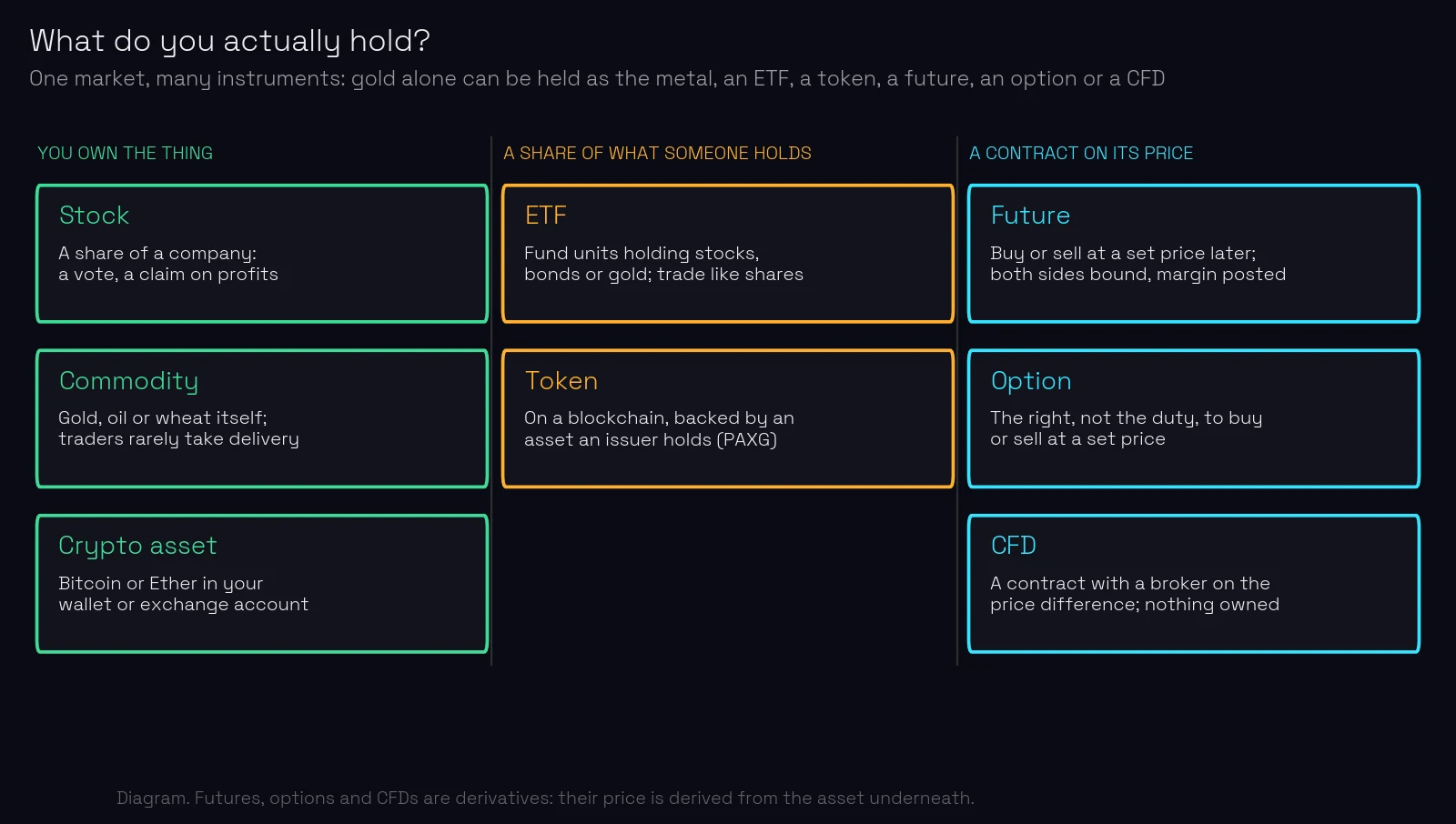
- The three ways to hold a market: own it, own a share of it, or hold a contract on its price
- How futures (deliverable and cash-settled), options, CFDs, ETFs and tokens work
- The difference between an underlying asset and a derivative
- How the same price move pays out differently in each
Owning the asset itself
Stock. A share is a slice of ownership in a company, common or preferred (see which markets exist). It carries a claim on the company’s profits, usually through dividends, and common shares carry a vote.
Commodity. A physical commodity: gold, oil, wheat, copper. Few traders ever hold a barrel or a bar; owning the physical thing means paying for storage and insurance. Most commodity trading uses the instruments below instead.
Crypto asset. Bitcoin or Ether is a crypto asset, a balance recorded on a blockchain. If it sits in your own wallet, you control it directly; on an exchange, the exchange holds it for you and owes it to you. Buying on a spot market means you own the asset itself.
Owning a share of what someone holds for you
ETFs
An exchange-traded fund (ETF) is a fund whose units trade on a stock exchange like a share. One unit can hold hundreds of stocks, a basket of bonds or a vault of gold. SPY tracks the S&P 500 index of large US companies, QQQ the Nasdaq-100, and GLD holds gold bars. You own units of the fund, and the fund owns the assets. Some ETFs are leveraged, aiming for two or three times the daily move of their index; because they reset every day, over weeks they can drift far from two or three times the index’s move, so they are built for short holding periods.
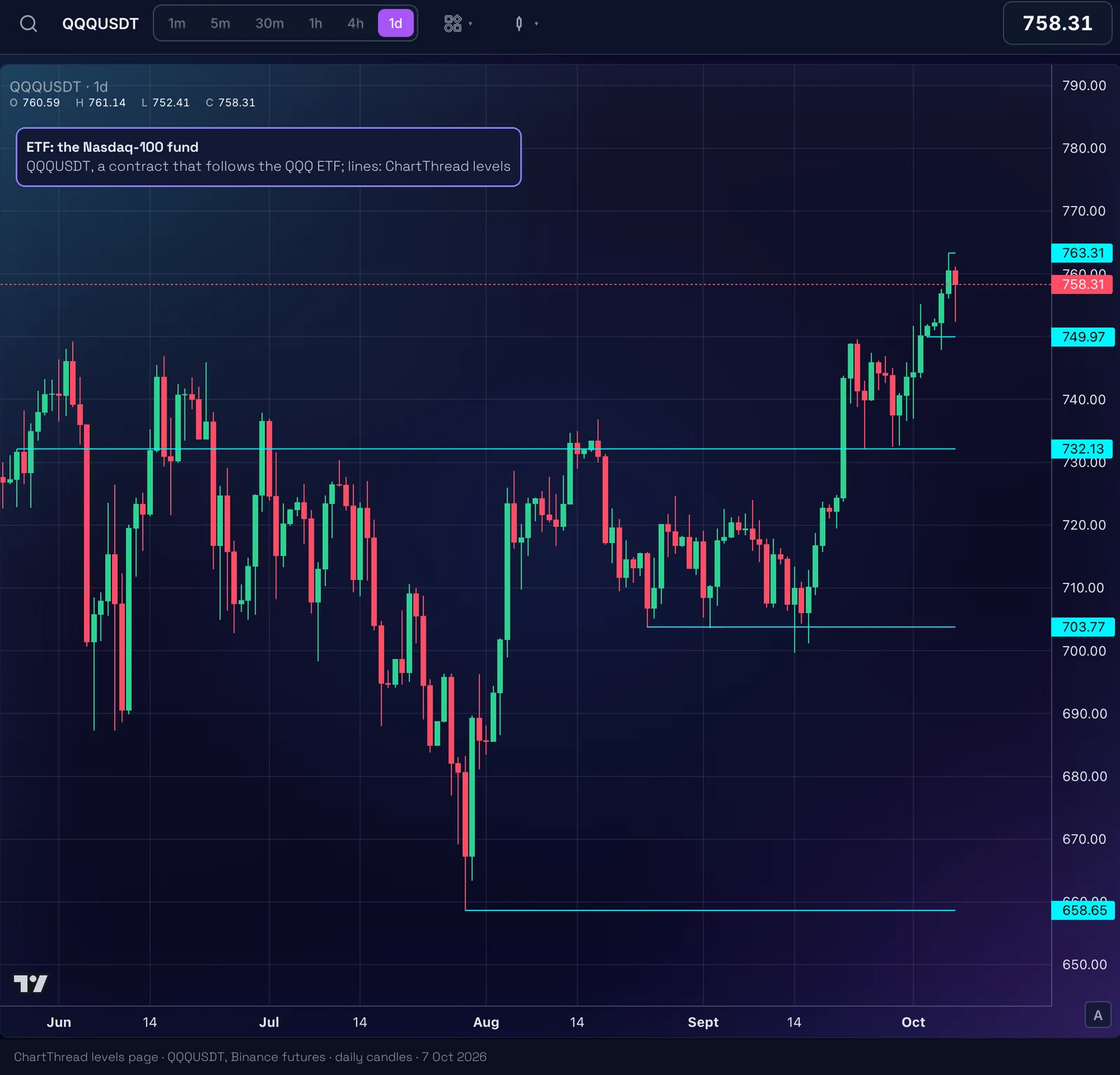
On ChartThread you can open contracts that follow ETFs: SPY, QQQ, the semiconductor fund SMH and the gold miners fund GDX.
Tokens: tokenized assets
A tokenized asset is a token on a blockchain that stands for a real asset held by an issuer. PAX Gold (PAXG), issued by Paxos, and Tether Gold (XAUT), issued by Tether, are each backed by one troy ounce of gold held in a vault. There are also tokens for shares and for funds of US Treasury bills. A token trades around the clock and moves like any crypto asset, but its value rests on the issuer: that the gold or the shares really exist, and that you can redeem the token for them.
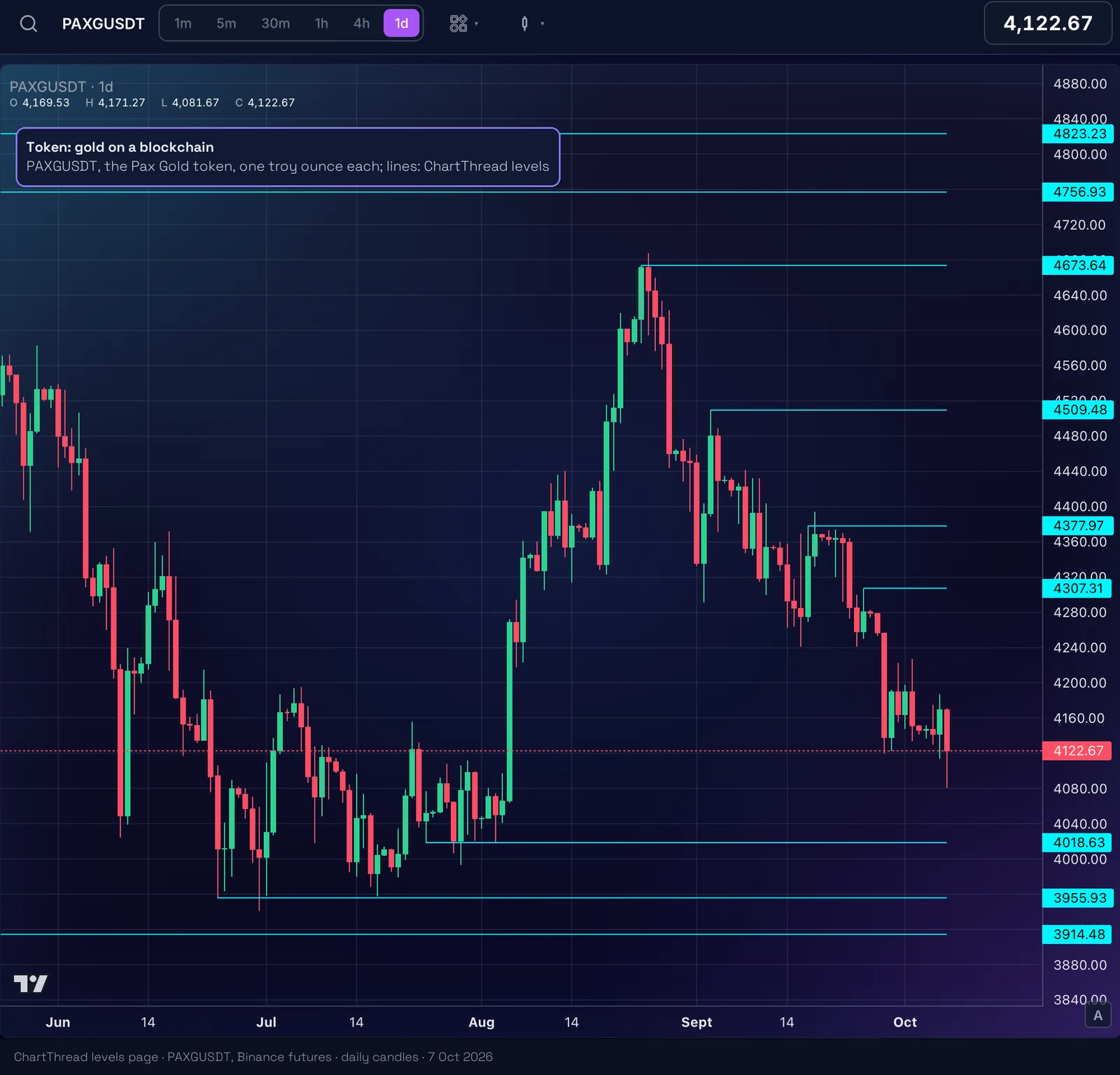
Tokens and the metal do not trade at exactly the same price. On ChartThread at the same moment on 7 October 2026, the PAXG contract was at 4,122.67, the XAUT contract at 4,113.78 and the gold contract XAUUSDT at 4,113.23: one asset, three prices, each set by its own order book. Compare them yourself: PAXG, XAUT and gold.
Holding a contract on the price
These are derivatives: contracts whose value is derived from the price of something else. Nobody needs to own the underlying asset for the contract to exist.
Futures: deliverable and cash-settled
A futures contract is an agreement to buy or sell an asset at a set price on a set date. Both sides are bound. You put down only a deposit, called margin, not the full price. Futures come in two kinds:
- Deliverable futures end with the real thing changing hands: a holder of a crude oil future on CME who keeps it to expiry must take delivery of the oil. Almost every trader closes the position before that day.
- Cash-settled futures end with a payment of the price difference, worked out from an index. Stock index futures such as the E-mini S&P 500 work this way, and so do crypto futures.
Crypto exchanges also list perpetual futures, which never expire and are kept close to the spot price by regular payments between longs and shorts (perpetual futures explained). Spot vs futures compares the two prices in detail.
Options
An option gives its buyer the right, but not the obligation, to buy (a call) or sell (a put) at a set price, called the strike, before or on a set date. The buyer pays the seller a fee, called the premium, for that right. The seller takes on the obligation.
CFDs
A contract for difference (CFD) is an agreement with a broker to exchange the difference in an asset’s price between the moment you open and the moment you close. You never own the share, currency or commodity; you hold a contract with the broker, who is often on the other side of your trade (see exchange or broker). CFDs make it easy to trade almost any market with leverage, which is also why regulators restrict them: they are not offered to retail traders in the United States, and in Europe the leverage on them is capped.
Underlying vs derivative: what is the difference?
The underlying is the real thing: the share, the barrel, the bitcoin. A derivative is a contract between two parties whose value depends on the underlying’s price. A Bitcoin future can be settled entirely in cash: at the end, the side that lost pays the side that won the difference.
That is what makes derivatives flexible. Selling something you do not own is awkward; selling a future is as simple as buying one, so betting on a fall (going short) is easy. And because you deposit margin instead of the full price, you can control a large position with a small amount of money. That is leverage.
Why is so much crypto trading in derivatives?
On crypto exchanges, much of the trading volume is in futures, especially perpetual futures. The reasons follow from the mechanics above: you can go short as easily as long, you need only margin, you never have to move assets between wallets, and the contract trades around the clock like the asset itself. Large traders also use futures to hedge the crypto they hold.
A worked example
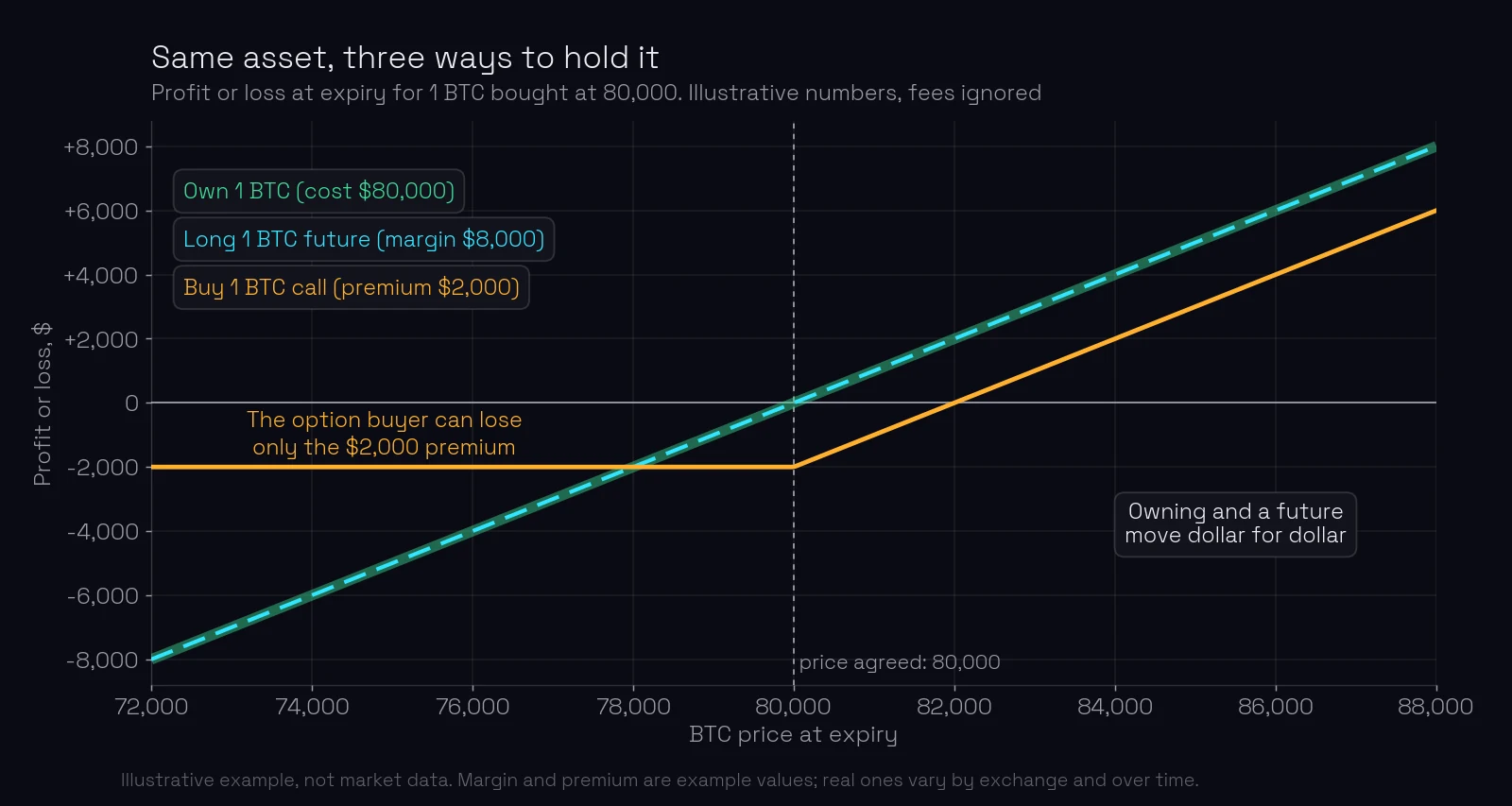
Bitcoin is at 80,000. Compare three ways to bet on a rise (illustrative numbers, fees ignored): buying 1 BTC on spot, buying one future for 1 BTC with an example margin of 8,000, and buying a call option on 1 BTC with a strike of 80,000 for a premium of 2,000. Real margins and premiums vary by exchange and over time.
Price rises to 84,000.
Spot and the future both gain the same amount:
But the money put down differs:
The call pays the price gain above the strike, minus the premium:
That is 100% of the 2,000 premium.
Price falls to 76,000. Spot loses 4,000 (5% of 80,000). The future also loses 4,000, which is 50% of the 8,000 margin. The call is simply not used, and the buyer loses the 2,000 premium, 100% of what was paid, but nothing more.
What most traders miss.
A future is not riskier per unit than owning the asset. In the example, both gain or lose exactly 4,000. What changes is how much money you put down, so it becomes easy to hold far more than you can afford. The risk sits in the size of the position, not in the instrument.
Every derivative has someone on the other side of your exact contract. For every long future there is a short one, so the total of open longs always equals the total of open shorts. The number of open contracts, called open interest, tells you how much is at stake, not which side is winning.
A fund or a token is only as good as whoever holds the asset. An ETF depends on its fund manager and custodian, a token on its issuer. Read who holds the asset, how you can redeem it, and what happens if they fail.
Common mistakes
- Thinking you own Bitcoin because you hold a Bitcoin future. You hold a contract on its price. You cannot withdraw it to a wallet.
- Judging an instrument by its percentage returns. Fifty percent on margin is the same 4,000 as five percent on the full price. Compare the money at risk.
- Buying options because “the loss is limited”. It is, to the premium, and the premium is lost entirely whenever price does not move far enough in time.
- Holding a leveraged ETF for months. It resets daily; over time it can lose value even if the index ends where it started.
- Ignoring when a contract ends. Futures and options have expiry dates; an asset you own does not.
Key takeaways
- An instrument is the form in which you trade a market; one market, such as gold, can be traded through many instruments.
- You can own the asset, own a share of what someone holds for you (ETF, token), or hold a contract on its price (future, option, CFD).
- Futures are deliverable or cash-settled; options give a right, not a duty; CFDs are a contract with your broker.
- Derivatives make shorting and leverage simple, which is why so much crypto trading happens in them.
- Leverage changes how much you put down, not how much each unit moves.
Lesson test · 9 questions
Check yourself
Can you pass on the first try?
Passing the test completes this lesson. Tests in a module open in order, each after the one before it. A first-try pass scores 100%. Each wrong answer costs 10 points, and every 10 wrong answers lock the test for 30 minutes. Once you pass, your score is final, except that a score of 50 or less can be retaken once.
Tests in a module open in order. Pass the test of the previous lesson first: Which markets exist? Stocks, bonds, commodities, forex and crypto. You can still read the questions here.
-
Example: Bitcoin is at 60,000. You buy one future on 1 BTC with a margin of 6,000. Price rises to 63,000. What do you make, before fees?
-
In the same example, price falls from 60,000 to 57,000 instead. How do owning 1 BTC on spot and the long future compare?
-
Example: you buy a call option on 1 BTC with a strike of 60,000 for a premium of 1,500. At expiry Bitcoin is at 64,000. What is your profit?
-
Same call option (strike 60,000, premium 1,500), but at expiry Bitcoin is at 55,000. What do you lose?
-
You hold a long Bitcoin future. A friend asks you to send them 0.01 BTC from it. What is the problem?
-
Why is betting on a fall easier with a future than with the asset itself?
-
You trade a contract for difference (CFD) on gold with a retail broker. Who is on the other side of your trade?
-
You hold a crude oil future on CME and keep it to the expiry date. What happens, and what happens with a cash-settled index future?
-
You hold PAXG, a token backed by gold. What does its value depend on that a gold bar in your own safe does not?
Free account
Take the test and keep your score
- Your answers are checked and every lesson you pass is marked complete.
- Your scores build into your course score, on any device.
- You come straight back to this question after signing up.
Next: spot vs futures, and what the gap between their prices tells you. To see the levels where a price is likely to react, whichever instrument you trade, open ChartThread’s levels.
Terms in this lesson
Related lessons
Educational content, not financial advice. Trading carries a risk of loss.