Maker vs taker fees: what trading really costs
Every trade has two sides. The maker placed an order that waited in the book. The taker came later and traded against it straight away. Makers are the liquidity that everyone else trades against, and exchanges reward them for it: on Binance and Bybit futures, a taker pays about two and a half times what a maker pays. This lesson shows who is who, what the two biggest exchanges really charge, and how to work out what a trade costs you.
What you’ll learn
- How to tell whether your order is a maker or a taker
- Why makers are the liquidity, and why they pay less
- What Binance and Bybit charge, on spot and on futures
- How to work out the real cost of a trade
Who is a maker, and who is a taker?
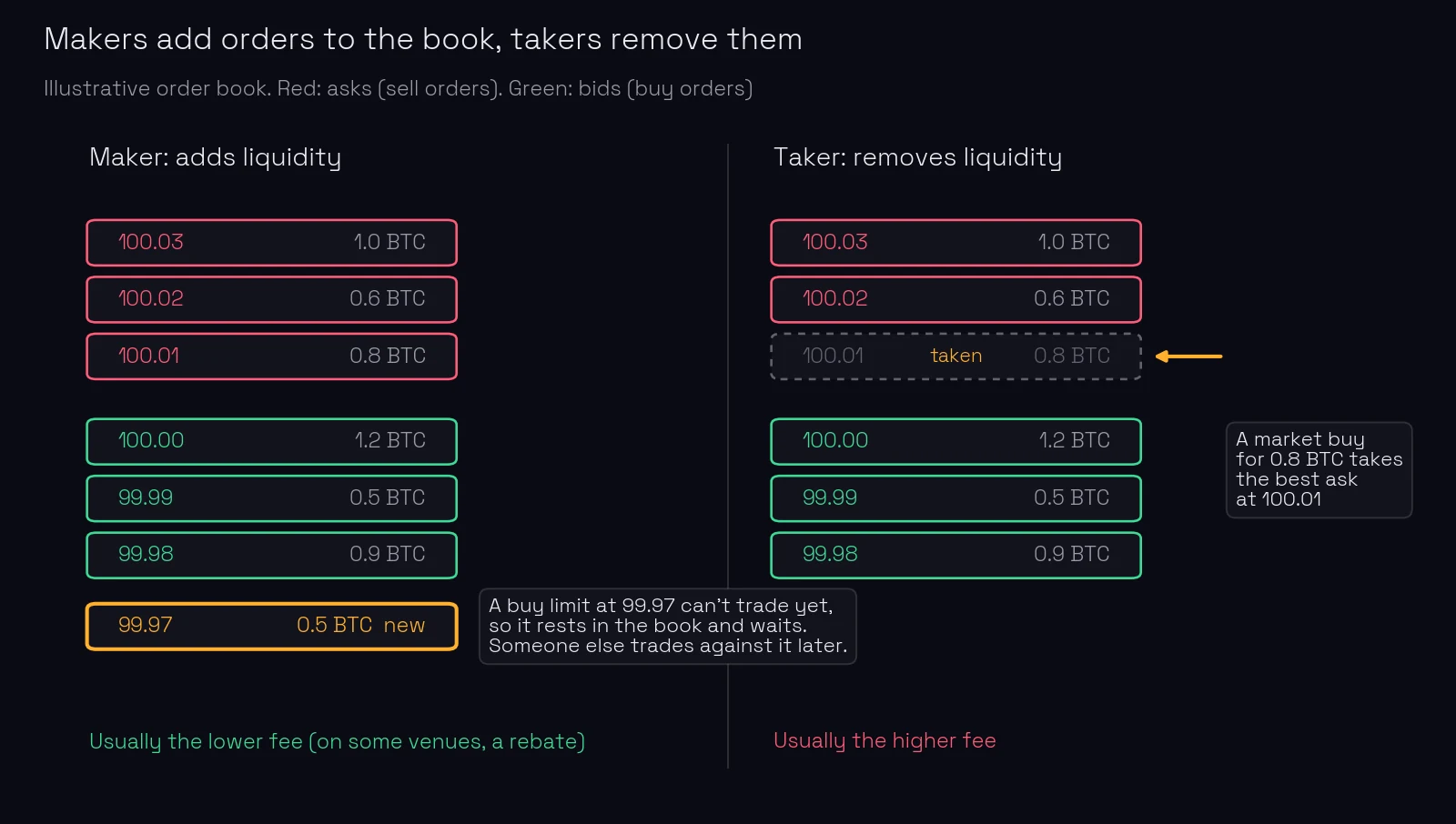
The order book is made of orders that wait. Your role depends on what your order does:
- It waits in the book: you are a maker. You added an order someone else can trade against.
- It trades at once: you are a taker. You took an order that was already waiting.
A market order is always a taker. A limit order is a maker only if it waits first. A buy limit placed above the best ask fills at once, so it is a taker too. If you want to be sure, use a post-only order: it cancels itself instead of filling as a taker.
Makers are the liquidity
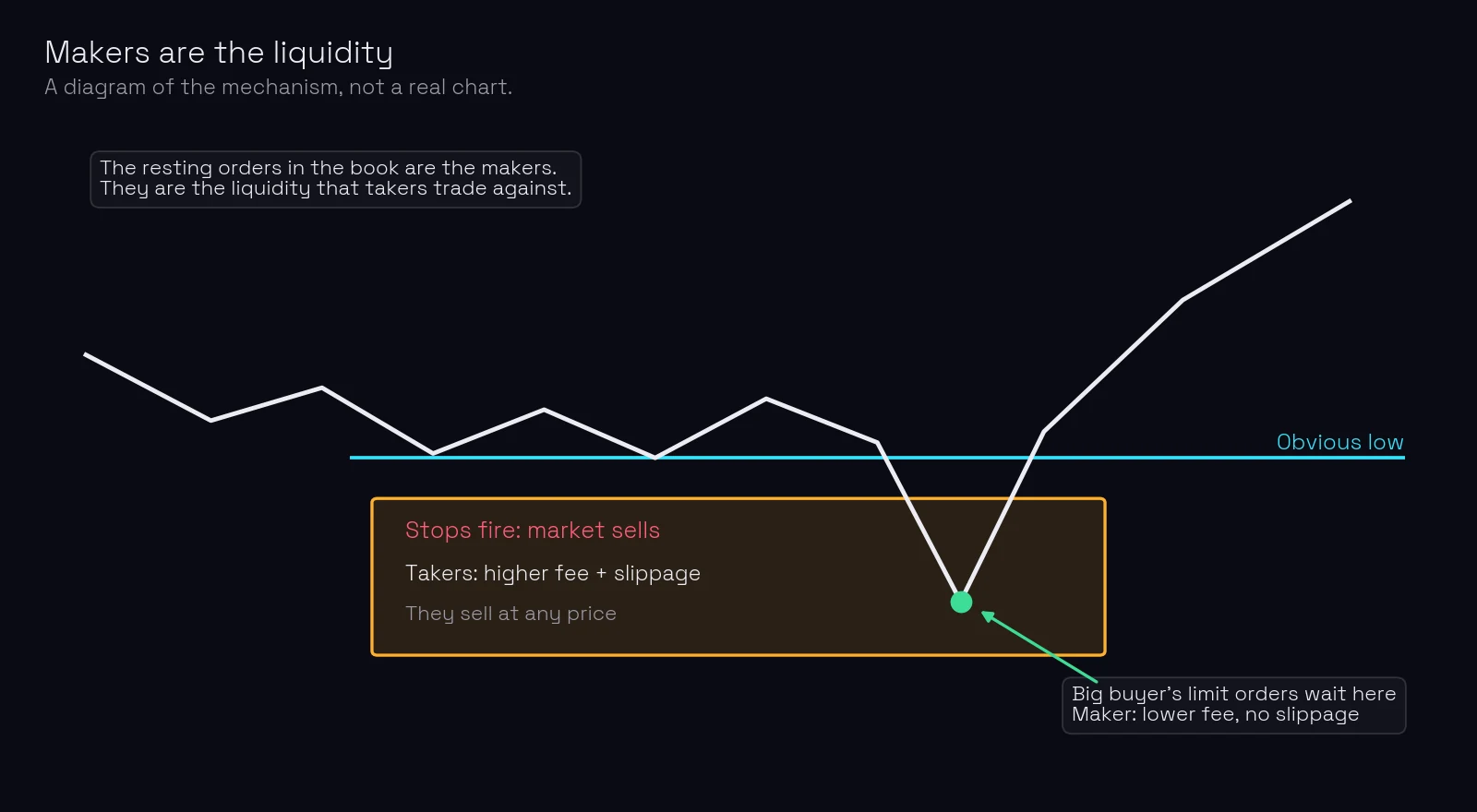
In what is liquidity you counted how much was waiting near the price: $25 million on Bitcoin, $964 on Twist Bioscience. Every dollar of that is a maker’s order. Makers build the liquidity; takers use it up.
That is why exchanges charge makers less. A deep book makes trading cheap and smooth, which brings more traders, who pay more fees. So the exchange pays for depth by giving makers a lower rate.
Now look at the honeypot from the last lesson again. Under an obvious low, stop losses fire as market sells. Those sellers are takers: they pay the higher fee and the slippage, and they sell at any price. The big buyer waiting there with limit orders is the maker: a better price, a lower fee and no slippage. The same trade, two very different bills.
What Binance and Bybit charge
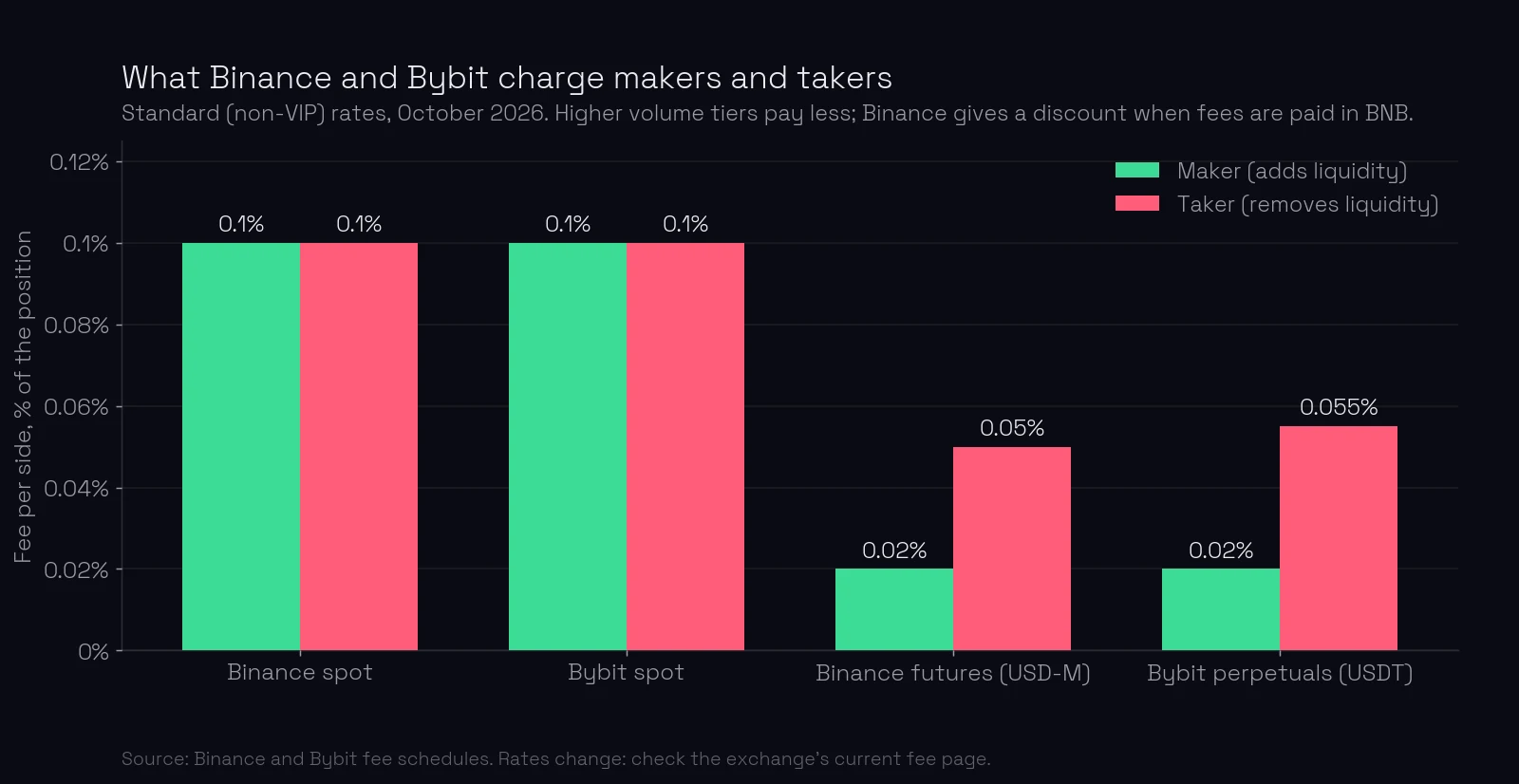
Standard (non-VIP) rates in October 2026, charged on each side of a trade:
| Maker | Taker | |
|---|---|---|
| Binance spot | 0.10% | 0.10% |
| Bybit spot | 0.10% | 0.10% |
| Binance futures (USD-M) | 0.02% | 0.05% |
| Bybit perpetuals (USDT) | 0.02% | 0.055% |
Three things to notice:
- On spot, at the standard tier, makers and takers pay the same. The difference shows up on futures.
- On futures, a taker pays 2.5 times more on Binance and 2.75 times more on Bybit.
- You can pay less. Both exchanges lower the rates as your 30-day trading volume grows (VIP tiers), and Binance gives a discount when you pay fees in its BNB token (25% on spot, 10% on futures).
Fee schedules change. Before you do the maths for real money, check the exchange’s current fee page.
Fees are charged on the whole position
The fee is a percentage of the full value of your position (size times price), not of the money you put in. With leverage, the position is bigger than your money, so the fee is bigger too.
A 0.05% taker fee on a $10,000 position is $5, whether you opened it with $10,000 or with $1,000 at 10x. Against your own money:
At 10x, a 0.05% fee is 0.5% of your money. At 50x it is 2.5%, for one side of one trade.
Example: a $1,000 trade at 10x on Binance futures
You put in $1,000 at 10x leverage, so the position is worth:
As a taker both ways (market order in, market order out, 0.05% each side):
As a maker both ways (limit orders that wait, 0.02% each side):
On Bybit, the taker version costs $11 (0.055% twice). Market orders also cross the spread, and a large one can slip. Twenty such taker round trips in a month cost about $200 in fees alone, a fifth of the $1,000, before any trade wins or loses.
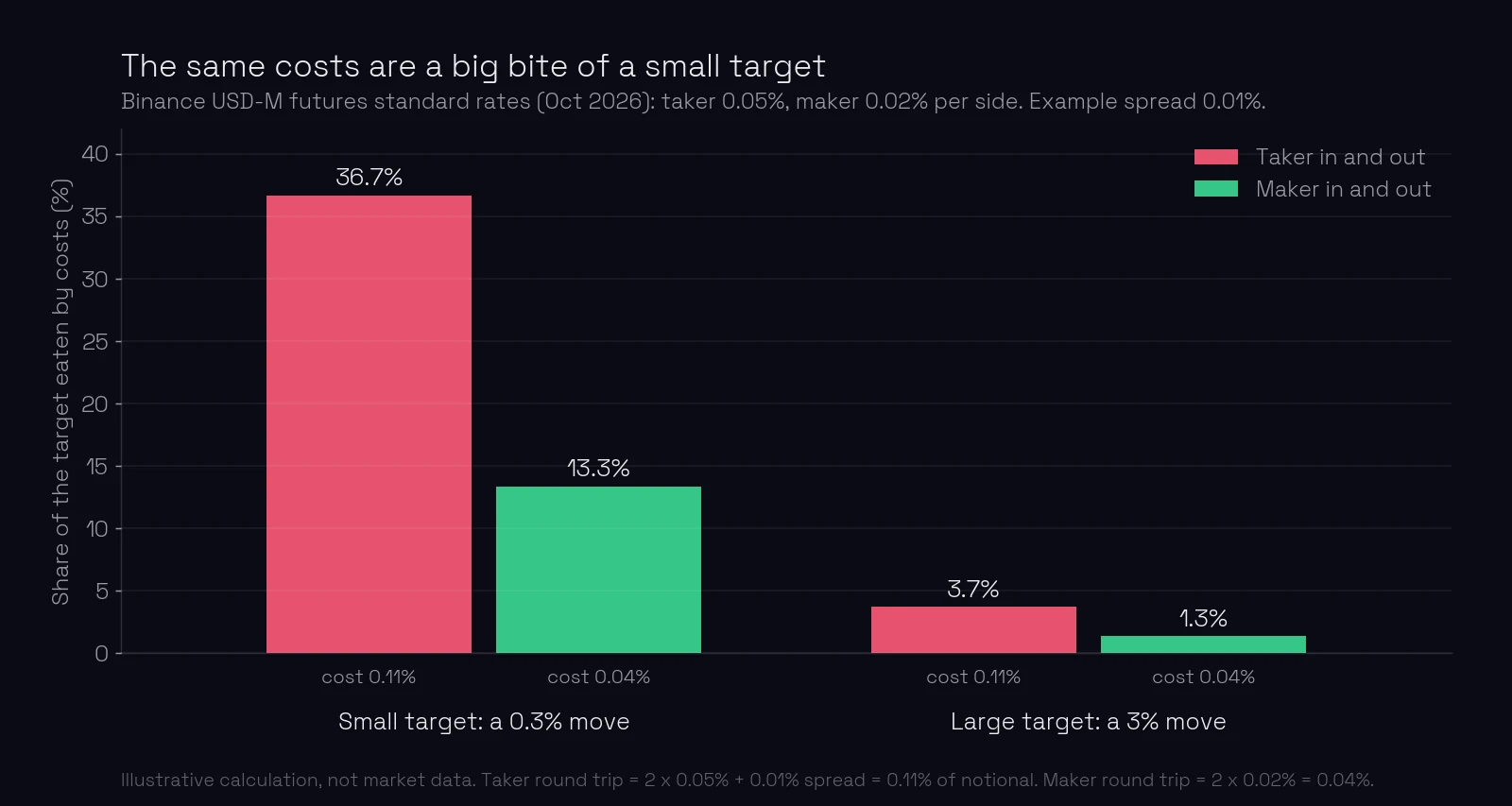
How much that hurts depends on your target. A 0.11% round trip is a third of a 0.3% target, and almost nothing on a 3% target. Small targets need maker orders, or they do not pay.
What most traders miss. Your losing trades are usually taker trades. A stop loss becomes a market order when it triggers, so even if you enter with limit orders as a maker, most exits that go wrong pay the taker fee and the slippage. Your winning exits can be makers: a take-profit placed as a limit order waits in the book. And on futures there is one more cost while you hold: funding, paid or received at regular intervals.
Common mistakes
- Working out the fee on your money instead of the position. Multiply by the full position size, or you underestimate the fee by the leverage.
- Counting only the entry. Every round trip pays two fees.
- Thinking every limit order is a maker. One that crosses the spread fills at once as a taker. Use post-only when the fee matters.
- Chasing tiny targets with market orders. If costs eat a third of the target, you need a very high win rate just to break even.
Key takeaways
- A maker’s order waits in the book; a taker trades against it at once.
- Makers are the liquidity. On futures they pay less: 0.02% against 0.05% (Binance) and 0.055% (Bybit) at the standard tier.
- On spot, at the standard tier, both pay 0.10% on Binance and Bybit.
- Fees are charged on the whole position, so leverage multiplies them against your money.
- Stops exit as takers; limit entries and take-profits can be makers.
Lesson test · 10 questions
Check yourself
Can you pass on the first try?
Passing the test completes this lesson. Tests in a module open in order, each after the one before it. A first-try pass scores 100%. Each wrong answer costs 10 points, and every 10 wrong answers lock the test for 30 minutes. Once you pass, your score is final, except that a score of 50 or less can be retaken once.
Tests in a module open in order. Pass the test of the previous lesson first: What is liquidity? Why some markets move smoothly. You can still read the questions here.
-
You place a buy limit below the current price and it waits in the order book. What are you?
-
The best ask is 100.01. You place a buy limit at 100.05. What happens?
-
Why do exchanges charge makers less on futures?
-
On Binance USD-M futures at the standard tier, what do a maker and a taker pay per side?
-
On Binance and Bybit spot, at the standard tier, how do maker and taker fees compare?
-
You open a 10,000 dollar position with 1,000 dollars at 10x, using a market order on Binance futures. What is the entry fee?
-
Same 10,000 dollar position, in and out with market orders on Binance futures. What do the fees for the round trip cost?
-
Stops fire under an obvious low and a big buyer fills on them with limit orders. Who pays the higher fee?
-
You enter every trade with a limit order. Why do most of your losing trades still pay the taker fee?
-
A round trip costs 0.11% of the position. Why does that hurt a 0.3% target much more than a 3% target?
Free account
Take the test and keep your score
- Your answers are checked and every lesson you pass is marked complete.
- Your scores build into your course score, on any device.
- You come straight back to this question after signing up.
Next: what is leverage? (And why it isn’t the risk). To see which instruments have deep books and where their levels are, open ChartThread’s levels page.
Terms in this lesson
Related lessons
Educational content, not financial advice. Trading carries a risk of loss.