Isolated vs cross margin: which is safer?
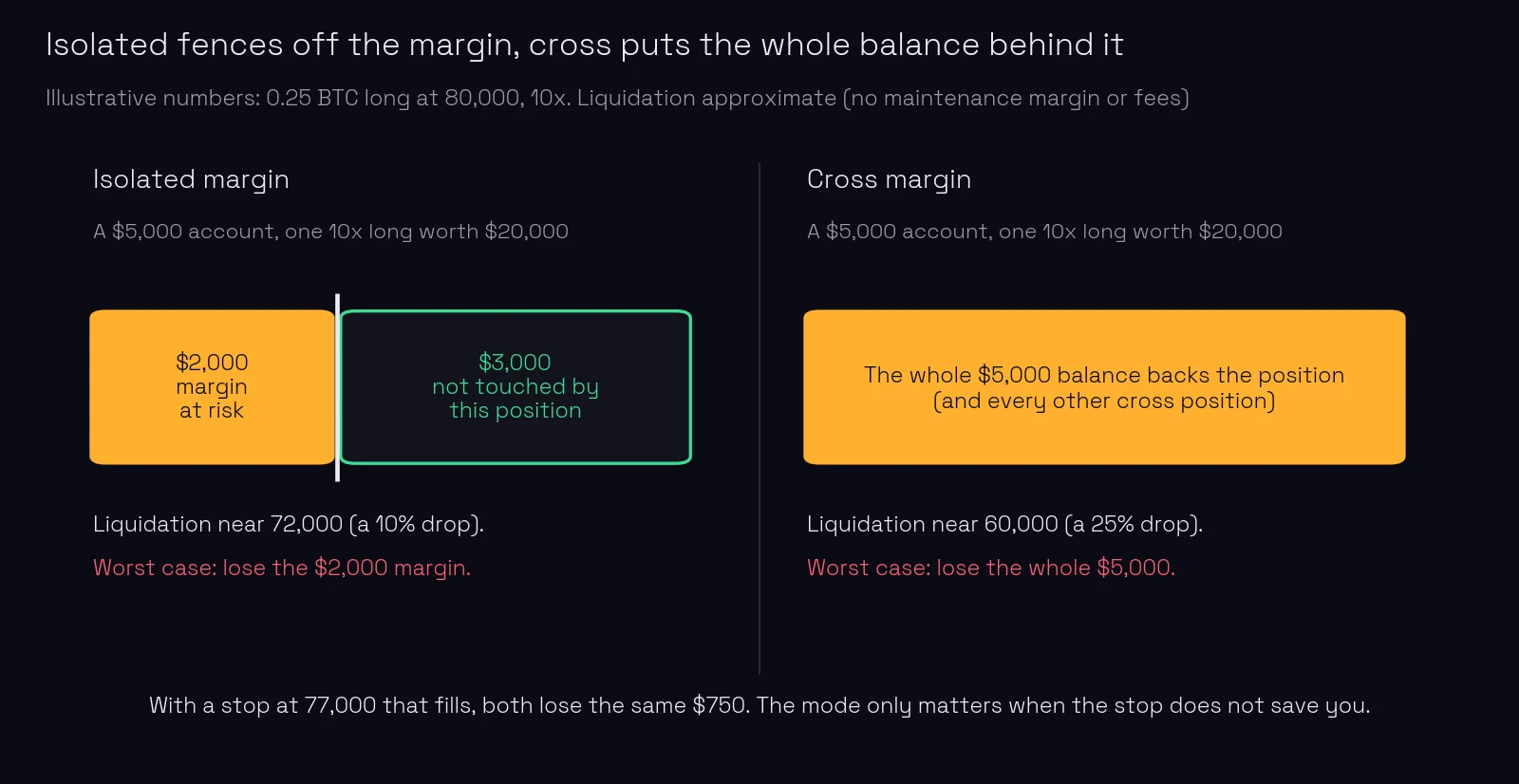
Isolated and cross are two ways a futures exchange decides how much of your money stands behind a position. With isolated margin, each position has its own fixed pot of margin, and if it is liquidated, that pot is all you lose. With cross margin, your whole balance backs all your open positions together: liquidation sits much further away, but when it comes, it can take the entire account. This lesson shows both on a real Bitcoin chart, and why isolated is the better default.
What you’ll learn
- What isolated and cross margin do with your balance
- Why isolated margin protects your deposit when the stop fails
- How margin lets you hold more positions with less capital
- The few cases where cross margin helps
- How ChartThread’s calculator does all these calculations for you
What is isolated margin?
When you open a position in isolated mode, the exchange takes the margin for that position (the notional divided by the leverage) and fences it off. Losses on the position eat only that margin. When it falls to the maintenance margin, the position is liquidated, and the rest of your balance is untouched.
The price of that fence is a closer liquidation price: with only the margin behind the trade, a smaller move uses it up. That is why the leverage must keep liquidation beyond your stop, never between the entry and the stop.
Isolated margin protects your deposit
Your stop is the first layer of protection. Isolated margin is the second, for the day the stop does not work:
- The market opens with a big gap. Price jumps straight past your stop. The exchange liquidates the position, and the loss stops at the margin.
- The move is too fast and the stop does not fill. Same result: the margin is the most you lose.
- The gap goes even beyond the liquidation price. On Binance and Bybit, the loss past the margin is covered by the exchange’s insurance fund, not by the rest of your balance.
So on isolated margin you always know your worst case before you enter: it is the margin. With leverage set so liquidation sits just beyond the stop, that margin is close to the loss you planned anyway (the second safeguard).
Margin lets you do more with less capital
Margin is also what makes futures useful for a small account. You do not pay the full price of a position, only its margin, so the same capital can:
- hold several positions at once, in different instruments, which spreads your risk (diversification);
- open a position you could not pay in full, such as a large lot of an expensive share.
With $3,000 you can hold $10,000 positions in NVIDIA, Tesla and SpaceX at 20x, with $500 of isolated margin each and $1,500 to spare. What you can afford to lose on each is still decided by its stop and the risk formula, not by how much the margin lets you open.
What is cross margin?
In cross mode there is no fence. Your whole available balance is one shared pot behind every cross position. As a position loses, the exchange keeps drawing on the rest of your balance to keep it open. Liquidation happens only when the account as a whole can no longer cover the losses.
That moves liquidation much further away. It also means one bad position can drain money that you thought of as belonging to other trades, or not trading at all. On many exchanges, profits on one cross position also support the others, so positions affect each other in both directions.
Exact rules differ by venue: how margin is shared, how the maintenance margin is calculated, whether spot balances count. Check your exchange’s documentation before relying on either mode.
Example: one long, three endings on the Bitcoin chart
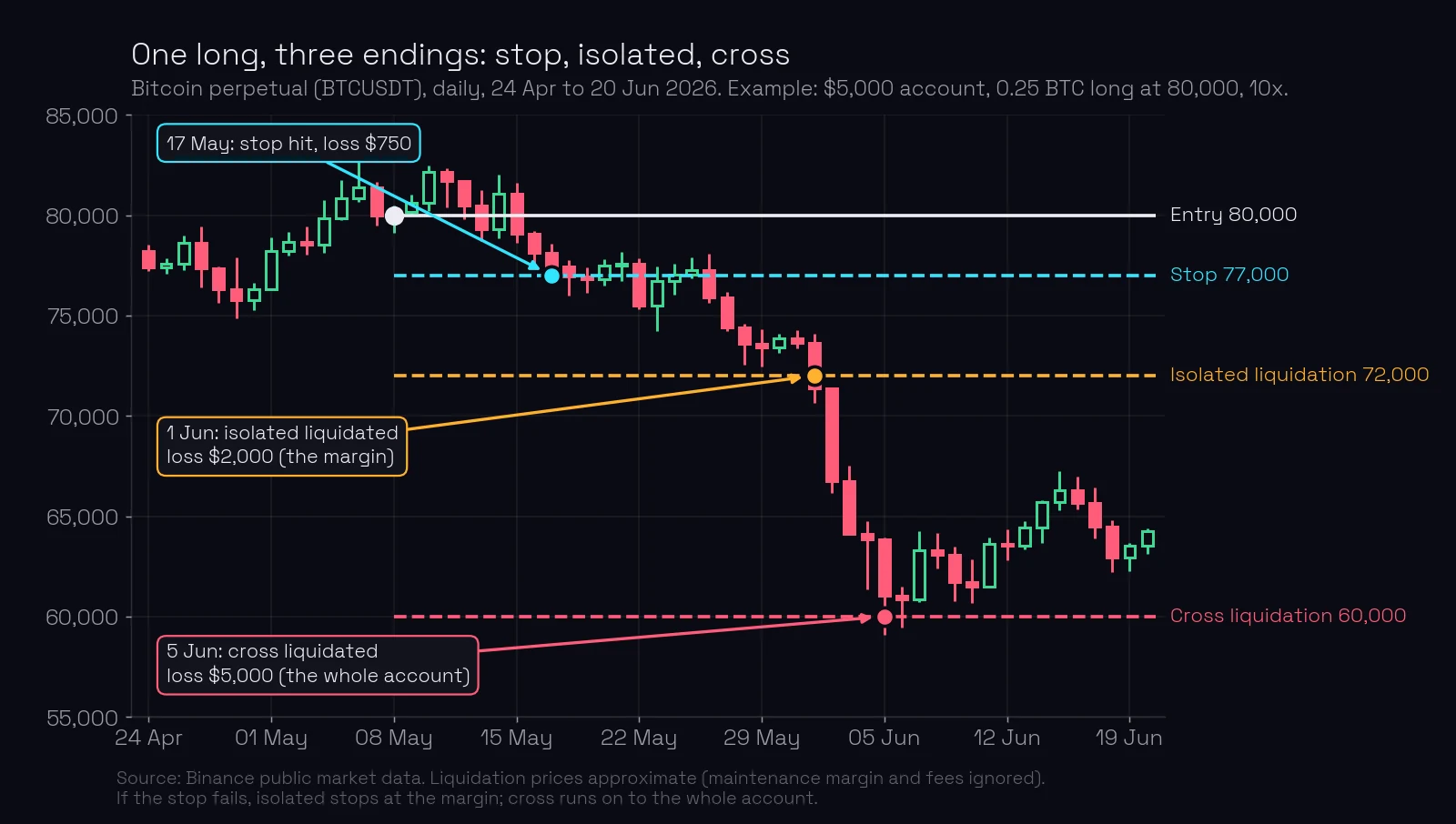
You have a $5,000 futures account and go long 0.25 BTC at 80,000 with 10x leverage on 8 May 2026, with a stop at 77,000. The liquidation prices ignore the maintenance margin and fees, which put the real ones a little closer.
Each $1 the price falls costs you $0.25. So:
Here is what Bitcoin actually did:
- 17 May: the stop is hit. In both modes the loss is . The mode changed nothing.
- 1 June: isolated is liquidated, if the stop had failed or was never placed. Loss: $2,000, the margin. The other $3,000 is safe.
- 5 June: cross is liquidated. It survived four more days of falling prices, only to lose all $5,000.
Cross did not save the trade. It only delayed the end, and made it two and a half times more expensive.
What most traders miss. A far-away liquidation is not protection; it is a bigger possible loss. Cross margin feels safer because the liquidation price is distant, but the distance exists only because more of your money stands behind the trade. And in cross mode your positions are not separate trades: two “small” positions in instruments that move together (correlated trades coming soon) can liquidate together and empty the account.
Let ChartThread do the maths
You do not have to calculate any of this by hand. The trade setup calculator on ChartThread’s levels page does every calculation in this lesson for you. Draw the entry, the stop and the take profit as lines on the chart, spot or futures, and enter how much you are willing to lose. It returns the position size, the margin and the maximum recommended leverage, and draws the liquidation line on the chart, just beyond your stop.
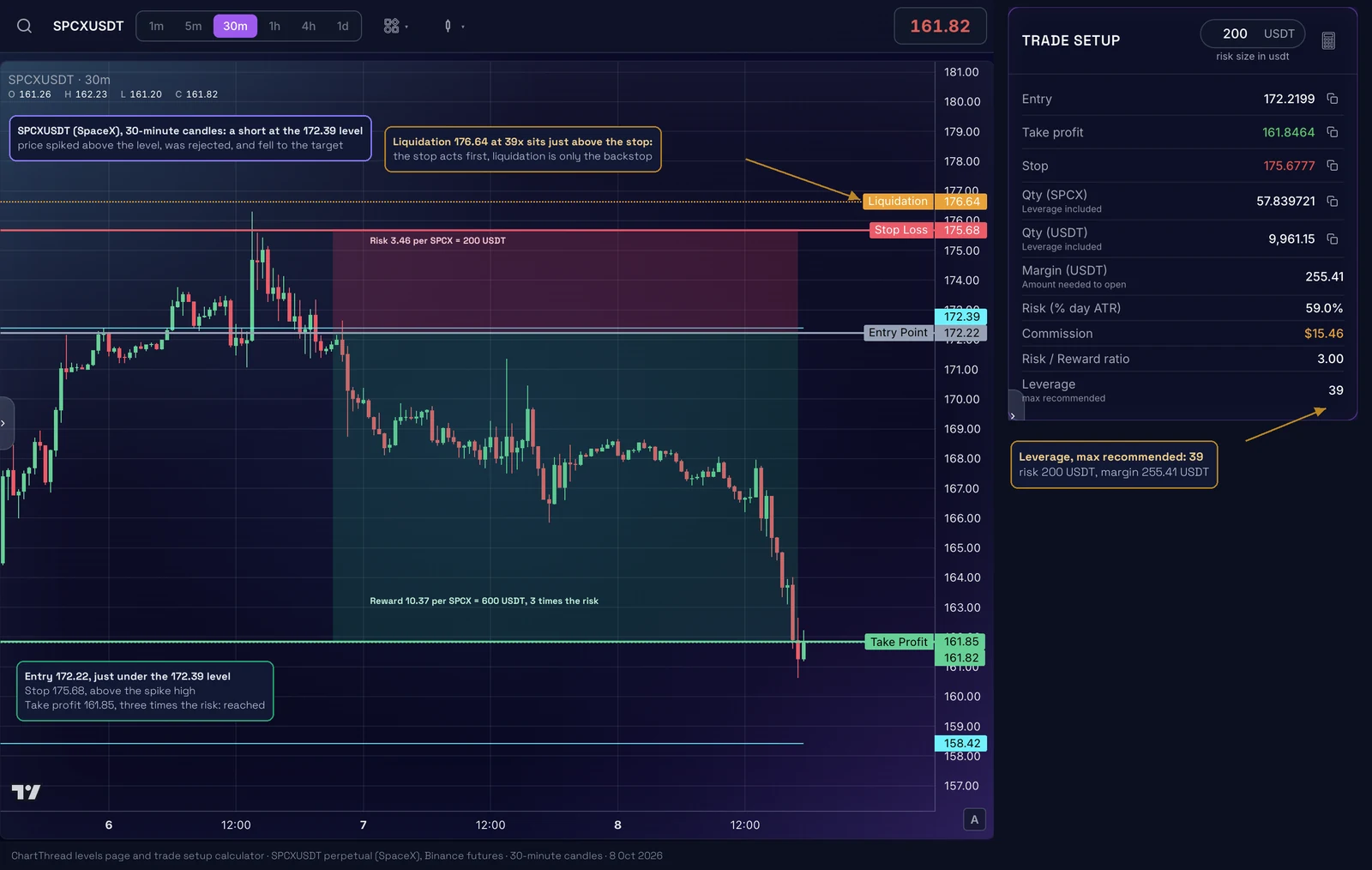
Drag a line and every number updates at once, so you can play with a setup before you trade it: move the stop and watch the size and the margin change, raise the risk and see where the liquidation line goes. It is the fastest way to get a feel for how margin, leverage and liquidation work together.
When does cross margin make sense?
The author’s view: there are very few cases where cross margin helps. It belongs to a few specific strategies. For everything else, it is better to trade with a calculated risk per trade and several layers of protection: the stop, then isolated margin with liquidation just beyond the stop, then the rest of the deposit kept out of the trade.
The cases where cross can help:
- A short that must survive the price doubling. On isolated margin, even a 1x short is liquidated when the price roughly doubles from the entry: the whole margin is gone. Say you short 0.1 BTC at 60,000 ($6,000) with $6,000 of isolated margin: liquidation sits near 120,000. On cross margin with $12,000 in the account, the whole balance stands behind the short and liquidation moves to near 180,000, so the position survives a doubling.
- A hedge: two positions that offset each other, where the profit on one side supports the margin of the other.
Common mistakes
- Using cross margin with no stop. Nothing then stands between a bad trade and the whole balance.
- Choosing cross to “avoid liquidation”. It moves liquidation further away by putting more money at risk. Fix the size or the stop instead.
- Forgetting that cross ties all positions together. Add up your total exposure, not each trade alone.
- Thinking isolated limits the planned loss. Your stop sets the planned loss. Isolated limits the loss when the stop fails.
Key takeaways
- Isolated: each position has its own margin, and only that margin can be lost, even in a gap or when the stop fails.
- Cross: the whole balance backs every position; liquidation is further away but can take everything.
- With a stop that fills, both modes lose the same amount.
- Margin lets a small account hold several positions or an expensive lot; size each one from its stop.
- Cross helps in few cases, such as a short that must survive a doubling or a hedge. By default, use isolated with a calculated risk per trade.
Lesson test · 9 questions
Check yourself
Can you pass on the first try?
Passing the test completes this lesson. Tests in a module open in order, each after the one before it. A first-try pass scores 100%. Each wrong answer costs 10 points, and every 10 wrong answers lock the test for 30 minutes. Once you pass, your score is final, except that a score of 50 or less can be retaken once.
Tests in a module open in order. Pass the test of the previous lesson first: What is leverage? (And why it isn't the risk). You can still read the questions here.
-
Example: a 4,000 USDT account goes long 0.2 BTC at 50,000 with 10x, isolated. Ignoring maintenance margin and fees, where is liquidation roughly?
-
Same trade, but in cross mode with the whole 4,000 USDT backing it. Where is liquidation roughly?
-
Same trade, with a stop at 48,000 that fills. How much do you lose in each mode?
-
In a crash, the same position gaps far past the stop without closing. What is the most you can lose in each mode?
-
You hold one isolated position and one cross position. The isolated one is liquidated. What happens to the cross position?
-
A trader switches to cross margin “to avoid liquidation”. What has actually changed?
-
A trader holds two small cross positions in instruments that tend to move together. Why is that riskier than it looks?
-
You short 0.1 BTC at 60,000 with 6,000 USDT of isolated margin (1x). Roughly where is liquidation, and what does cross margin with 12,000 USDT in the account change?
-
With 3,000 USDT you hold 10,000 USDT positions in three different shares at 20x, isolated. What does margin make possible here, and what still decides the risk?
Free account
Take the test and keep your score
- Your answers are checked and every lesson you pass is marked complete.
- Your scores build into your course score, on any device.
- You come straight back to this question after signing up.
Next: what is liquidation, and how do you never get liquidated?. To set stops at prices the market respects, start from ChartThread’s levels page.
Terms in this lesson
Related lessons
Educational content, not financial advice. Trading carries a risk of loss.