Spot vs futures: what's the difference?
On a spot market you pay the full price and the asset becomes yours: buy Apple shares and you own them. On a futures market you trade a contract on the price instead: you put down a deposit called margin, you can profit from a fall as easily as from a rise, and a dated contract ends on a set day. The two prices stay very close, and the small gap between them, the basis, tells you something about the market.
What you’ll learn
- What you hold on spot and what you hold with a future
- How margin, lots, leverage, shorting and expiry work in futures
- How much leverage to use: between liquidation and a stop that fails
- What the basis is, and why it shrinks to zero at expiry
What is spot trading?
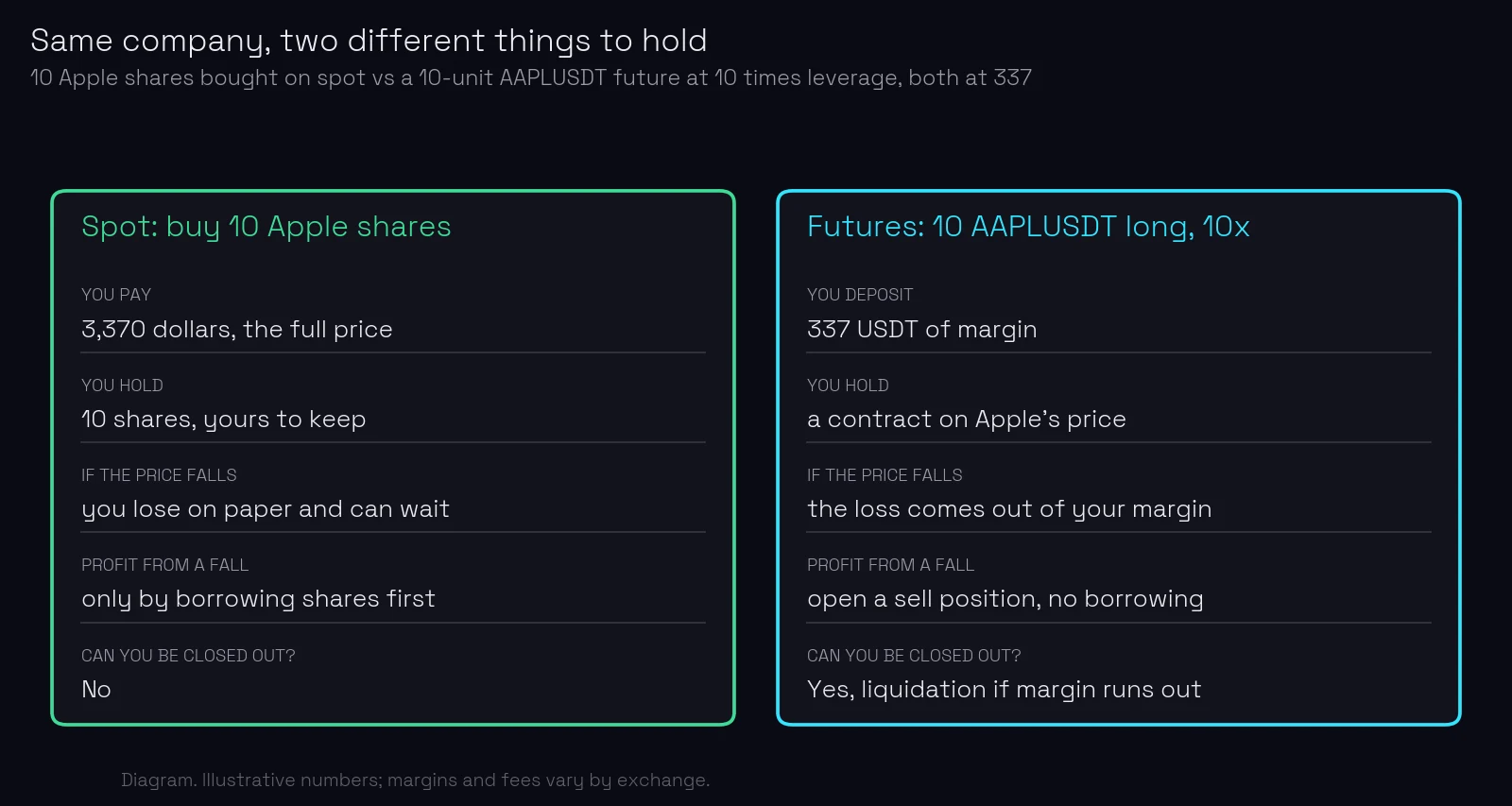
Spot means “on the spot”: you pay now and receive the asset now. Buy 10 Apple shares at 337 dollars through a broker and you pay 3,370 dollars and own 10 shares. You can hold them as long as you like, collect the dividends, or sell them. If the price halves, you still have 10 shares. Nothing forces you out.
The limits are just as simple. You can only buy what you can pay for, and you can only sell what you have. Profiting from a fall on spot means borrowing shares first, which is more complicated (see how to short sell).
What is a futures contract?
A future is an agreement to buy or sell an asset at a set price later. Many futures, including those on crypto exchanges, never deliver the asset: profits and losses are paid in cash as the price moves. On Binance, for example, AAPLUSDT is a futures contract that follows Apple’s share price and settles in USDT. Five things change compared with spot.
Margin. You deposit only part of the position’s value. The exchange holds it as a guarantee that you can cover losses.
Lots. You trade the contract in the sizes the exchange allows, explained in the next section.
Leverage. Because you deposit less, you can control a position bigger than your deposit. 10 AAPLUSDT at 337 is a position worth 3,370 USDT; at 10 times leverage, the margin needed is 337.
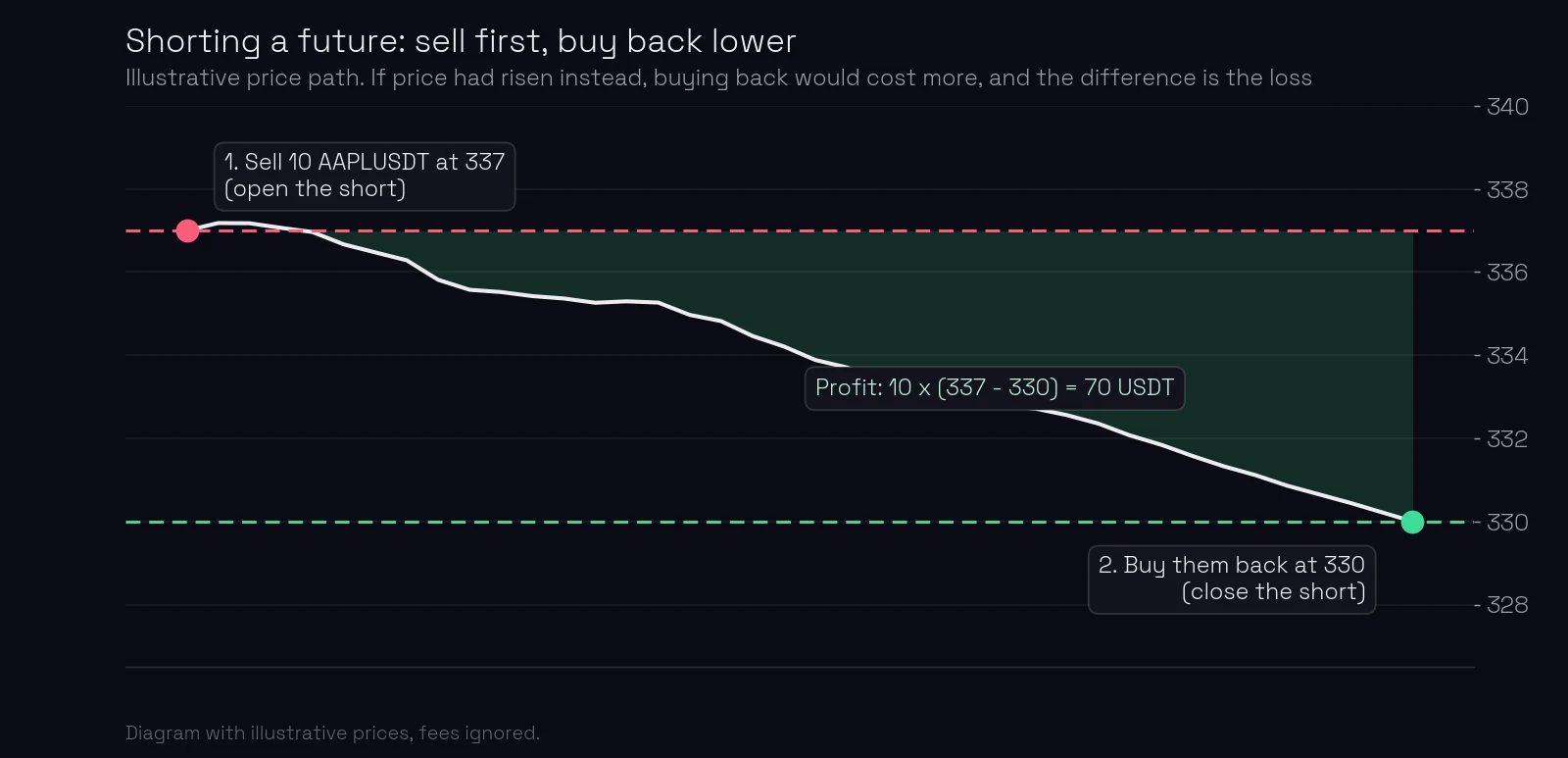
Shorting. To profit from a fall on spot you would have to borrow shares, sell them and buy them back later. With a future you skip the borrowing: you simply open a sell position, which means you agree to sell at today’s price. If the price then falls, buying the contract back costs less than you sold it for, and the difference is your profit. Sell 10 AAPLUSDT at 337, buy them back at 330, and you gain 10 × 7 = 70 USDT. If the price rises instead, you lose in exactly the same way. This is called going short.
Expiry. A dated future ends on a set day and is settled against the spot price. The perpetual future, the most traded kind on crypto exchanges, has no expiry at all; it is kept close to spot by regular payments between longs and shorts, explained in what a perpetual future is.
One more difference: if your losses eat through your margin, the exchange closes the position for you. That is liquidation, and it never happens on spot.
Lots: how much is one unit?
Every instrument trades in fixed quantities, called lots or contract sizes, and your position must be a whole number of them.
- Shares traditionally traded in round lots of 100 shares; a smaller order was an odd lot. Most brokers today let you buy any number of shares, and many offer fractions of a share.
- Exchange futures have a fixed size set by the exchange. One CME gold contract is 100 troy ounces, one CME crude oil contract is 1,000 barrels, and one E-mini S&P 500 contract is 50 dollars times the index. With gold near 4,100 dollars, one gold contract is worth about 410,000 dollars, and every 1 dollar move in gold is 100 dollars of profit or loss. Micro contracts, one tenth of the size, exist for smaller accounts.
- Forex trades in lots of 100,000 units of the base currency (standard), 10,000 (mini) or 1,000 (micro).
- Crypto exchange futures set a minimum and a step instead. On Binance, AAPLUSDT trades in steps of 0.01, with a minimum order value of 5 USDT.
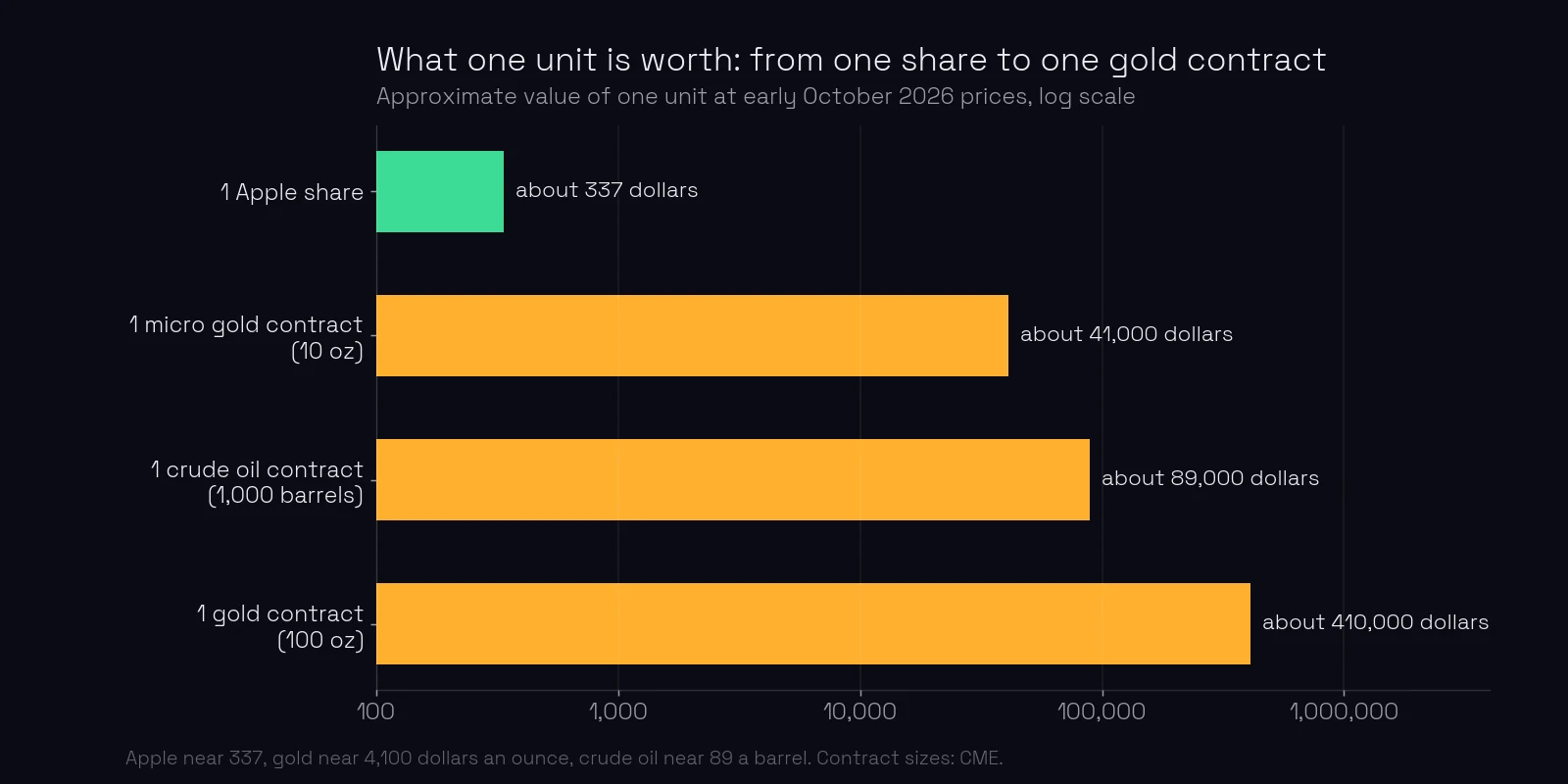
This matters because you size a position from the money you are willing to lose, then round it to the lot. If one lot already risks more than your plan allows, the answer is a smaller contract or no trade, never a wider stop.
How much leverage should you use?
Leverage does not change how much you lose when your stop is hit; your position size does. What leverage changes is where liquidation sits, and that matters in two directions.
- Too much leverage puts liquidation closer to your entry than your stop. Price reaches liquidation first, the exchange closes the position and keeps your margin, and your stop never gets a chance to act.
- Too little leverage locks far more money as margin than your trade needs. Normally that does not matter, because your stop closes the trade. But when a stop does not fill at its price, in a gap, a sudden squeeze or a fast move through thin order books, the loss keeps running until something closes the position. With isolated margin, the most you can lose is the margin; with a large margin, that is a lot of money.
The balance is leverage set so that liquidation sits just beyond your stop: the stop acts first, and if it fails, liquidation closes the position with a loss close to the one you planned. ChartThread’s levels page has a trade setup calculator that works this out. You draw the entry, stop and take profit as lines on the chart, spot or futures, enter how much you are willing to lose, and it returns the position size, the margin and the maximum recommended leverage, drawing the liquidation line where that leverage would put it.
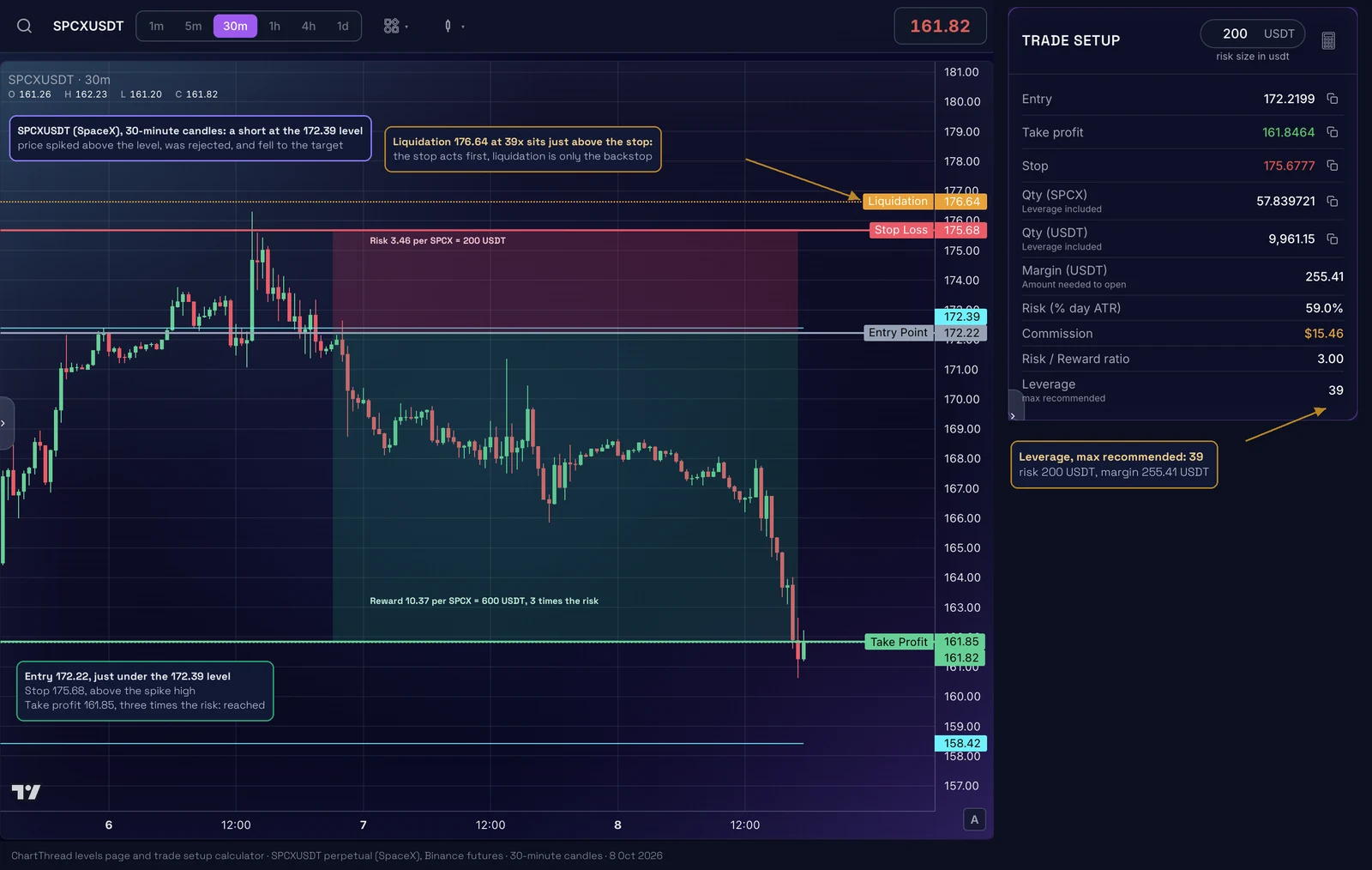
The example is a short that played out. Price rallied into the 172.39 level, spiked above it and was pushed back down: sellers were defending the level. The entry sits just under the level at 172.22. The stop sits above the spike high at 175.68, because a move back above that high would mean the sellers had given up. The take profit at 161.85 is three times the 3.46 risk, and price reached it the next day. With 200 USDT at risk, that is 57.84 SPCX.
For a short, liquidation sits above the entry, so the question is how far above. The calculator keeps a buffer between the stop and liquidation, here a quarter of the stop distance (0.86), and finds the leverage that puts liquidation at the end of it:
At 39 times, liquidation lands near 176.64, above the 175.68 stop, and the margin is 255.41 USDT for a planned loss of 200 USDT. Use more than 39 and liquidation moves below the stop, so the exchange would close the short before the stop could act. Use much less and a failed stop could cost far more than the 200 USDT you planned. Try the calculator on SpaceX, or on any chart you trade.
How close are spot and futures prices?
Very close, because traders profit from any large gap: if the future is too expensive, they sell it and buy the asset, and that pushes the two prices together. The chart below shows five days of Apple: the share price, as the index Binance builds from it, and the AAPLUSDT perpetual future.
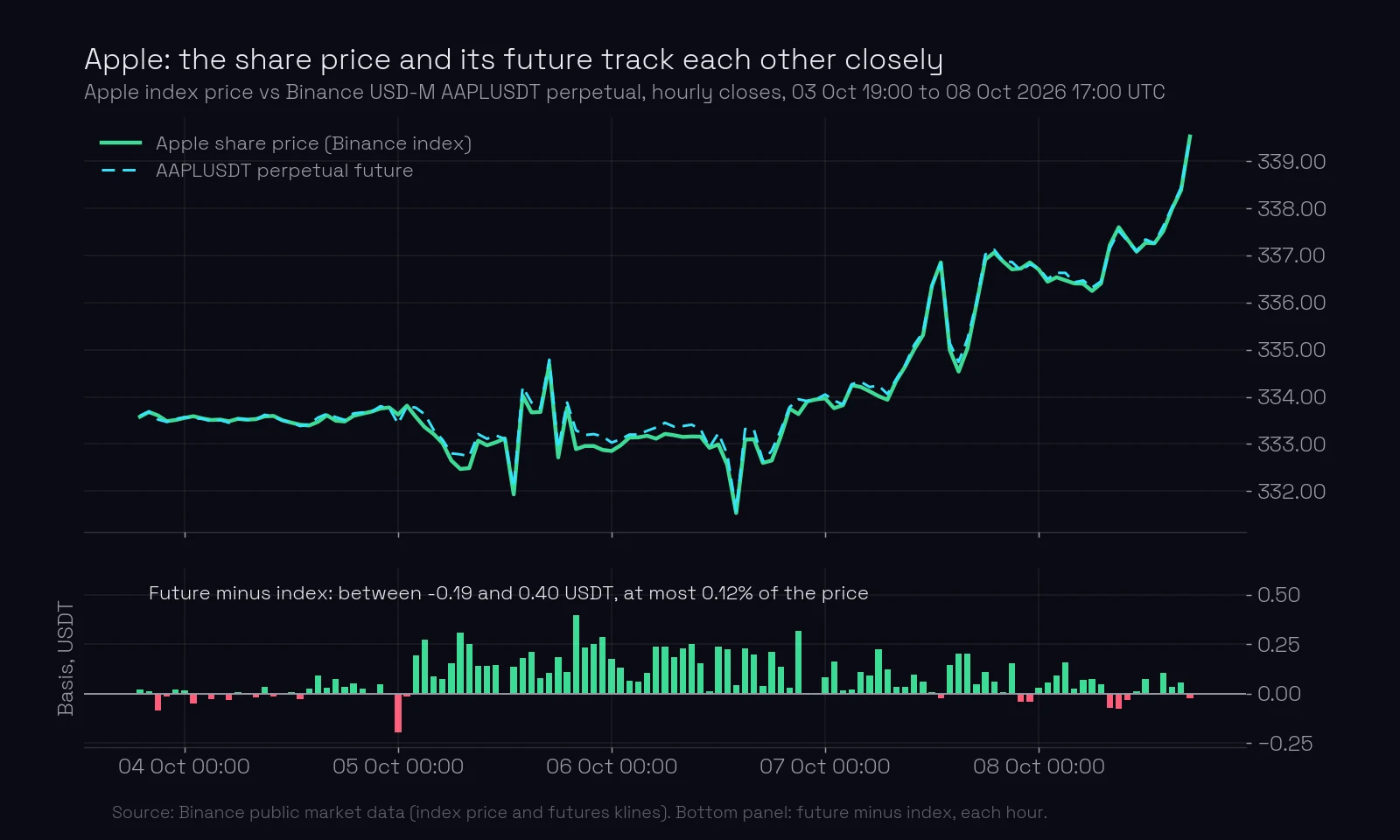
The difference between the futures price and the spot price is called the basis:
Over these five days it was mostly positive and never more than 0.40 USDT on a price near 335. A positive basis means the future traded a little dearer than the share; a negative one means a little cheaper.
Why does a dated future meet spot at expiry?
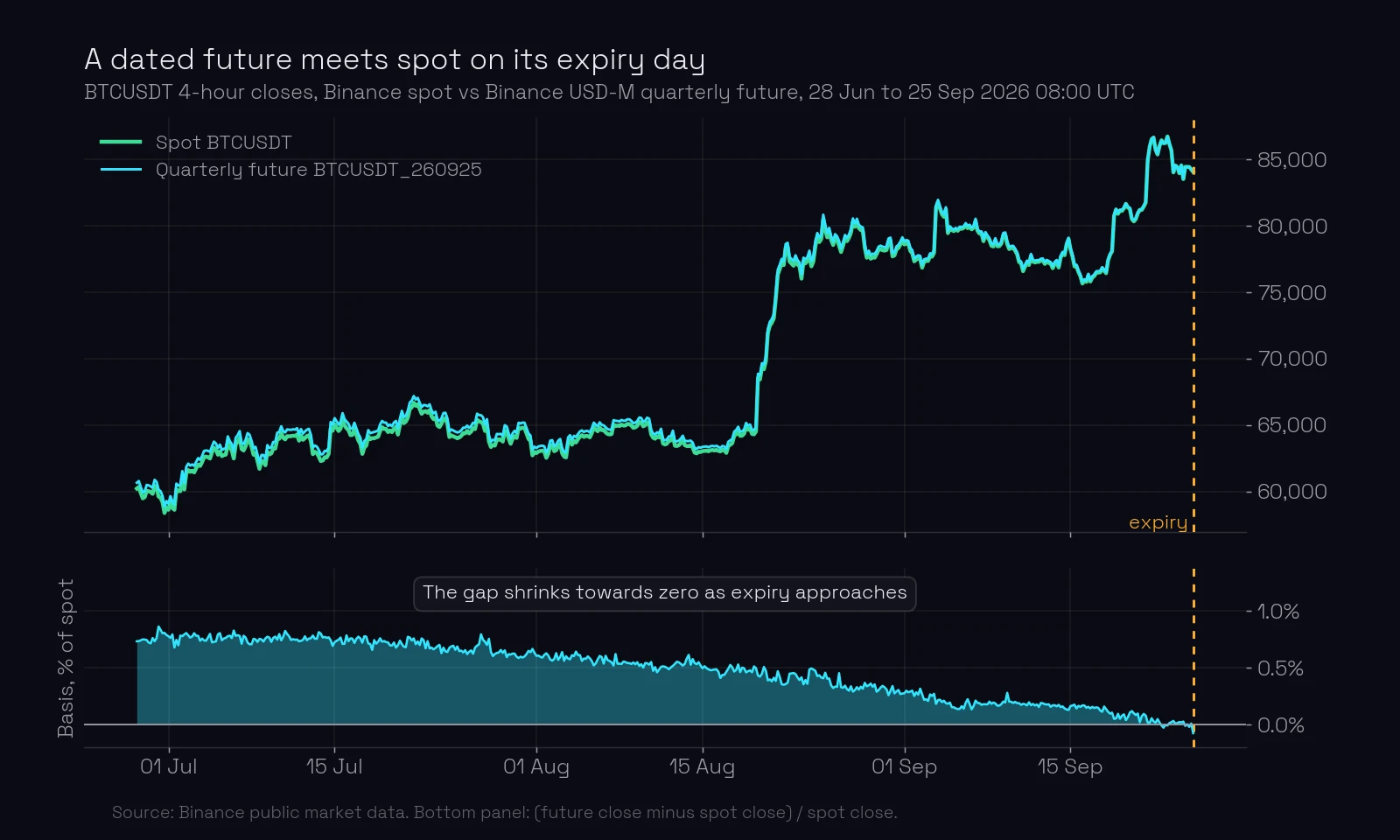
On its expiry day, a dated future is settled against an index of spot prices. At that moment it must be worth the same as spot, so whatever gap existed before has to close. Apple has no dated future on Binance, so the chart shows Binance’s Bitcoin quarterly contract that expired on 25 September 2026: three months earlier it traded about 0.7% above spot, and the gap shrank almost steadily to zero.
What the basis on a quarterly contract is worth
Real data from the second chart. At 08:00 UTC on 28 June 2026, the quarterly future closed the 4-hour candle at 60,659.60 and spot at 60,219.99.
As a share of the spot price:
Expiry was 89 days away. To compare this with an interest rate, scale it to a year:
Now the trade that keeps the gap in line. Buy 1 BTC on spot at 60,219.99 and sell one quarterly future on 1 BTC at 60,659.60. At expiry the future settles at the spot price, whatever that is, so the gain on one side cancels the loss on the other, and the 439.61 gap is what remains, before fees. Traders who do this, called cash-and-carry or basis traders, are the reason a dated future cannot drift far from spot.
What most traders miss.
The basis is a price, not noise. A positive basis is what futures buyers pay to hold the asset without paying for all of it now. When many traders want leveraged longs, the basis widens; when the mood turns, it narrows or goes negative. Watching it tells you how eager the leveraged side is.
Your stop triggers on the instrument you trade, not the chart you drew. If you draw a level on the spot chart and trade the future, your stop follows the futures price, or the exchange’s mark price if you set it that way. A small gap is enough to stop you out on futures while spot never touched your price. Draw the level on the chart of the instrument you trade.
On spot, time is on your side; on futures, it is not. A spot holder can sit through a deep fall. A futures position with too little margin is closed at the worst moment and cannot wait for the recovery.
Common mistakes
- Choosing leverage before the stop. Set the stop from the chart, size the position from your risk, then pick leverage so liquidation sits beyond the stop.
- Using the maximum leverage the exchange allows. That puts liquidation inside your stop on almost any normal trade.
- Ignoring the lot size. Round your position to the instrument’s lot; if one lot is too big for your risk, trade a smaller contract or skip the trade.
- Setting stops from the spot chart on a futures position. Check the basis, or use the futures chart.
- Forgetting a dated contract ends. Close or roll the position before expiry, or it is settled for you.
Key takeaways
- Spot: you pay in full and own the asset; nobody can close you out.
- Futures: a contract on the price, with margin, lots, leverage, easy shorting, and an expiry for dated contracts.
- Leverage moves liquidation, not your planned loss: set it so liquidation sits just beyond your stop.
- Basis = futures price minus spot price; arbitrage keeps it small.
- A dated future converges to spot at expiry, so its basis shrinks to zero.
Lesson test · 10 questions
Check yourself
Can you pass on the first try?
Passing the test completes this lesson. Tests in a module open in order, each after the one before it. A first-try pass scores 100%. Each wrong answer costs 10 points, and every 10 wrong answers lock the test for 30 minutes. Once you pass, your score is final, except that a score of 50 or less can be retaken once.
Tests in a module open in order. Pass the test of the previous lesson first: Classes of instruments: shares, futures, options, ETFs, CFDs and tokens. You can still read the questions here.
-
The AAPLUSDT future trades at 337.90 and the Apple share price is 338.00. What is the basis, and what does it mean?
-
Example: a quarterly future trades 600 above a spot price of 60,000, with 90 days to expiry. Scaled to a year, what is the basis, roughly?
-
A quarterly future trades 1.5% above spot a month before expiry. What happens to that gap by the expiry day?
-
Example: you buy 1 BTC on spot at 60,000 and sell one quarterly future on 1 BTC at 60,500. At expiry spot is at 55,000. What is your total result, before fees?
-
You open a futures position of 20 AAPLUSDT at 340 with 10 times leverage. How much margin do you need?
-
You drew a level on the spot chart and set a stop just beyond it on your futures position. Your stop was hit, but spot never touched the price. Why?
-
You hold 10 Apple shares and a 10 AAPLUSDT long future with little margin. The price drops 20%. What is different between the two?
-
Over a few weeks, a futures basis widens from small to clearly positive. What does that suggest?
-
Your long has entry 100.00 and a stop at 98.00. You choose 100x leverage. What happens if price falls to 98.50?
-
One CME gold contract is 100 troy ounces. Gold moves from 4,100 to 4,105 dollars. What is the profit or loss on one contract?
Free account
Take the test and keep your score
- Your answers are checked and every lesson you pass is marked complete.
- Your scores build into your course score, on any device.
- You come straight back to this question after signing up.
Next: the perpetual future, a contract with no expiry. To size a trade and find the leverage that keeps liquidation beyond your stop, open ChartThread’s levels.
Terms in this lesson
Related lessons
Educational content, not financial advice. Trading carries a risk of loss.