Level type 4: limit-player levels
Some prices are touched again and again and never give way. Behind them sits one large player with orders at that exact price. This is the fourth level type: the limit-player level.
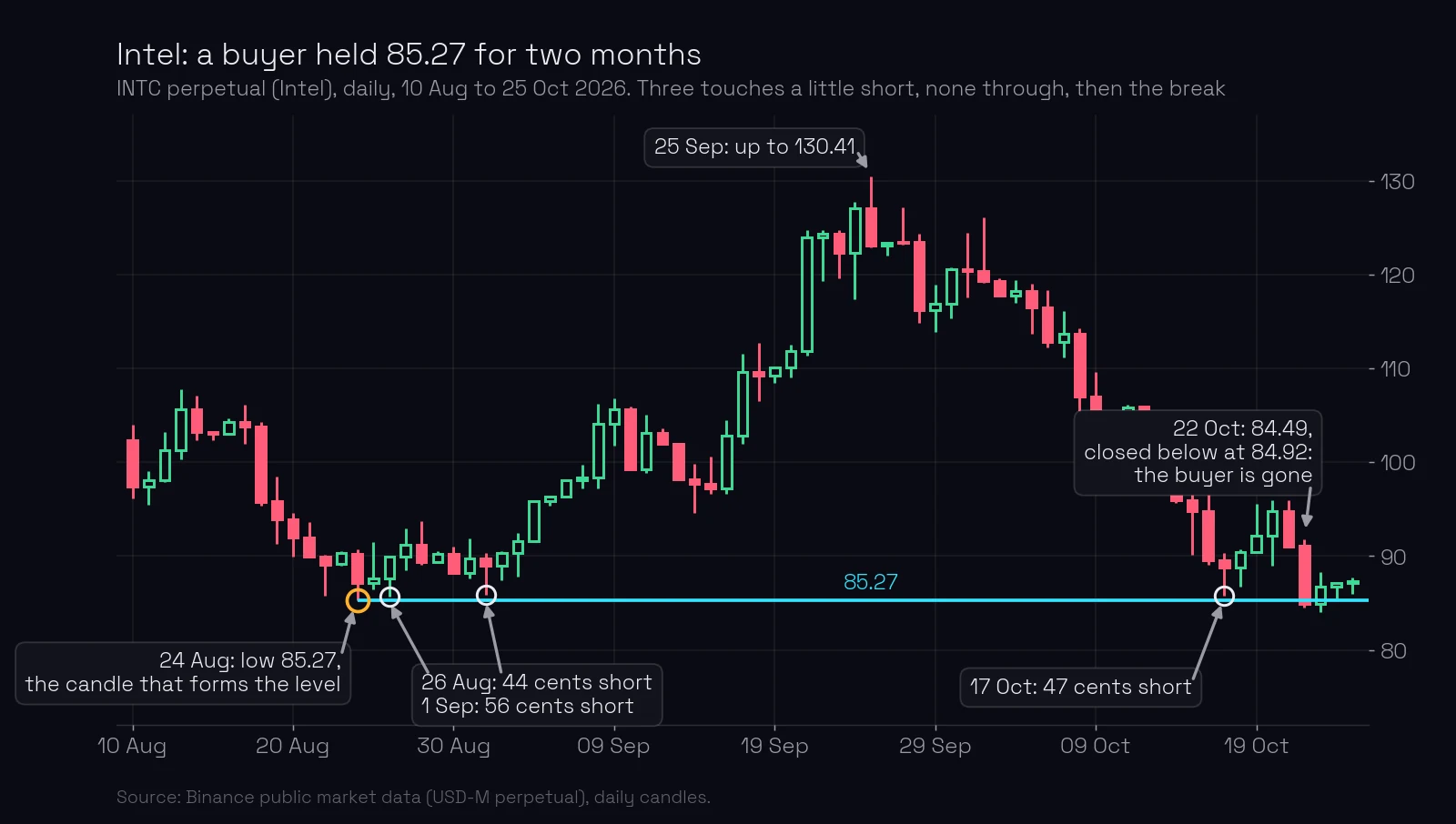
On 24 August 2026 Intel’s contract fell to 85.27. Over the next two months price came back to that price three times, stopped a few cents short every time, and never went through. Someone was buying at that price.
What you’ll learn
- What a limit-player level is and how to recognise it.
- Why four or five touches of the same price point to a big player.
- Why the stop on a limit-player level can be much shorter.
- Why a limit player beats an abnormal candle.
What is a limit-player level?
A limit-player level is a price a player holds no matter what. It is created by very powerful players: a limit player who has to buy or sell a large amount puts limit orders at one price and lets the market come to them. Every order that reaches that price is filled by them, so price cannot get through.
On the chart you recognise it by three things:
- The level is touched at least three times. Falling slightly short of it is allowed.
- It never breaks through. Price comes to the level and turns, again and again.
- The touches are precise. To the cent, or a few cents short, against a daily range of several dollars.
Like every level, it is one exact price from the high or low of a real candle. A low held by a buyer and a high held by a seller work the same way.
Four or five touches: a big player
Four to five touches of the same price show that there is a big limit player in the market. One touch can be chance. Several touches within cents of each other cannot.
Intel shows the pattern. Its perpetual contract fell from 107.75 on 13 August to 85.27 on 24 August, and the fall stopped there. Then:
- On 26 August price came down to 85.71, 44 cents short.
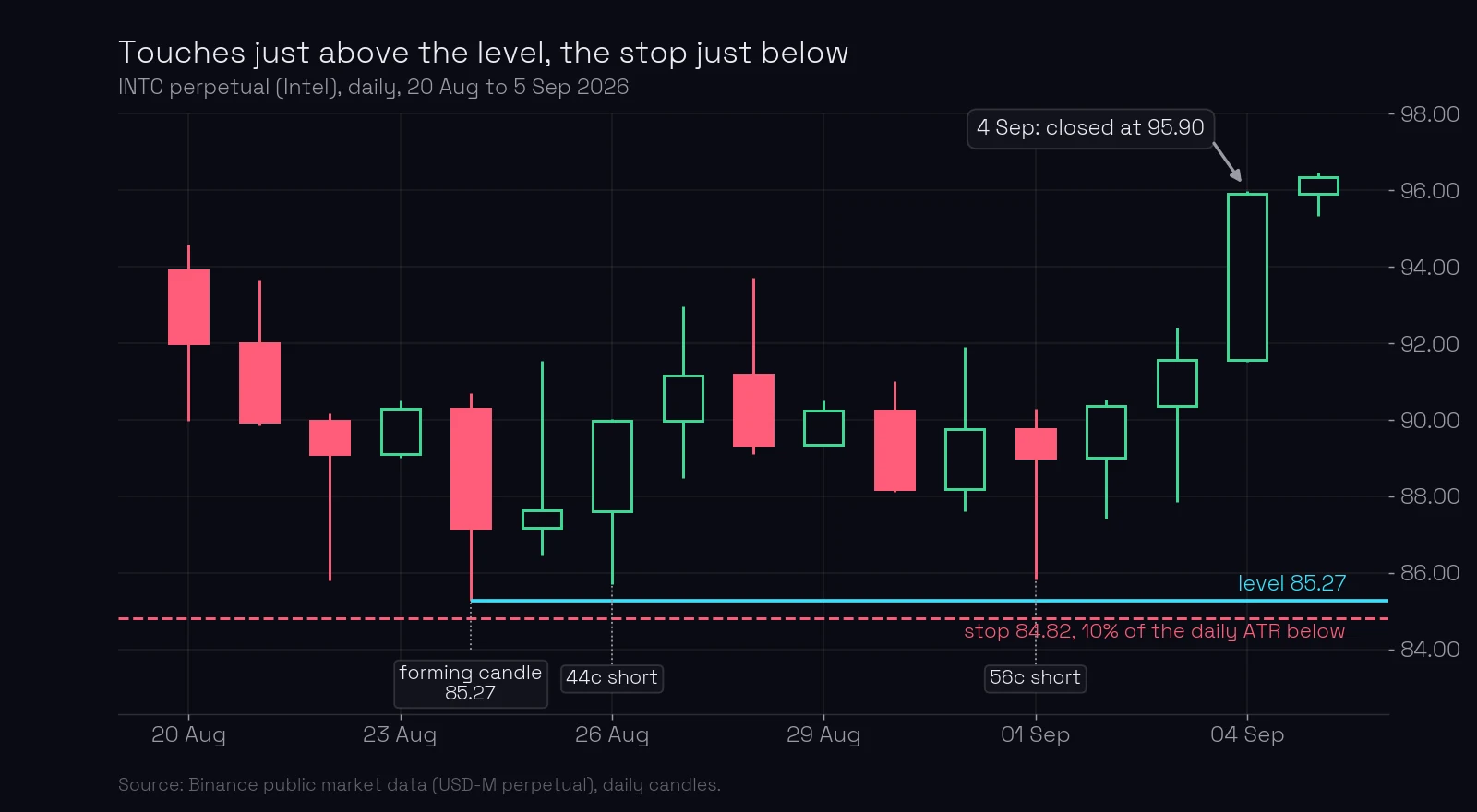
- On 1 September it came down to 85.83, 56 cents short. Three days later it closed at 95.90, and by 25 September it was at 130.41.
- On 17 October, after a fall from that high, it came down to 85.74, 47 cents short.
The daily average true range (ATR) was 4.47 to 5.22 dollars, so each miss was about a tenth of a normal day. Three touches, none through: a buyer was holding 85.27.
Short of the level is allowed, through it is not
A limit-player level may not be reached by a few cents. That is normal: the player’s orders sit at the price, and the market does not always get all the way down to them. But price never breaks through the level. If it does, the level is somewhere else: the player was not at that price.
Apple is the counter-example. On 3 June 2026 its contract made a high of 317.06, and on 8 June it went 40 cents above, to 317.46, before falling back. Price came up near that high again in July, but 317.06 was not a limit-player level: price had already gone through it. A limit player holds the price no matter what.
Why the stop can be much shorter
The more powerful the level, the shorter the stop-loss. On a limit-player level the stop should be much shorter still, for a simple reason: if the level breaks, it will take your stop anyway.
Think about what a break means here. The player held the price through every touch. If price gets through, that player’s orders are filled or gone, and there is nothing left at that price. A wide stop does not give the trade more room to work; it only makes the loss bigger when the player is gone. The course places the stop 10% of the daily ATR beyond the level.
Better than an abnormal candle
A limit buyer is better than an abnormal candle, a candle at least 1.8 times the daily ATR (abnormal-candle levels coming soon). The reason is the ideal entry point and the very short stop. An abnormal candle is one event. A limit player shows you the same exact price three, four, five times, so you know where the orders are and can enter right next to them with the stop just beyond.
Example: Intel’s buyer at 85.27, touch by touch
| Date | Low | Short of 85.27 | Daily ATR | In ATR |
|---|---|---|---|---|
| 26 August | 85.71 | 0.44 | 4.65 | 0.09 |
| 1 September | 85.83 | 0.56 | 4.47 | 0.13 |
| 17 October | 85.74 | 0.47 | 5.22 | 0.09 |
Now the stop on 1 September, the second touch:
The stop goes at 85.27 − 0.45 = 84.82. Say you bought at 85.90 on 1 September, next to the level (the day’s low was 85.83, so the order would have filled). Your risk is 85.90 − 84.82 = 1.08 a share. With $100 of risk:
Three days later, on 4 September, price closed at 95.90.
The same level shows why the stop must be short. A buyer on the third touch, 17 October, would have put the stop at 85.27 − 0.52 = 84.75 (the ATR was 5.22). On 22 October price fell to 84.49 and closed below the level, at 84.92: the buyer at 85.27 was gone, and the short stop cost only the planned amount. A stop of several dollars “for safety” would have lost more, for nothing.
Where exactly to enter next to a level is the subject of the point of entry. Intel’s chart with its levels is on ChartThread’s levels page.
What most traders miss. Every touch is the limit player filling part of their order. Four or five touches show you that the player is big; they also mean part of the order is already used. That is why the stop must be short. When the last of the orders is filled, nothing is left at that price, and price goes through, as Intel did on 22 October.
Common mistakes
- Calling two touches a limit-player level. Fix: it needs at least three touches, and four or five show a big player.
- Rejecting a level because price fell a little short. Fix: falling slightly short is allowed; judge “a little” against the daily ATR.
- Keeping a limit level after price went through it. Fix: a limit-player level is never broken. If price went through, the player was not there, and the level is elsewhere.
- Giving a limit level a wide stop. Fix: if the level breaks, the player is gone; keep the stop 10% of the daily ATR beyond it.
Key takeaways
- A limit-player level is a price a very powerful player holds no matter what.
- It is touched at least three times, falling slightly short is allowed, and it never breaks through.
- Four to five touches of the same price show a big limit player.
- On a limit level the stop should be much shorter: if the level breaks, it takes the stop anyway.
- A limit player beats an abnormal candle: the entry is ideal and the stop very short.
Lesson test · 7 questions
Check yourself
Can you pass on the first try?
Passing the test completes this lesson. Tests in a module open in order, each after the one before it. A first-try pass scores 100%. Each wrong answer costs 10 points, and every 10 wrong answers lock the test for 30 minutes. Once you pass, your score is final, except that a score of 50 or less can be retaken once.
-
What is a limit-player level?
-
How many touches does a limit-player level need at the least?
-
A low at 85.27. Later lows: 85.71, 85.83, 85.74, with a daily ATR of about 5. How do you read them?
-
Why should the stop on a limit-player level be much shorter?
-
A limit buyer holds 85.27. On the day price comes back to it, the instrument’s daily ATR is 4.47. You buy at 85.90 with the stop 10% of the ATR below the level. What is the risk per share?
-
A high at 317.06 is later passed by 40 cents before price falls back. Can 317.06 be a limit-player level?
-
Which is better for a trade, according to the course?
Free account
Take the test and keep your score
- Your answers are checked and every lesson you pass is marked complete.
- Your scores build into your course score, on any device.
- You come straight back to this question after signing up.
Next: level type 5, historical levels coming soon. On ChartThread’s levels page you can check how many times price has come back to each level.
Terms in this lesson
Related lessons
- Level type 8: abnormal-candle levels coming soon
- Touches to the cent: why precision matters
- Additional touches: when repeats confirm a level coming soon
- Near misses: candles that almost touch the level coming soon
- Pillar four, the point of entry: exactly where to get in
Educational content, not financial advice. Trading carries a risk of loss.